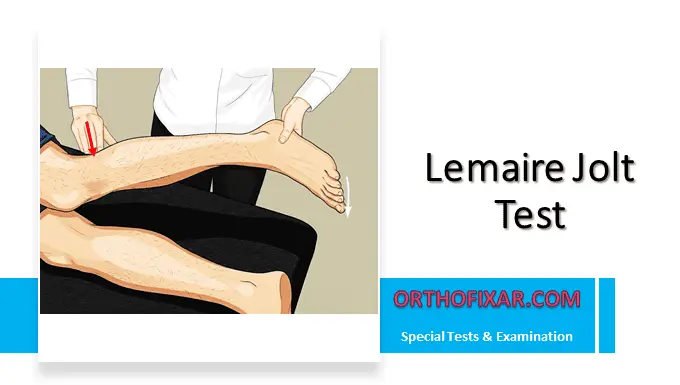
Lemaire Jolt Test is a specialized clinical examination maneuver used to assess anterolateral rotatory instability of the knee, most commonly associated with anterior cruciate ligament (ACL) deficiency and injury to the anterolateral complex. Although less frequently performed than pivot-shift variants, it remains an important test for advanced orthopedic and sports medicine evaluation.
Purpose of the Test
The Lemaire Jolt Test evaluates:
- Anterolateral rotatory instability
- Functional integrity of the ACL
- Contribution of the anterolateral structures, including the iliotibial band and lateral capsule
A positive Lemaire Jolt Test indicates pathological anterior translation and rotation of the tibia relative to the femur.
How to Perform the Lemaire Jolt Test for ACL Tears?
Patient Position
- The patient is placed in a side-lying (lateral decubitus) position
- The test leg is uppermost
- The knee starts in full extension
- Patient relaxation is essential for accurate interpretation
Examiner Position and Hand Placement
- Distal hand (foot control):
- The examiner grasps the patient’s foot
- The tibia is medially rotated while the knee is in extension
- Proximal hand (lateral stabilization):
- The dorsum of the examiner’s other hand applies light pressure against:
- The biceps femoris tendon
- The head of the fibula
- The dorsum of the examiner’s other hand applies light pressure against:
This hand acts as a stabilizing and palpating contact point to detect abnormal tibial movement.
Lemaire Jolt Test Maneuver
- While maintaining medial rotation of the tibia, the examiner passively flexes and extends the knee
- The movement is smooth and controlled
- Special attention is paid during early knee flexion
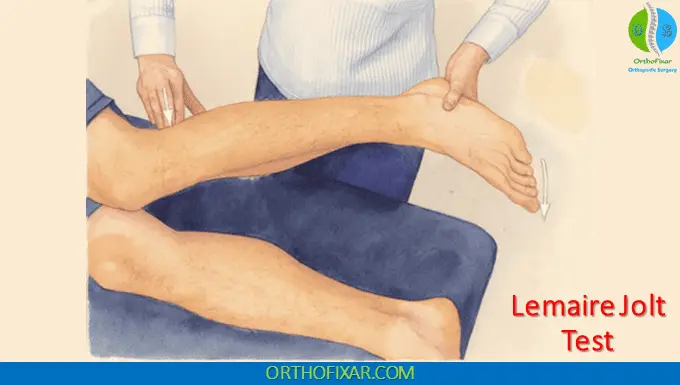
Positive Lemaire Jolt Test
- At approximately 15°–20° of knee flexion, a sudden “jolt” or shift of the tibia is felt
- This represents anterior displacement of the lateral tibial plateau
- A palpable or visible jolt indicates a positive Lemaire Jolt Test
Clinical Interpretation
A positive test suggests:
- Anterolateral rotatory instability
- ACL insufficiency, often chronic
- Possible involvement of the anterolateral ligament or lateral capsular structures
The test is particularly useful when combined with other rotational instability tests, such as:
Common Errors and Pitfalls
- Inadequate patient relaxation
- Excessive force during rotation
- Poor control of tibial rotation
- Misinterpreting soft tissue movement as a true jolt
Teaching Tips for Students
- Always compare with the contralateral (uninjured) knee
- Perform the test slowly to appreciate subtle instability
- Think of the jolt as a dynamic subluxation event, similar in mechanism to the pivot shift
Clinical Relevance
Lemaire Jolt Test is particularly relevant in:
- Chronic ACL injuries
- High-demand athletes
- Preoperative evaluation before ACL reconstruction
- Consideration of anterolateral augmentation procedures
Comparison of Rotational Instability Tests of the Knee
| Feature | Lemaire Jolt Test | Pivot Shift Test | Slocum Test |
|---|---|---|---|
| Primary Purpose | Assess anterolateral rotatory instability | Detect dynamic anterolateral rotatory instability | Differentiate anteromedial vs anterolateral instability |
| Main Structure Assessed | ACL and anterolateral complex | ACL (functional instability) | ACL with rotational component |
| Patient Position | Side-lying, test leg uppermost | Supine | Supine |
| Knee Starting Position | Full extension | Full extension | 80°–90° flexion |
| Key Tibial Rotation | Medial rotation | Internal rotation | Internal (anterolateral) or external (anteromedial) rotation |
| Examiner Hand Placement | One hand on foot (medial rotation), other stabilizing fibular head/biceps tendon | One hand applies valgus force at knee, other controls ankle rotation | Examiner sits on forefoot to maintain tibial rotation |
| Test Maneuver | Passive flexion–extension with maintained medial rotation | Valgus stress + internal rotation during flexion | Anterior drawer maneuver with rotated tibia |
| Positive Finding | Sudden palpable “jolt” at 15°–20° flexion | Sudden reduction (“clunk”) of lateral tibial plateau around 20°–40° flexion | Increased anterior translation compared to contralateral side |
| Best Use Scenario | Subtle or chronic anterolateral instability | Functional instability in ACL-deficient knees | Differentiating type of rotary instability |
| Patient Relaxation Required | Very high | High | Moderate |
| Exam Difficulty | Moderate to high (less commonly taught) | High (examiner-dependent) | Moderate |
| Exam Tip | Focus on early flexion jolt | Perform slowly; compare sides | Correct tibial rotation is critical |
References & More
- Liorzou G. Knee Ligaments: Clinical Examination. Berlin: Springer-Verlag; 1991.
- Orthopedic Physical Assessment by David J. Magee, 7th Edition.