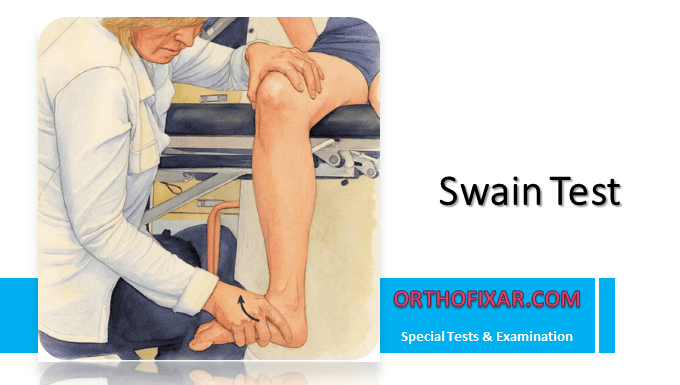
The Swain Test is a clinical maneuver used to assess the integrity of the medial collateral ligament (MCL) complex of the knee. First described by Lonergan and Taylor, this test helps differentiate medial knee pain caused by MCL injury from other intra-articular sources.
The Swain test is specifically designed to evaluate:
- Injury to the medial collateral ligament complex
- Post-operative healing status of the medial structures
- Chronic medial or posteromedial knee laxity
Because the knee is placed at 90° of flexion, the cruciate ligaments become relatively lax. This isolates stress onto the collateral ligaments, making the test more sensitive for detecting medial side pathology.
How to Perform the Swain Test?
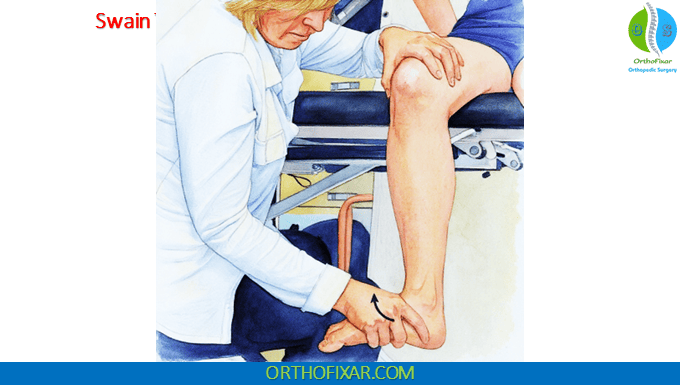
- The patient sits on the examining table with knees flexed to 90°, legs hanging freely over the edge.
- First, the examiner passively applies lateral rotation of the tibia on the femur in the uninjured (good) leg to establish a baseline response.
- The same movement is then performed on the injured leg.
- The movement should be smooth and pain-free on the healthy side. The key diagnostic value comes from comparing the injured side to the normal baseline.
See Also: Knee MCL Sprain
What is the Positive Swain Test?
A test is considered positive when the patient reports:
- Pain along the medial joint line
- Localized tenderness at the MCL or posteromedial structures.
What it indicates:
- MCL complex injury (most common)
- Inadequate healing in post-surgical patients
- Chronic medial or posteromedial laxity in long-standing cases
→ In chronic cases, pain may present medially or posteromedially due to capsular or ligamentous stretching.
Clinical Importance
The Swain test provides valuable information in situations such as:
- Acute knee trauma with suspected MCL sprain
- Post-operative follow-up after MCL repair or reconstruction
- Chronic instability complaints on the medial side of the knee
- Differentiating MCL injury from cruciate or meniscal pathology
→ Because at 90° knee flexion, the cruciate ligaments are lax and do not contribute significantly to resistance.
References & More
- Lonergan KT, Taylor DC. Medial collateral ligament injuries of the knee: an evolution of surgical reconstruction. Tech Knee Surg. 2002;1(2):137–145.
- Marchant MH, Tibor LM, Sekiya JK, et al. Management of medial-sided knee injuries, part 1: medial collateral ligament. Am J Sports Med. 2011;39:1102–1113. PubMed