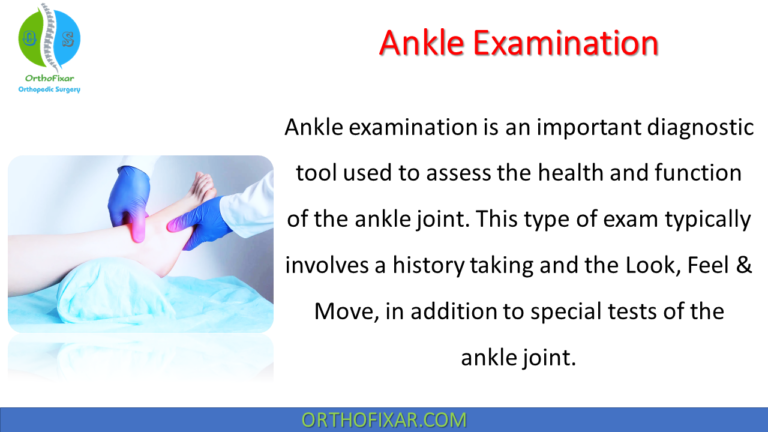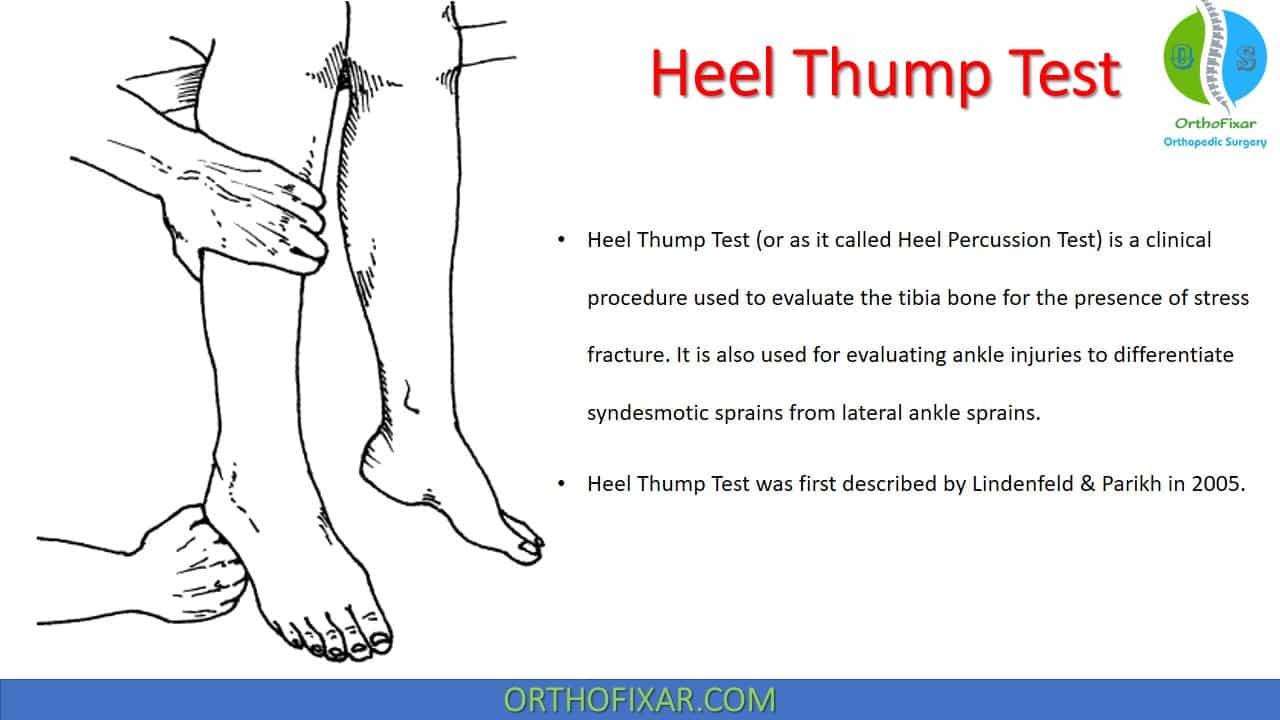
The Heel Thump Test (or as it called Heel Percussion Test) is a clinical procedure used to evaluate the tibia bone for the presence of stress fracture. It is also used for evaluating ankle injuries to differentiate syndesmotic sprains from lateral ankle sprains.
Heel Thump Test was first described by Lindenfeld & Parikh in 2005.
How to Perform the Heel Thump Test?
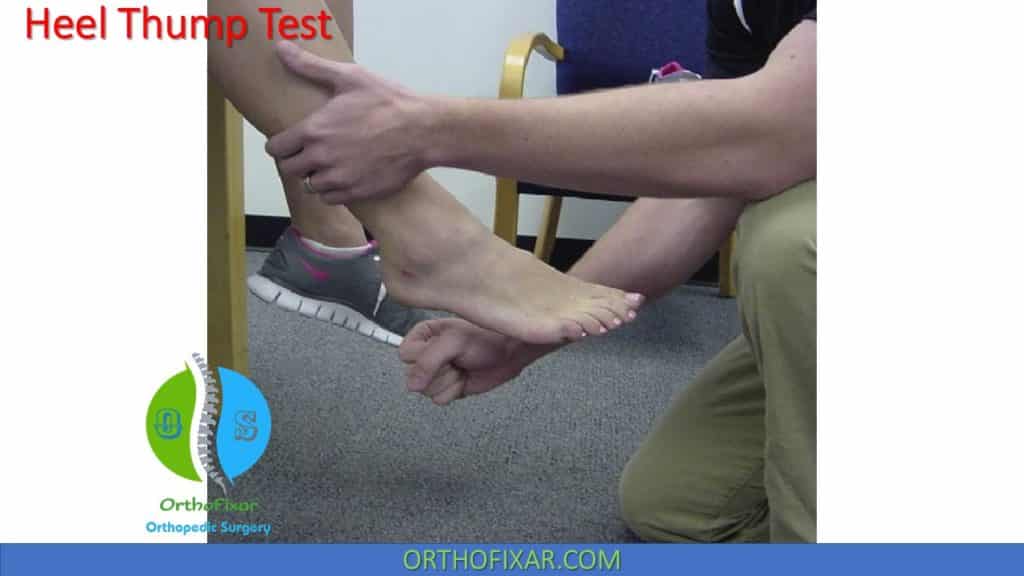
- The patient sits at the edge of the examination table with the lower legs hanging down loosely and both feet plantar flexed at the ankle.
- The examiner holds the patient’s lower leg with one hand, and with the other hand delivers an axillary directed gentle thump to the heel with the fist.
- Thumping the heel forces the talus to contact the mortise and reproduce the patient’s pain complaint.
See Also: Ankle Anatomy
What does a positive Heel Thump Test mean?
Heel Thump Test is positive if pain is experienced at the distal tibiofibular syndesmosis, this suggests the presence of syndesmosis injury or pain along the shaft of the tibia may indicate a stress fracture.
Although the heel thump test has been recommended to help differentiate between a syndesmotic injury and a lateral ankle sprain, it is also used for tibial stress fractures.
See Also: Cotton Test | Syndesmosis Injury
Sensitivity & Specificity
The diagnostic accuracy of this test is unknown.
Notes
- Heel Thump test may have supplemental value if there is enough swelling to decrease the specificity of palpation.
- It is also valuable when the injury is too acutely uncomfortable to induce dorsiflexion and/or external rotation stresses.
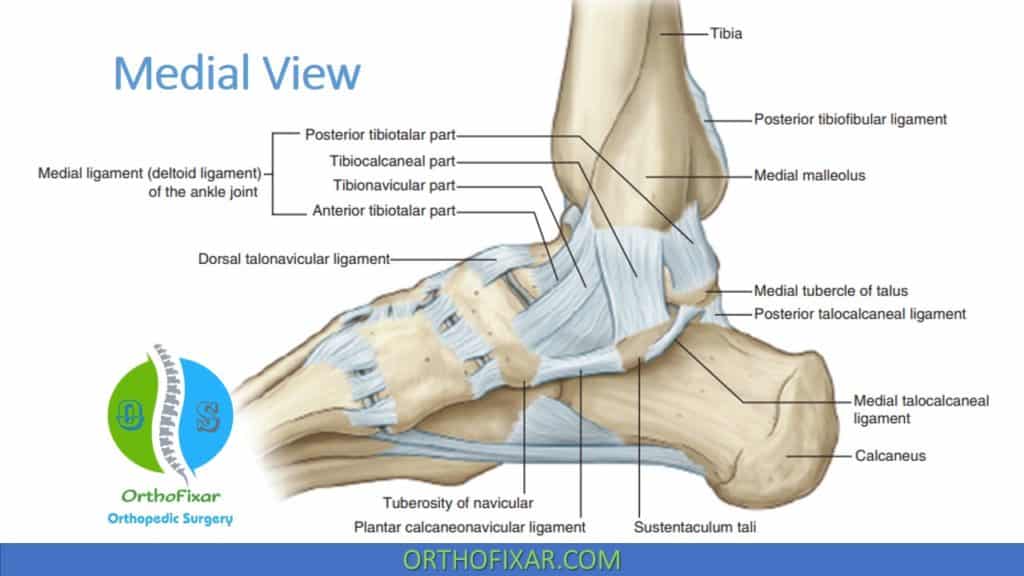
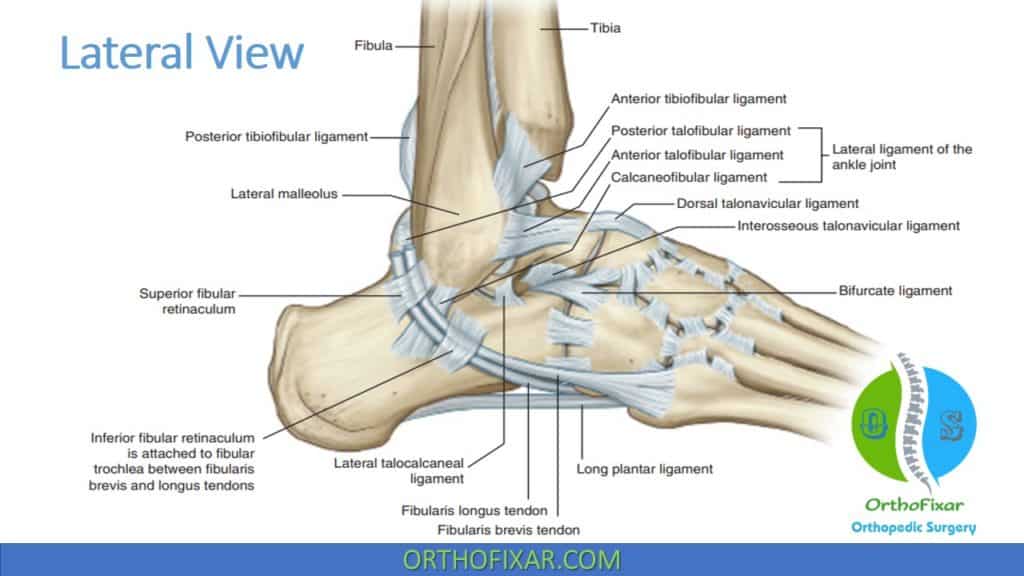
Related Anatomy
Ankle Ligaments Anatomy
| Ligament | Proximal Attachment | Distal Attachment | Function |
|---|---|---|---|
| Anterior inferior tibiofibular | Tibia | Fibula | Stability of ankle mortise |
| Interosseous ligament | Tibia | Fibula | Stability of ankle mortise |
| Posterior inferior tibiofibular ligament | Tibia | Fibula | Stability of ankle mortise |
| Ligament | Proximal Attachment | Distal Attachment | Function |
|---|---|---|---|
| Anterior talofibular | Lateral malleolus | Transversely to talus anteriorly | Limits inversion in plantar flexion |
| Calcaneofibular | Lateral malleolus | Obliquely to calcaneus posteriorly | Limits inversion in neutral or dorsiflexion |
| Posterior talofibular | Lateral malleolus | Transversely to talus posteriorly | Limits posterior talar displacement and external rotation |
| Ligament | Proximal Attachment | Distal Attachment | Function |
|---|---|---|---|
| Tibionavicular | Medial malleolus | Navicular tuberosity | Limits talar external rotation |
| Tibiocalcaneal | Medial malleolus | Sustentaculum tali | Limits hindfoot eversion |
| Anterior tibiotalar | Medial malleolus | Medial surface of talu | Limits lateral displacement of talus, external rotation |
| Posterior tibiotalar | Medial malleolus | Inner side of talus | Limits lateral displacement |
Reference
- Edward P. Mulligan. Evaluation and management of ankle syndesmosis injuries. May 2011 Physical therapy in sport: official journal of the Association of Chartered Physiotherapists in Sports Medicine 12(2):57-69. Researchgate.
- Clinical Tests for the Musculoskeletal system 3rd Edition.
- MILLER’S REVIEW OF ORTHOPAEDICS 7th Edition.