The Crossover Test is a functional clinical examination used to assess anterolateral rotatory instability of the knee, most commonly associated with anterior cruciate ligament (ACL) insufficiency. This test is considered a self-activated variation of the lateral pivot shift test, as it reproduces similar biomechanical forces through patient-driven movement rather than examiner-applied stress.
The test is particularly useful in cooperative patients and can help demonstrate instability during dynamic loading.
Purpose of the Test:
- To evaluate rotational knee instability
- To identify ACL deficiency, especially chronic cases
- To reproduce symptoms experienced during functional activities such as pivoting or twisting.
See Also: Pivot Shift Test
How to Perform the Crossover Test?
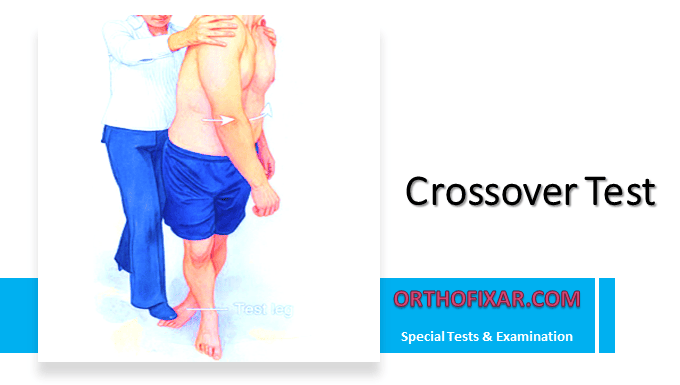
- The patient stands upright in a relaxed position. The uninvolved (normal) leg is crossed in front of the involved leg.
- The examiner stands close to the patient for safety and stabilization. One foot is placed gently but firmly on the patient’s involved foot to prevent it from rotating or moving.
- The patient is instructed to cross the uninvolved leg in front of the involved leg. The examiner steps on the involved foot to stabilize it against the floor.
- The patient is then asked to rotate the upper torso away from the injured leg, approximately 90 degrees, while keeping the foot fixed.
- Once this position is achieved, the patient is instructed to contract the quadriceps muscles.

What does a Positive Crossover Test Mean?
The test is considered positive if:
- The patient experiences a sensation of giving way or instability
- There is pain or apprehension
- The patient reports reproduction of their typical symptoms
These findings suggest anterolateral rotatory instability, most commonly due to an ACL tear.
Clinical Significance
- The Crossover Test simulates functional loading conditions, making it clinically relevant.
- It is especially helpful when traditional pivot shift testing is difficult due to patient guarding.
- Because the movement is patient-controlled, it can sometimes reveal instability not evident during passive testing.
Limitations
- Requires good patient balance and cooperation
- Not suitable in acute injuries with significant pain or swelling
- Less reliable in patients with poor proprioception or fear of movement
References & More
- Orthopedic Physical Assessment by David J. Magee, 7th Edition.