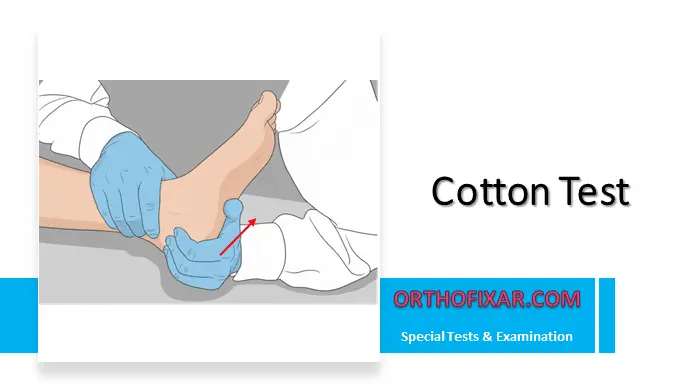
The Cotton Test, also known as the Lateral Stress Test, is a clinical examination maneuver used to assess distal tibiofibular syndesmosis instability. It is particularly valuable in the evaluation of high ankle sprains and suspected tibiofibular diastasis associated with ankle trauma.
The distal tibia and fibula are stabilized by the ankle syndesmosis, which consists of four key ligaments:
- Tibiofibular interosseous ligament
- Anteroinferior tibiofibular ligament (AITFL)
- Posteroinferior tibiofibular ligament (PITFL)
- Transverse tibiofibular ligament
These ligaments maintain the congruency of the ankle mortise. Disruption of one or more of these structures can lead to abnormal separation (diastasis) between the tibia and fibula, resulting in ankle instability and impaired load transmission.
See Also: Ankle Anatomy
How to Perform the Cotton Test?
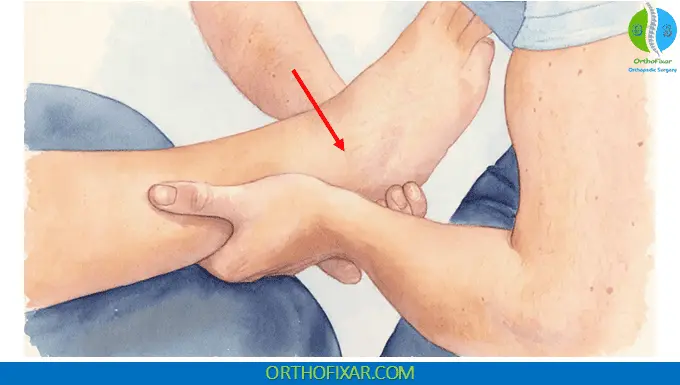
- The patient is typically positioned supine or seated, the ankle is placed in a neutral position and the leg should be relaxed to avoid muscular guarding.
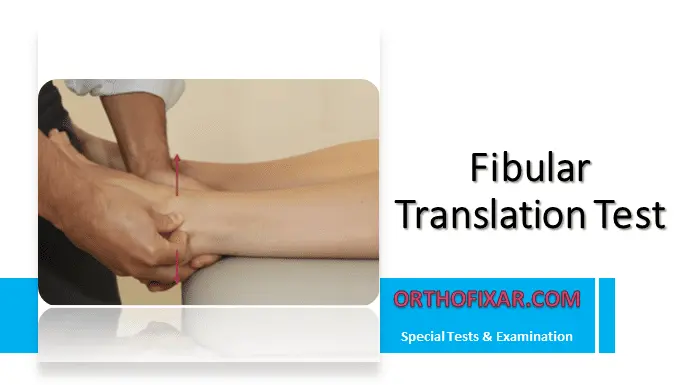
- The examiner stabilizes the distal tibia and fibula firmly with one hand.
- With the other hand, the examiner grasps the patient’s foot.
- A lateral translation force is applied to the foot relative to the tibia.
- Important: This is a pure lateral translation, not an eversion force. The movement is assessed for excessive displacement or abnormal motion.
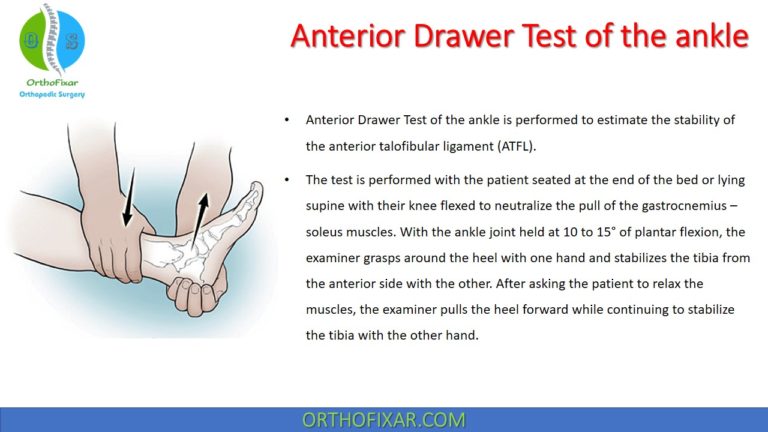
See Also: Anterior Drawer Test of the Ankle
What does a Positive Cotton Test Mean?
- Normal Test: Minimal lateral translation with a firm end feel.
- Positive Test:
- Lateral translation greater than 3–5 mm, and/or
- A palpable or audible “clunk”
A positive Cotton Test indicates syndesmotic instability, suggestive of partial or complete disruption of the distal tibiofibular ligaments.
Cotton Test Accuracy
The Cotton Test demonstrates high specificity but moderate sensitivity for the detection of coronal plane distal tibiofibular syndesmotic instability.
Based on Lalevée et al., Cadaveric Study, the Cotton Test showed a sensitivity of 73.3%, specificity of 100%, and an overall diagnostic accuracy of 86.7% when a relative increase in tibiofibular clear space (TFCS) greater than 2 mm was used as the diagnostic threshold.
These findings indicate that a positive Cotton Test is highly reliable for confirming syndesmotic instability, as false-positive results were not observed. However, the moderate sensitivity suggests that the test may fail to detect some cases of subtle instability, particularly due to its dynamic nature and the difficulty in applying a consistent, controlled lateral distraction force intraoperatively. Despite these limitations, the Cotton Test remains a valuable diagnostic tool, with slightly superior accuracy compared to the Tap Test, though examiner technique and fluoroscopic control significantly influence its reliability.
References & More
- Beumer A, Swierstra BA, Mulder PG. Clinical diagnosis of syndesmotic ankle instability: evaluation of stress tests behind the curtain. Acta Orthop Scand. 2002;73:667–669. PubMed
- Stiehl JB. Complex ankle fracture dislocations with syndesmotic diastasis. Ortho Rev. 1990;19:499–507. PubMed
- Adamson C, Cymet T. Ankle sprains: evaluation, treatment, rehabilitation. Maryland Med J. 1997;46:530–537. PubMed
- Lalevée M, Giarola IC, Vivtcharenko V, Martins FS, Mansur NS, Giordano V, Wajnsztejn A, Li S, Dibbern KN, Femino JE, Netto CDC. Comparison Between Cotton Test and Tap Test for the Assessment of Coronal Syndesmotic Instability: A Cadaveric Study. Foot Ankle Orthop. 2022 Jan 21;7(1):2473011421S00299. doi: 10.1177/2473011421S00299. PMCID: PMC8793468. PubMed
- Peng JR. Solving the dilemma of the high ankle sprain in the athlete. Sports Med Arthro Rev. 2000;8:316–325.
- Dutton M. Dutton’s Orthopedic Examination,Evaluation and Intervention. 3rd ed. New York:McGraw-Hill; 2012.
- Orthopedic Physical Assessment by David J. Magee, 7th Edition.