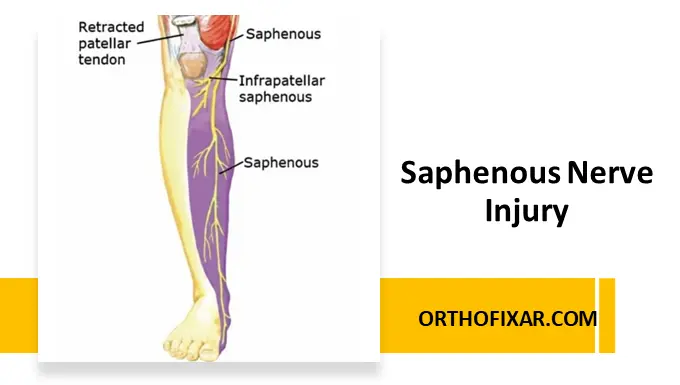
Saphenous Nerve Injury or entrapment is an underrecognized cause of medial knee and leg pain, particularly in postoperative and sports-related settings.
The saphenous nerve is a purely sensory terminal branch of the femoral nerve, arising from the L2–L4 spinal nerve roots. It represents the longest cutaneous nerve in the human body and plays a critical role in sensory innervation of the medial aspect of the lower limb.
Anatomy & Course
The saphenous nerve originates from the posterior division of the femoral nerve in the femoral triangle, just inferior to the inguinal ligament. It descends within the adductor canal (Hunter’s canal), accompanying the femoral artery and vein.
As it exits the adductor canal, the nerve passes between the vastus medialis and adductor magnus muscles, where it becomes superficial. Distally, it divides into infrapatellar and sartorial branches, supplying cutaneous sensation to:
- The medial aspect of the knee
- The medial leg
- The medial border of the foot (to the level of the first metatarsal)
Importantly, the saphenous nerve has no motor function.
See Also: Saphenous Nerve Anatomy
Saphenous Nerve Injury Mechanisms
Saphenous nerve injury may occur due to:
- Iatrogenic causes, particularly during:
- Knee arthroscopy
- Total knee arthroplasty
- Varicose vein surgery
- Femoral catheterization
- Direct trauma to the medial thigh or knee
- Entrapment neuropathy, most commonly where the nerve passes between the vastus medialis and adductor magnus muscles
- Repetitive stress or hypertrophy of surrounding musculature
Clinical Presentation
Patients typically present with:
- Burning, aching, or dysesthetic pain along the medial knee and medial calf
- Paresthesia or hypersensitivity in the saphenous nerve distribution
- Pain aggravated by:
- Walking or prolonged standing
- Stair climbing
- Quadriceps contraction or resisted knee extension
- Absence of motor weakness or reflex changes
Because symptoms may mimic meniscal pathology or medial collateral ligament injury, saphenous nerve injury is frequently misdiagnosed.
Physical Examination
Key examination findings include:
- Localized tenderness along the medial femoral condyle or adductor canal
- Reproduction of symptoms with:
- Palpation over the adductor canal
- Quadriceps activation
- Possible positive Tinel’s sign over the medial knee
- Normal motor strength and knee stability
Diagnostic Considerations
Diagnosis is primarily clinical, supported by:
- Careful anatomical correlation of symptoms
- Exclusion of intra-articular knee pathology
- Diagnostic local anesthetic injection around the saphenous nerve (when indicated)
- Electrophysiological studies are of limited value due to the nerve’s purely sensory nature
Management
Management depends on etiology and symptom severity:
- Conservative treatment:
- Activity modification
- Nonsteroidal anti-inflammatory drugs (NSAIDs)
- Physical therapy focusing on quadriceps flexibility and load reduction
- Interventional options:
- Ultrasound-guided nerve block or corticosteroid injection
- Surgical decompression or neurectomy may be considered in refractory cases
Educational Pearls
- The saphenous nerve is a sensory-only nerve—motor deficits exclude its involvement.
- Medial knee pain without structural instability should raise suspicion of saphenous nerve entrapment.
- Postoperative medial knee pain after arthroscopy or knee replacement is a classic clinical scenario of saphenous nerve injury.
References & More
- Worth RM, Kettlekamp DB, Defalque RJ, et al. Saphenous nerve entrapment: a cause of medial nerve pain. Am J Sports Med. 1984;12:80–81. PubMed
- .Cox JS, Blanda JB. Periarticular pathologies. In: DeLee JC, Drez D, eds. Orthopedic Sports Medicine. Philadelphia: WB Saunders; 1994.
- Pecina MM, Krmpotic-Nemanic J, Markiewitz AD. Tunnel Syndromes. Boca Raton, FL: CRC Press; 1991.
- Orthopedic Physical Assessment by David J. Magee, 7th Edition.
Closed.