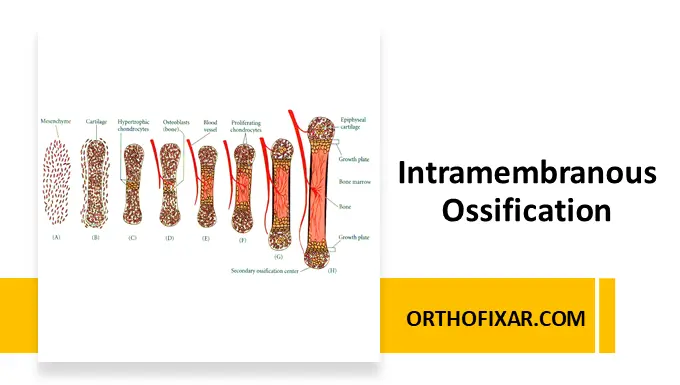
Intramembranous ossification is one of the two primary mechanisms of bone formation in the human body. Unlike endochondral ossification, which involves a cartilage template, intramembranous ossification forms bone directly from embryonic mesenchymal tissue. This process is essential for the development of many flat bones, including the bones of the skull, facial skeleton, and portions of the clavicle.
In addition to embryonic skeletal development, intramembranous ossification plays a critical role in bone growth in thickness, fracture healing, periosteal reactions, and bone remodeling throughout life. Understanding this process is fundamental for medical students, orthopedic surgeons, radiologists, and anatomists.
What is Intramembranous Ossification?
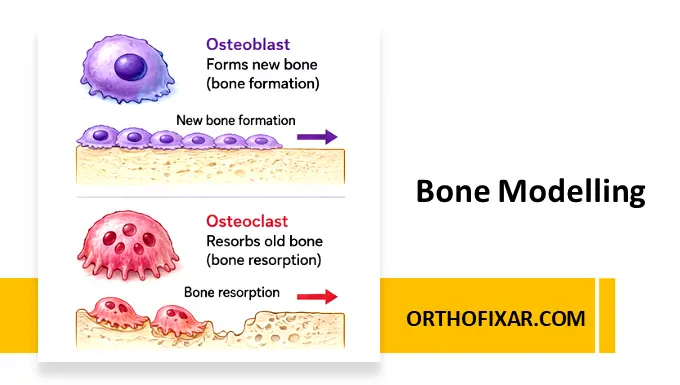
Intramembranous ossification is the direct formation of bone from mesenchymal connective tissue without a cartilaginous precursor. Mesenchymal stem cells differentiate into osteoblasts, which secrete osteoid that subsequently mineralizes to form mature bone.
This mechanism is responsible for forming:
- Flat bones of the skull
- Most facial bones
- Parts of the mandible
- Portions of the clavicle
The process begins during embryonic development around the sixth to seventh week of gestation and continues throughout growth and skeletal maturation.
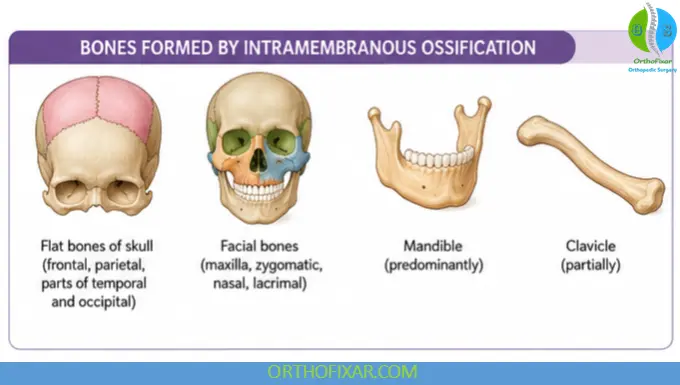
Bones Formed by Intramembranous Ossification
Several bones develop primarily through intramembranous ossification:
Skull Bones
- Frontal bone
- Parietal bones
- Portions of the occipital bone
- Portions of the temporal bone
Facial Bones
- Maxilla
- Zygomatic bones
- Nasal bones
- Lacrimal bones
Other Bones
- Mandible (predominantly)
- Clavicle (partially)
These bones require rapid formation and flexibility during fetal development, particularly to accommodate brain growth and facilitate childbirth.
Embryological Origin
Intramembranous ossification begins within highly vascularized mesenchymal tissue. Mesenchymal cells condense and differentiate into osteoprogenitor cells, which subsequently become osteoblasts.
The embryological origins include:
- Neural crest cells for many craniofacial bones
- Mesoderm-derived mesenchyme for other skeletal components
This direct conversion of mesenchymal tissue into bone distinguishes intramembranous ossification from endochondral ossification.
Stages of Intramembranous Ossification
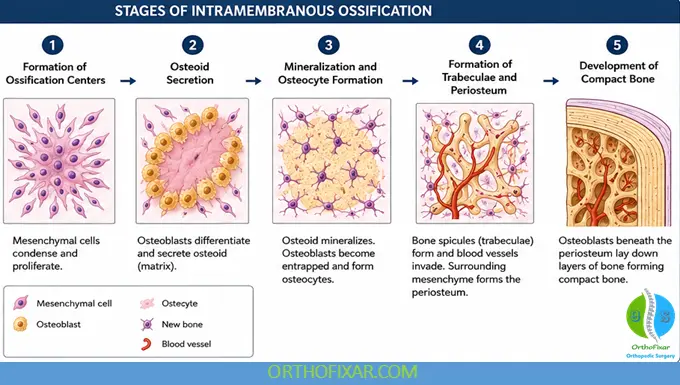
The process can be divided into five major stages.
Stage 1: Formation of Ossification Centers
Mesenchymal stem cells aggregate in specific regions known as ossification centers.
At these sites:
- Mesenchymal cells proliferate
- Osteoprogenitor cells develop
- Osteoblast differentiation begins
These osteoblasts initiate bone formation.
Stage 2: Osteoid Secretion
Osteoblasts secrete osteoid, an unmineralized extracellular matrix composed mainly of:
- Type I collagen
- Proteoglycans
- Glycoproteins
The osteoid serves as the framework for future mineral deposition.
Stage 3: Mineralization and Osteocyte Formation
Calcium phosphate crystals are deposited within the osteoid.
As mineralization progresses:
- Osteoblasts become trapped within the matrix
- Entrapped osteoblasts transform into osteocytes
- Bone tissue begins to mature
This marks the formation of primitive woven bone.
Stage 4: Formation of Trabeculae and Periosteum
Bone spicules enlarge and fuse to form trabeculae.
At the same time:
- Blood vessels invade the developing bone
- Mesenchymal cells surrounding the bone condense
- The periosteum develops
The resulting trabecular network forms immature spongy bone.
Stage 5: Development of Compact Bone
Osteoblasts located beneath the periosteum continue depositing bone matrix.
This produces:
- Lamellar bone
- Compact (cortical) bone
- Mature skeletal architecture
The external layers become dense cortical bone while internal regions remain cancellous.
Histological Features of Intramembranous Ossification
Microscopically, intramembranous ossification is characterized by:
Osteoblasts
Cuboidal bone-forming cells that synthesize osteoid.
Osteocytes
Mature bone cells embedded within lacunae.
Trabeculae
Interconnecting spicules of developing bone.
Vascular Channels
Blood vessels that provide nutrients and facilitate marrow formation.
Periosteum
A dense connective tissue membrane covering the external surface of bone.
Appositional Growth and Periosteal Bone Formation
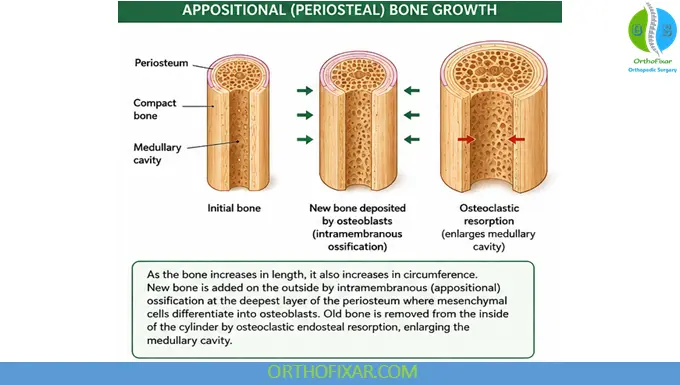
A major function of intramembranous ossification after birth is appositional growth, which increases the diameter and thickness of bones.
How Bone Increases in Circumference
As a long bone grows in length, it must also increase in circumference to maintain structural integrity.
This occurs through:
- New bone deposition beneath the periosteum.
- Differentiation of mesenchymal cells into osteoblasts.
- Formation of additional cortical bone on the outer surface.
- Simultaneous osteoclastic resorption on the inner surface.
This coordinated process enlarges the medullary cavity while preserving cortical thickness.
Role of the Periosteum
The deepest osteogenic layer of the periosteum contains mesenchymal stem cells capable of differentiating into osteoblasts.
These osteoblasts deposit new bone directly onto the external surface through intramembranous ossification, a process known as appositional bone growth.
Enlargement of the Medullary Cavity
Since long bones are essentially hollow cylinders:
- External bone deposition increases bone diameter.
- Internal osteoclastic resorption enlarges the marrow cavity.
This ensures proportional growth and optimal mechanical strength.
Intramembranous Ossification During Fracture Healing
Intramembranous ossification contributes significantly to fracture repair.
When fracture fragments are stable and well vascularized:
- Mesenchymal stem cells differentiate directly into osteoblasts.
- New bone forms without a cartilage intermediary.
- Healing occurs more rapidly.
This mechanism is particularly important in:
- Craniofacial fractures
- Stable cortical fractures
- Surgical bone graft incorporation
Periosteal Reaction and Clinical Significance
Intramembranous periosteal bone formation commonly occurs in response to pathological stimuli.
Causes of Periosteal New Bone Formation
Trauma
Periosteal stripping from fractures stimulates osteoblast activity and new bone deposition.
Infection
Osteomyelitis may trigger reactive periosteal ossification.
Tumors
Primary bone tumors and metastatic lesions often induce periosteal reactions.
Radiographic Importance
The appearance of periosteal new bone formation on imaging studies serves as an important diagnostic clue.
Common radiographic patterns include:
- Solid periosteal reaction
- Lamellated (onion-skin) reaction
- Spiculated reaction
- Codman triangle
Recognition of these patterns helps clinicians identify underlying disease processes.
Intramembranous Ossification vs Endochondral Ossification
Presence of Cartilage Template
Intramembranous Ossification
- No cartilage model
Endochondral Ossification
- Requires a hyaline cartilage model
Primary Bones Formed
Intramembranous Ossification
- Flat bones of skull
- Facial bones
- Clavicle
Endochondral Ossification
- Long bones
- Short bones
- Most axial skeleton bones
Mechanism
Intramembranous Ossification
- Mesenchyme directly becomes bone
Endochondral Ossification
- Cartilage is replaced by bone
Growth Function
Intramembranous Ossification
- Appositional growth
- Bone thickening
Endochondral Ossification
- Longitudinal growth
Clinical Correlations
Cleidocranial Dysplasia
A genetic disorder characterized by defective intramembranous ossification resulting in:
- Hypoplastic clavicles
- Delayed closure of fontanelles
- Craniofacial abnormalities
Craniosynostosis
Premature fusion of cranial sutures due to abnormal ossification patterns.
Fracture Repair
Intramembranous ossification contributes to direct bone healing under stable fixation conditions.
Bone Tumors
Periosteal reactions caused by tumor growth can provide important diagnostic information during imaging evaluation.
Key Points for Medical Students
- Intramembranous ossification forms bone directly from mesenchymal tissue.
- No cartilage precursor is involved.
- It forms most flat skull bones, facial bones, and parts of the clavicle.
- Osteoblasts secrete osteoid, which mineralizes to become bone.
- Appositional growth increases bone diameter through periosteal bone deposition.
- Osteoclastic endosteal resorption enlarges the medullary cavity during growth.
- Periosteal new bone formation is an important radiographic sign in trauma, infection, and tumors.
- Intramembranous ossification plays a major role in fracture healing and bone remodeling.
Conclusion
Intramembranous ossification is a fundamental mechanism of skeletal development and postnatal bone growth. By directly transforming mesenchymal tissue into bone, it enables the formation of craniofacial structures, contributes to appositional growth, and participates in fracture repair and periosteal reactions. A thorough understanding of this process is essential for interpreting bone development, radiographic findings, and various orthopedic and craniofacial disorders.
References & More
- Breeland G, Sinkler MA, Menezes RG. Embryology, Bone Ossification. StatPearls Publishing. NCBI Bookshelf. Link
- Gilbert SF. Osteogenesis: The Development of Bones. Developmental Biology. NCBI Bookshelf. Link
- Moreira CA, Dempster DW, Baron R. Anatomy and Ultrastructure of Bone – Histogenesis, Growth and Remodeling. [Updated 2019 Jun 5]. In: Feingold KR, Adler RA, Ahmed SF, et al., editors. Endotext [Internet]. South Dartmouth (MA): MDText.com, Inc.; 2000-. Available from: https://www.ncbi.nlm.nih.gov/books/NBK279149/
- Debnath S, et al. Discovery of a periosteal stem cell mediating intramembranous bone formation. Nature. 2018. Link