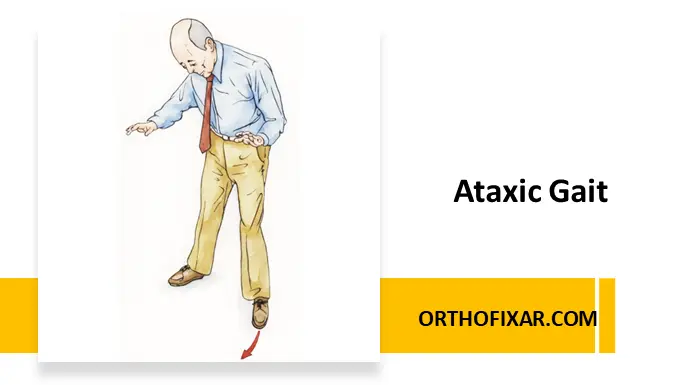
Ataxic gait is a neurologic gait abnormality characterized by impaired balance, poor coordination, and an unsteady walking pattern. It results from dysfunction of the cerebellum, sensory pathways, or their central connections. Patients typically demonstrate difficulty maintaining equilibrium, leading to a wide-based, irregular, and unstable gait.
In simple terms, the ataxic gait definition refers to a walking pattern in which coordinated movement is lost, making ambulation appear staggering or drunken.
Pathophysiology of Ataxic Gait
Ataxic gait arises when the nervous system structures responsible for coordination and proprioception fail to function properly. The two most clinically relevant forms are:
- Cerebellar ataxia
- Sensory ataxia
Each type produces distinct gait characteristics that help guide clinical diagnosis.
See Also: Antalgic Gait (Painful Gait)
Clinical Characteristics of Ataxic Gait
General Features
Patients with ataxic gait commonly present with:
- Poor balance and postural instability
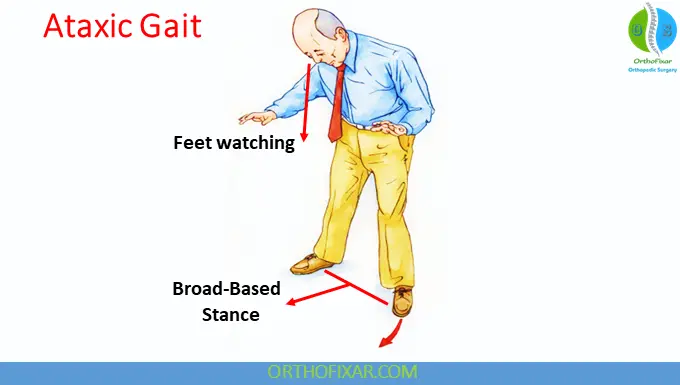
- A broad-based stance to increase stability
- Irregular, jerky, and weaving movements
- Difficulty walking in a straight line
These abnormalities worsen with attempts at precise or rapid movements.
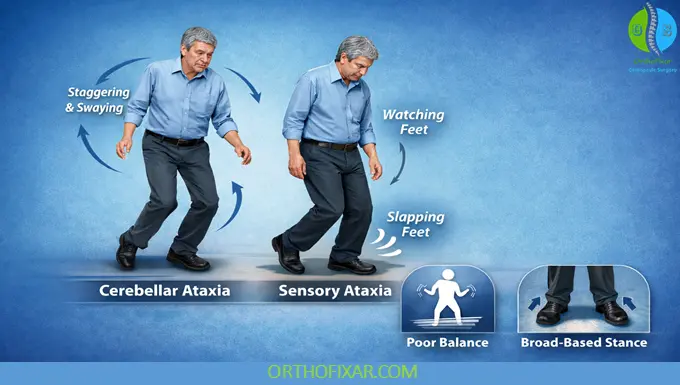
Cerebellar Ataxic Gait
The gait of a patient with cerebellar ataxia is typically dramatic and easily recognizable:
- Walking is marked by lurching or staggering
- Movements are exaggerated and poorly controlled
- The patient may sway from side to side, even when standing still
- Balance remains impaired even with visual input
Cerebellar lesions disrupt motor coordination regardless of sensory feedback, resulting in persistent instability.
See Also: Coordination Tests
Sensory Ataxic Gait
Sensory ataxia results from impaired proprioception due to peripheral neuropathy or dorsal column disease. Key features include:
- Slapping of the feet against the ground due to loss of position sense
- Excessive reliance on vision, with the patient watching their feet while walking
- Gait becomes worse in low-light conditions or when the eyes are closed
- Movements appear irregular, jerky, and weaving
Unlike cerebellar ataxia, sensory ataxic gait improves with visual compensation.
Common Causes of Ataxic Gait
Ataxic gait may be associated with a wide range of conditions, including:
- Cerebellar stroke or tumor
- Multiple sclerosis
- Alcohol-related cerebellar degeneration
- Vitamin B12 deficiency
- Peripheral neuropathy
- Spinal cord disorders affecting the dorsal columns
Clinical Assessment
Evaluation of ataxic gait includes:
- Observation of stance width and walking pattern
- Heel-to-toe (tandem) walking
- Romberg test (particularly useful in sensory ataxia)
- Neurologic examination focusing on coordination, reflexes, and sensation
Accurate gait analysis is essential for localizing the underlying neurologic pathology.
Summary
Ataxic gait is a hallmark sign of neurologic dysfunction involving impaired coordination or sensory input. Whether caused by cerebellar disease or sensory loss, recognition of its defining features—such as a broad base, staggering, exaggerated movements, or foot slapping—is critical for diagnosis and management.
References & More
- Judge RD, Zuidema GD, Fitzgerald FT: Clinical diagnosis: a physiological approach, Boston, 1982, Little, Brown.
- Orthopedic Physical Assessment by David J. Magee, 7th Edition.
- Hafiz S, De Jesus O. Ataxia. [Updated 2023 Aug 23]. In: StatPearls [Internet]. Treasure Island (FL): StatPearls Publishing; 2025 Jan-. Available from: Pubmed
- Cabaraux P, Agrawal SK, Cai H, Calabro RS, Casali C, Damm L, Doss S, Habas C, Horn AKE, Ilg W, Louis ED, Mitoma H, Monaco V, Petracca M, Ranavolo A, Rao AK, Ruggieri S, Schirinzi T, Serrao M, Summa S, Strupp M, Surgent O, Synofzik M, Tao S, Terasi H, Torres-Russotto D, Travers B, Roper JA, Manto M. Consensus Paper: Ataxic Gait. Cerebellum. 2023 Jun;22(3):394-430. doi: 10.1007/s12311-022-01373-9. Epub 2022 Apr 12. Erratum in: Cerebellum. 2023 Jun;22(3):431-432. doi: 10.1007/s12311-022-01413-4. PMID: 35414041. Pubmed
Closed.