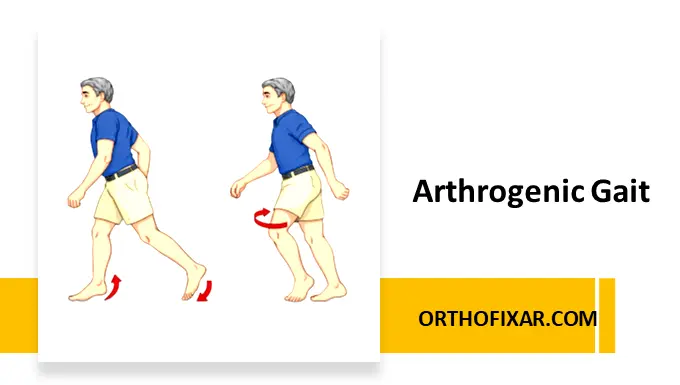
Arthrogenic gait is an abnormal walking pattern caused by joint pathology rather than muscle weakness or neurologic disease. It commonly results from joint stiffness, laxity, or deformity and may be painful or pain-free, depending on the underlying condition. This gait pattern is most often associated with disorders of the hip or knee and is frequently encountered in orthopedic and rehabilitation settings.
Understanding arthrogenic gait is essential for accurate gait analysis, diagnosis, and appropriate management planning.
Definition of Arthrogenic Gait
An arthrogenic gait occurs when restricted joint motion alters normal biomechanics of walking. The limitation may arise from:
- Joint stiffness (e.g., osteoarthritis, post-immobilization)
- Joint deformity
- Joint laxity
- Surgical fusion (arthrodesis)
- Recent removal from immobilization devices such as a cylinder cast
Because normal joint motion is compromised, the body compensates to maintain forward progression and foot clearance.
See Also: Gait Cycle
Mechanism of Arthrogenic Gait
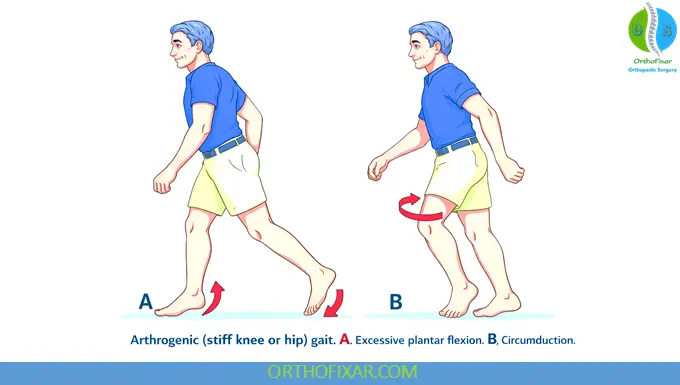
When the hip or knee is stiff or fused, the patient cannot adequately flex the limb during the swing phase. As a result, compensatory movements are required to prevent the toes from dragging on the ground.
Common compensatory mechanisms include:
- Pelvic elevation (hip hiking) on the affected side
- Exaggerated plantar flexion of the opposite ankle
- Circumduction of the stiff limb, producing a circumducted gait
In circumduction, the affected leg moves in an arc away from the body, which helps reduce the vertical elevation needed for toe clearance.
Key Clinical Features
Patients with arthrogenic gait often demonstrate the following characteristics:
- Lifting the entire limb higher than normal during the swing phase
- Reduced hip and/or knee flexion
- Circumduction of the affected limb
- Asymmetry between the two legs during walking
- Possible pain, although the gait may also be pain-free
Because of reduced flexibility in the hip, knee, or both, step length differs between the two limbs.
See Also: Antalgic Gait (Painful Gait)
Effect on Gait Length
Loss of joint mobility significantly affects stride mechanics:
- Gait lengths are unequal between the two legs
- When the stiff limb is weight-bearing, the gait length is usually shorter
- The contralateral limb often compensates with exaggerated movements to maintain balance and forward motion
These changes contribute to increased energy expenditure and reduced walking efficiency.
Common Causes of Arthrogenic Gait
Arthrogenic gait may be seen in patients with:
- Knee or hip arthrodesis
- Advanced osteoarthritis
- Post-casting or prolonged immobilization
- Joint deformities following trauma
- Postoperative stiffness after joint surgery
Clinical Assessment
Assessment of arthrogenic gait includes:
- Observation of stance and swing phases
- Evaluation of joint range of motion
- Comparison of step length and cadence
- Assessment of compensatory pelvic and ankle movements
A thorough gait analysis helps differentiate arthrogenic gait from neurologic or myogenic gait abnormalities.
Summary
Arthrogenic gait is a joint-related gait abnormality caused by stiffness, deformity, or laxity of the hip or knee. Reduced joint motion leads to compensatory strategies such as pelvic elevation and circumduction to achieve toe clearance. These adaptations result in asymmetric gait lengths, with a shorter step when the stiff limb bears weight. Early recognition is important for appropriate orthopedic management and rehabilitation planning.
References & More
- Orthopedic Physical Assessment by David J. Magee, 7th Edition.
- Pitton Rissardo J, Lui F. Gait Disturbances. [Updated 2025 Nov 8]. In: StatPearls [Internet]. Treasure Island (FL): StatPearls Publishing; 2025 Jan-. Available from: Pubmed
- Hulleck AA, Menoth Mohan D, Abdallah N, El Rich M, Khalaf K. Present and future of gait assessment in clinical practice: Towards the application of novel trends and technologies. Front Med Technol. 2022 Dec 16;4:901331. doi: 10.3389/fmedt.2022.901331. PMID: 36590154; PMCID: PMC9800936. Pubmed

Closed.