The ulnar nerve is the largest branch of the medial cord of the brachial plexus. It’s formed from the from the C8 and T1 nerve roots of the brachial plexus. The nerve courses along the medial arm and forearm, and then it passes into the wrist, hand, and fingers.
Ulnar Nerve Anatomy
It arises from the medial cord of the brachial plexus and contains fibers from the C8 and T1 nerve roots, although C7 may contribute some fibers.
See Also: Brachial Plexus Anatomy
The ulnar nerve continues along the anterior compartment of the arm, and it passes through the medial intermuscular septum at the level of the coracobrachialis insertion. As the ulnar nerve passes into the posterior compartment of the arm, it courses through the arcade of Struthers, which is a potential site for its compression.
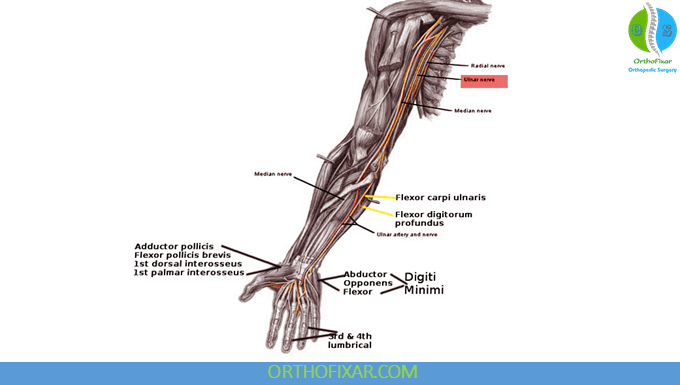
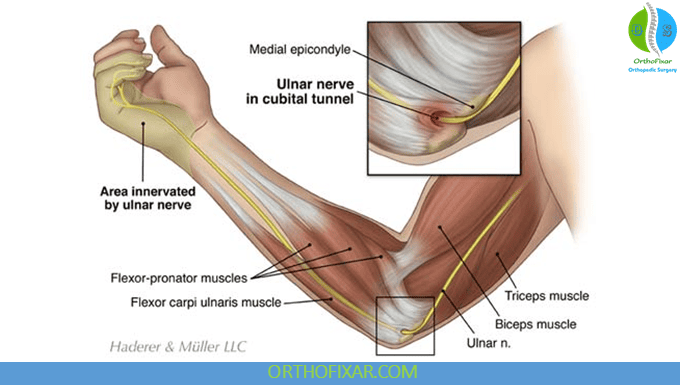
At the level of the elbow, the ulnar nerve passes posterior to the medial epicondyle, where it passes through the cubital tunnel. From there, the ulnar nerve passes between the two heads of the flexor carpi ulnaris origin and traverses the deep flexor–pronator aponeurosis. This aponeurosis is superficial to the flexor digitorum profundus, but deep to the flexor carpi ulnaris and flexor digitorum superficialis muscles.
The ulnar nerve enters the forearm by coursing posterior to the medial humeral condyle and passing between the heads of the flexor carpi ulnaris, before resting on the flexor digitorum profundus. It then continues distally to the wrist passing between the flexor carpi ulnaris and the flexor digitorum profundus muscles, which it supplies.
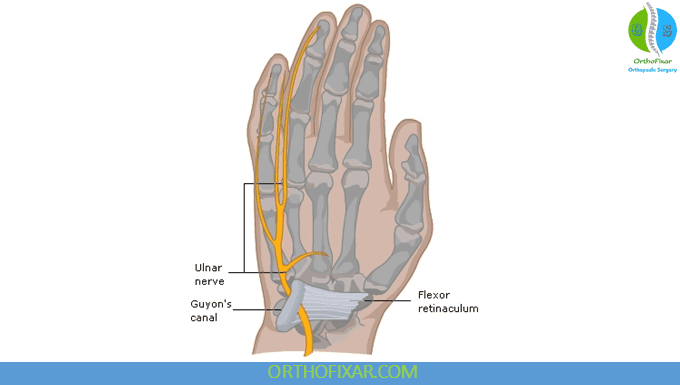
Proximal to the wrist, the palmar cutaneous branch of the ulnar nerve arises. This branch runs across the palmar aspect of the forearm and the wrist outside of the tunnel of Guyon to supply the proximal part of the ulnar side of the palm. A few centimeters more distally to the tunnel, a posterior (dorsal) cutaneous branch arises and supplies the ulnar side of the dorsum of the hand, the posterior (dorsal) aspect of the fifth finger, and the ulnar half of the forefinger.
Ulnar Nerve Function
Motor Function
The ulnar nerve supplies the flexor carpi ulnaris, the ulnar head of the flexor digitorum profundus, and all of the small muscles deep and medial to the long flexor tendon of the thumb, except the first two lumbricales, indicated by terminal branches in hand.
Forearm Muscles
- Flexor carpi ulnaris: Primary wrist flexor and ulnar deviator
- Flexor digitorum profundus (ring and small fingers): Deep finger flexors for digits 4 and 5
Hand Muscles
The ulnar nerve’s motor distribution in the hand is extensive and includes:
- Hypothenar muscles: Abductor digiti minimi, opponens digiti minimi, and flexor digiti minimi
- Deep thumb muscles: Adductor pollicis and deep head of flexor pollicis brevis
- Intrinsic muscles: All interossei (palmar and dorsal) and the third and fourth lumbrical muscles
This motor distribution explains the characteristic “claw hand” deformity seen in ulnar neuropathy, where loss of intrinsic muscle function leads to hyperextension.
See Also: Forearm Muscles Anatomy & Function
Sensory Function
Its sensory distribution includes the skin of the little finger and the medial half of the hand and the ring finger.
Forearm and Wrist
- Dorsoulnar forearm and wrist: Via the dorsal cutaneous branch, which arises in the distal forearm
Hand
- Ulnar half of the ring finger and entire small finger: Both palmar and dorsal aspects
- Ulnar aspect of the palm: Via the superficial sensory branch
See Also: Hand Nerves and Blood Supply

Clinical Significance
The anatomical course of the ulnar nerve creates several potential sites of compression or injury:
- Arcade of Struthers: Proximal ulnar neuropathy
- Cubital tunnel: Most common site of ulnar nerve compression
- Guyon’s canal: Distal ulnar neuropathy with varying presentations depending on the exact location within the canal
The nerve’s superficial course at the elbow makes it particularly vulnerable to trauma and compression, while its extensive motor innervation in the hand means that injuries can result in significant functional impairment.
Ulnar Nerve Injury
The clinical features of ulnar nerve impairment include the following:
- Claw hand, resulting from unopposed action of the extensor digitorum communis in the fourth and fifth digits.
- An inability to extend the second and distal phalanges of any of the fingers.
- An inability to adduct or abduct the fingers, or to oppose all the fingertips, as in making a cone with the fingers and the thumb.
- An inability to adduct the thumb.
- At the wrist, flexion is weak and ulnar deviation is lost. The ulnar reflex is absent.
- Atrophy of the interosseous spaces (especially the first) and of the hypothenar eminence.
- A loss of sensation on the ulnar side of the hand and ring finger and, most markedly, over the entire little finger.
- Partial lesions of the ulnar nerve may produce only motor weakness or paralysis of a few of the muscles supplied by the nerve. Lesions that occur in the distal forearm or at the wrist spare the deep flexors and the flexor carpi ulnaris.

References & More
- Dutton’s Orthopaedic Examination, Evaluation, And Intervention 3rd Edition.
- The Ulnar Nerve – Teach Me Anatomy
- Becker RE, Manna B. Anatomy, Shoulder and Upper Limb, Ulnar Nerve. [Updated 2023 Jul 24]. In: StatPearls [Internet]. Treasure Island (FL): StatPearls Publishing; 2023 Jan-. Available from: https://www.ncbi.nlm.nih.gov/books/NBK499892/