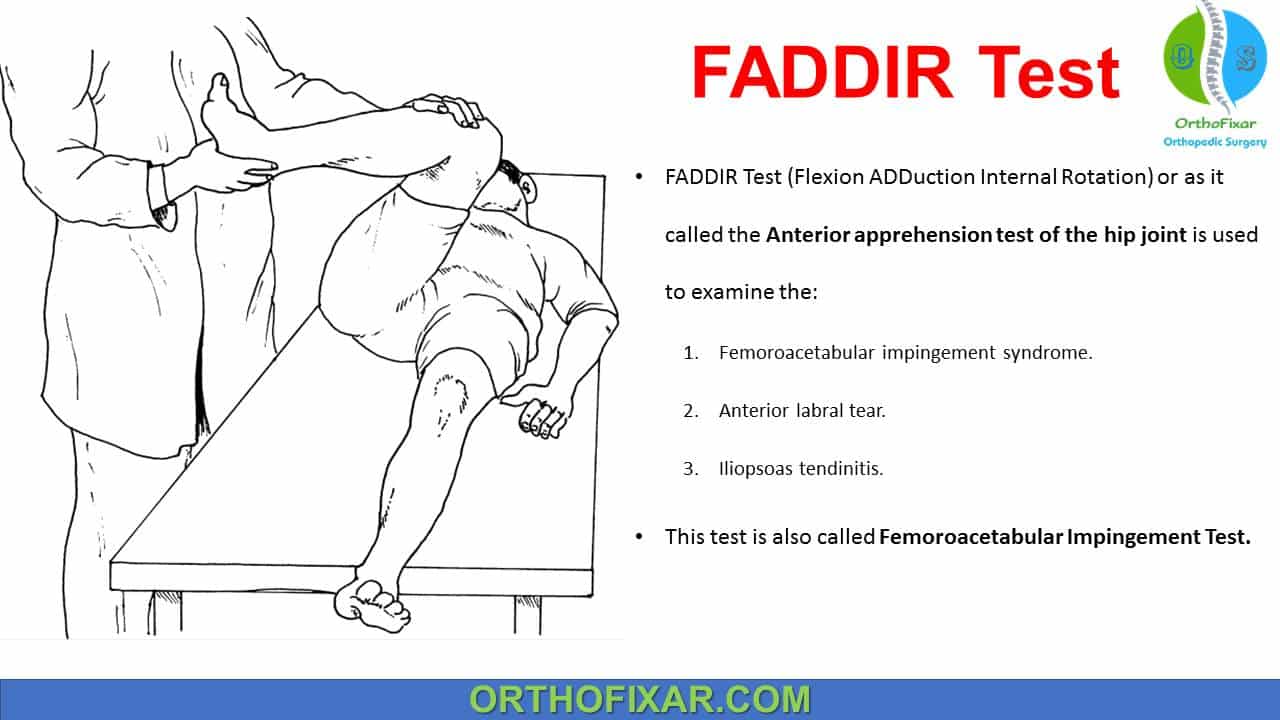
The FADDIR test (Flexion ADDuction Internal Rotation test), also called the FADIR test or the Anterior apprehension test of the hip joint, is a commonly used orthopedic physical examination maneuver for evaluating femoroacetabular impingement (FAI) and associated intra-articular hip pathology such as acetabular labral tears. It is widely used in sports medicine, orthopedics, and physiotherapy because hip impingement is a major source of groin pain in active adults and athletes.
FADDIR Test is used to examine the:
- Femoroacetabular impingement syndrome.
- Anterior labral tear.
- Iliopsoas tendinitis.
This test is also called Femoroacetabular Impingement Test or hip impingement test.
The maneuver places the hip in a position that narrows the anterior joint space, increasing impingement between bony structures if pathology is present.
Anatomy Relevant to the FADIR Test
The hip is a ball-and-socket joint composed of:
- Femoral head
- Acetabulum
- Acetabular labrum
- Articular cartilage
- Joint capsule
In femoroacetabular impingement, abnormal bony morphology leads to repetitive mechanical conflict during hip motion.
See Also: Hip Joint Anatomy
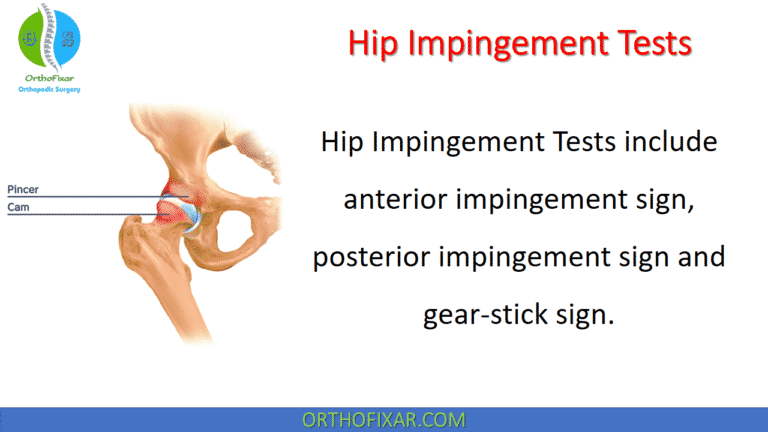
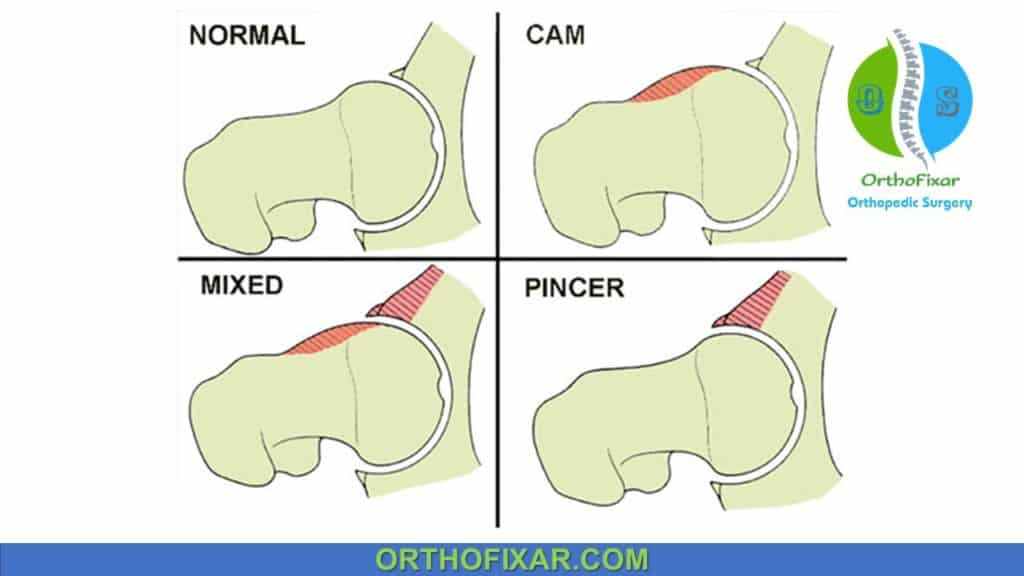
Types of Femoroacetabular Impingement
Cam Impingement
Occurs when the femoral head-neck junction loses its normal spherical contour.
Pincer Impingement
Occurs when there is excessive acetabular coverage over the femoral head.
Mixed Impingement
Combination of cam and pincer deformities.
The FADDIR position reproduces anterior impingement by forcing the femoral neck toward the acetabular rim.
Indications for the FADDIR Test
The test is commonly performed in patients presenting with:
- Groin pain
- Mechanical hip symptoms
- Clicking or locking sensation
- Reduced hip range of motion
- Pain during squatting
- Pain during pivoting activities
- Athletic hip pain
It is especially useful in young athletic populations participating in:
- Soccer
- Hockey
- Dance
- Running
- Martial arts
- Weightlifting
How do you perform a FADIR Test?
- The patient lies supine.
- The examiner grasps the affected leg near the heel with one hand and at the knee with the other and passively flexes the hip and knee.
- Then the hip is hyper flexed, internally rotated, and adducted.
- Hip Position: Flexion+Adduction+Internal Rotation

What does a positive FADDIR Test mean?
The FADDIR Test is positive if groin pain with limitation of flexion and internal rotation is elected. The forced movement combining flexion, adduction, and internal rotation brings the femoral neck into contact with the anterolateral acetabular rim.
Impingement occurs when bony prominences at the junction of the femoral head and neck (cam impingement) and/or at the anterior rim of the acetabulum (pincer impingement) cause the femoral neck to contact the anterior rim of the acetabulum earlier than normal. The same occurs also in the case of deep acetabular sockets.
This impingement causes lesions of the acetabular labrum and joint cartilage, especially in young and physically active individuals, who clinically experience groin pain when sitting and when involved in sports activities.
The symptoms are usually partially or completely relieved by the movement combining flexion and external rotation, during which the femoral neck moves laterally by the anterior acetabular roof without impingement.
Restrictions of internal rotation and of flexion occur in multiple other disorders that must be considered in the differential diagnosis, including Legg Calvé Perthes disease, epiphysiolysis, and decreased anteversion.
Conditions Associated with a Positive FADIR Test
- Femoroacetabular Impingement Syndrome (FAIS): The most common indication for the test.
- Acetabular Labral Tear: Internal rotation and adduction can compress damaged labral tissue.
- Hip Chondral Injury: Cartilage lesions may become symptomatic during provocative maneuvers.
- Iliopsoas-Related Pathology: Occasionally produces anterior hip pain during testing.
- Early Hip Osteoarthritis: Can also provoke pain during the maneuver.
Sensitivity & Specificity
The FADDIR Test (Flexion ADDuction Internal Rotation) accuracy for screening cam and pincer morphology (Femoroacetabular Impingement) according to Nicola C Casartelli in his study:
- Sensitivity: 41-60 %
- Specificity: 47-52 %
Another study by Burnett et al found that Sensitivity of FADDIR Test was 95 % (Specificity not calculated).
Notes
- Forced passive hyperextension and external rotation can cause a painful anterior subluxation of the femoral head, in which the femoral head contacts the labrum , which is partially or completely torn (in hip dysplasia).
- Deep-seated joint pains suggest posteroinferior impingement.
- Decreasing the femoral offset (cam impingement) as well as extending the roof can cause structural changes leading to the development of osteoarthritis of the hip.
- If a labral lesion is present, forcing the movement combination of hip flexion, abduction, and internal rotation will lead to pain due to contact of the femoral neck with the anterolateral acetabular rim (impingement test).
Additional Physical Examination Tests
The FADIR test is commonly combined with other hip tests for better diagnostic accuracy.
FABER Test
Evaluates intra-articular hip and sacroiliac pathology.
Scour Test
Assesses labral pathology and articular cartilage abnormalities.
Internal Rotation Over Pressure (IROP) Test
May demonstrate high sensitivity for FAI.
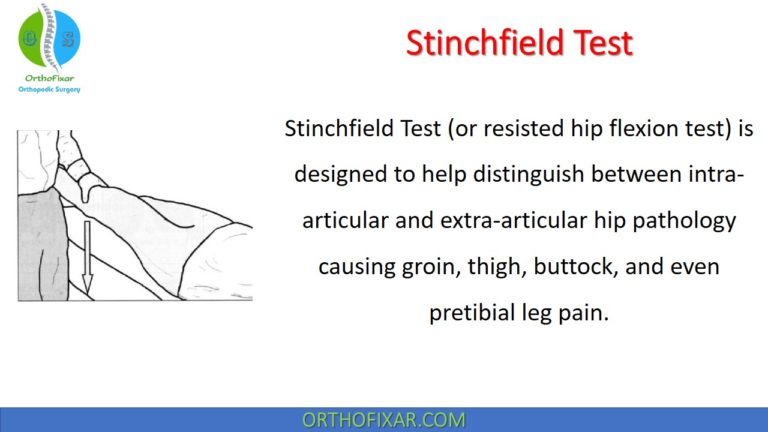
Stinchfield Test
Evaluates hip flexor and intra-articular pathology.
Systematic reviews suggest that combining several physical examination maneuvers improves diagnostic confidence.
Conclusion
The FADIR test is one of the most important physical examination maneuvers for assessing femoroacetabular impingement and related intra-articular hip disorders. Its high sensitivity makes it a valuable screening tool in patients with hip and groin pain, especially athletes and active adults.
However, due to variable specificity, the test should always be interpreted alongside patient history, imaging studies, and additional clinical examination findings. Early identification of hip impingement may help prevent progressive joint degeneration and improve long-term hip function.
Frequently Asked Questions (FAQs)
What does FADIR stand for?
FADDIR stands for:
Flexion
ADduction
Internal Rotation
It is a provocative hip examination maneuver.
Is the FADIR test painful?
The test may reproduce groin pain in patients with hip impingement or labral pathology.
What does a positive FADIR test indicate?
A positive test suggests possible:
– Femoroacetabular impingement
– Labral tear
– Intra-articular hip pathology
What is the difference between FADIR and FABER tests?
FADDIR stresses anterior hip impingement structures.
FABER evaluates hip joint and sacroiliac joint pathology.
Can the FADIR test diagnose a labral tear?
No. The test can suggest labral pathology, but imaging such as MRI or MR arthrography is typically required for confirmation.
Reference
- Nicola C Casartelli, Romana Brunner, Nicola A Maffiuletti, Mario Bizzini, Michael Leunig, Christian W Pfirrmann, Reto Sutter. The FADIR test accuracy for screening cam and pincer morphology in youth ice hockey players. J Sci Med Sport. 2018 Feb;21(2):134-138. doi: 10.1016/ j.jsams.2017.06.011. Epub 2017 Jun 21. PMID: 28669665. Pubmed
- Clinical presentation of patients with tears of the acetabular labrum. Burnett RS, Della Rocca GJ, Prather H, Curry M, Maloney WJ, Clohisy JCJ Bone Joint Surg Am. 2006 Jul; 88(7):1448-57. [PubMed].
- Pacheco-Carrillo A, Medina-Porqueres I. Physical examination tests for the diagnosis of femoroacetabular impingement. A systematic review. Phys Ther Sport. 2016 Sep;21:87-93. doi: 10.1016/j.ptsp.2016.01.002. Epub 2016 Jan 27. PMID: 27150967. Pubmed
- Clinical Tests for the Musculoskeletal System, Third Edition.
- Millers Review of Orthopaedics, 7th Edition.