If your knee suddenly refuses to bend or straighten, you are likely experiencing a locked knee. This condition can be alarming and painful, but understanding the common causes, warning signs, and treatment options can help you take the right steps toward recovery. Whether the locking is a temporary catch or a complete inability to move the joint, this article explains what is happening inside your knee and what you can do about it.
What Is a Locked Knee?
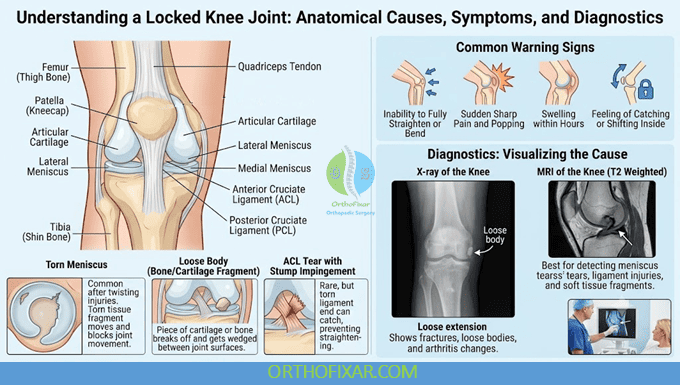
A locked knee occurs when something physically blocks the normal motion of the knee joint. You may find that your knee gets stuck in a bent position and cannot straighten, or less commonly, it locks in full extension. This is not the same as a knee that feels stiff or weak. Locking is a mechanical problem inside the joint, often caused by a loose body, a torn meniscus, or a ligament issue.
There are two main types of locked knee:
- True locked knee – A physical obstruction prevents movement. The knee will not bend or straighten no matter how hard you try.
- Pseudo locked knee – Pain or muscle spasm makes it feel like the knee is locked, but there is no actual mechanical block. The knee usually unlocks with rest or gentle movement.
Common Causes of Locked Knee
The most frequent causes of a locked knee involve damage to the cartilage or meniscus. Knowing what can trigger the problem helps you recognize the signs early.
- Meniscus tear – A torn piece of the C-shaped cartilage can flip into the joint space and block movement. This is the most common cause of true locking, especially after twisting injuries.
- Loose body – A fragment of bone or cartilage breaks off and floats freely inside the knee. When it wedges between the joint surfaces, the knee locks.
- Bucket-handle meniscus tear – A specific type of tear where a large flap of meniscus moves like a handle into the center of the knee, causing a complete block.
- Anterior cruciate ligament (ACL) injury – Although rare, a torn ACL can sometimes cause locking if the ligament stump gets caught in the joint.
- Patellar dislocation or subluxation – The kneecap moves out of its groove and can temporarily lock the knee in a bent position.
- Osteoarthritis – Advanced arthritis can produce bone spurs or loose cartilage fragments that cause intermittent locking.
“The most common emergency I see for a locked knee is a bucket-handle meniscus tear. When a patient cannot straighten their leg beyond 30 degrees, they usually need urgent surgical intervention.” — Dr. Laura Simmons, orthopedic surgeon
Warning Signs to Watch For
Not every knee click or catch means you have a locked knee. But certain warning signs suggest you need medical attention quickly.
- Inability to fully straighten or bend the knee – If your knee remains stuck in one position despite trying to move it, this is a red flag.
- Sudden sharp pain at the time of locking – Often accompanied by a popping sensation.
- Swelling that develops within a few hours – Can indicate bleeding inside the joint (hemarthrosis) from a meniscus or ligament tear.
- Feeling of something shifting inside the knee – Patients often describe a “click” or “clunk” when the knee locks or unlocks.
- Giving way or instability – The knee may feel like it will buckle when you try to put weight on it.
- Repeated locking episodes – Even if the knee unlocks on its own, recurring locking points to an underlying structural problem.
- Inability to bear weight – If you cannot stand on the affected leg, seek care immediately.
When to Seek Medical Help
If your knee locks and does not unlock within a few minutes, or if you cannot straighten it, you should see a healthcare provider or visit an urgent care center. Trying to force the knee to move can worsen the injury. Seek emergency care if:
- The knee is deformed or obviously dislocated.
- You have numbness or tingling in your foot or lower leg.
- You cannot put any weight on the leg.
- The pain is severe and unrelenting.
For mild locking that resolves quickly but keeps happening, schedule an appointment with an orthopedic specialist. Early diagnosis can prevent further damage to the knee cartilage.
How Doctors Diagnose a Locked Knee
Diagnosis begins with a history and physical exam. Your doctor will ask about the mechanism of injury, past knee problems, and how often locking occurs. During the exam, they will check range of motion, stability, and tenderness.
The following imaging tests help confirm the cause:
- X-ray – Shows fractures, loose bodies, and arthritis changes.
- Magnetic resonance imaging (MRI) – The best test for detecting meniscus tears, ligament injuries, and loose cartilage fragments.
- Computed tomography (CT) scan – Sometimes used to get a detailed view of bone fragments.
Treatment Options for Locked Knee
Treatment depends on the underlying cause and whether the knee is truly locked or pseudo-locked. Here is a summary of common approaches.
| Cause | Non-Surgical Treatment | Surgical Treatment | Recovery Outlook |
|---|---|---|---|
| Meniscus tear (minor) | Rest, ice, physical therapy | Arthroscopic meniscectomy or repair | Good if flap is trimmed or repaired |
| Bucket-handle tear | Not effective – typically requires surgery | Emergency arthroscopic repair or removal | Excellent if treated early |
| Loose body | Can sometimes dissolve? No – needs removal | Arthroscopic removal of fragment | Very good, symptoms resolve |
| ACL stump impingement | Rarely resolves on its own | Arthroscopic debridement or ACL reconstruction | Good after rehab |
| Patellar dislocation | Bracing, physical therapy | Medial patellofemoral ligament repair (if recurrent) | Varies; often good with therapy |
| Osteoarthritis locking | Anti-inflammatory meds, injections, activity modification | Arthroscopic debridement or knee replacement | Moderate; depends on arthritis stage |
“For a true mechanical lock, non-surgical treatment rarely works. If your knee is stuck, you need an arthroscopy to remove the blocking tissue. Waiting too long can lead to cartilage damage.” — Dr. Robert Chen, sports medicine specialist
Recovery and Prevention
Recovery from a locked knee depends on the treatment. After arthroscopic surgery, most people return to daily activities within a few weeks. Full recovery for a meniscus repair may take three to six months. Physical therapy is essential to regain strength and range of motion.
To reduce the risk of future locking episodes:
- Strengthen your quadriceps, hamstrings, and calf muscles to support the knee.
- Avoid sudden twisting movements without proper warm-up.
- li>Wear appropriate footwear that provides good traction and stability.
- Maintain a healthy body weight to reduce stress on the knee joint.
- Treat minor knee injuries promptly before they become major problems.
Conclusion
A locked knee is more than an inconvenience—it signals a structural problem inside the joint that usually requires medical attention. True locking, especially when you cannot straighten your leg, is often caused by a displaced meniscus tear or loose body. Warning signs like sudden pain, swelling, and inability to bear weight should prompt an evaluation by an orthopedic specialist. With accurate diagnosis and timely treatment, most people recover fully and return to their normal activities. Ignoring repeated locking episodes can lead to permanent cartilage damage and arthritis. If your knee locks, do not wait—get it checked.
Frequently Asked Questions
What does a locked knee feel like?
Most people describe it as a sudden inability to straighten or bend the knee, often accompanied by sharp pain and a sensation of something catching inside the joint. The knee may feel stuck in one position.
Can a locked knee fix itself?
Pseudo-locked knees caused by pain or muscle spasm may resolve with rest and gentle movement. However, true mechanical locking almost never goes away without treatment. The blocking fragment needs to be removed or repositioned surgically.
Is a locked knee an emergency?
If you cannot unlock your knee after a few minutes, or if you have severe pain, deformity, numbness, or inability to bear weight, it is best to seek urgent care. Delayed treatment can lead to cartilage damage.
What is the most common cause of a locked knee?
The most common cause is a bucket-handle tear of the medial meniscus. This injury often occurs during sports that involve twisting, such as soccer or basketball.
Can walking make a locked knee worse?
Yes. Trying to walk on a locked knee can force the blocking fragment deeper into the joint, causing more damage to the cartilage and worsening the tear. It is safer to rest and use crutches until you see a doctor.
How long does it take to recover from locked knee surgery?
Recovery varies. For a simple arthroscopic removal of a loose body or small meniscus flap, most people return to normal walking within one to two weeks. For a meniscus repair, recovery can take three to six months with physical therapy.
Will I need crutches after surgery?
Most likely yes, especially if a meniscus repair was performed. You may be non-weight-bearing or toe-touch weight-bearing for several weeks. Your surgeon will give you specific instructions based on the procedure.
Can arthritis cause a locked knee?
Yes. Advanced osteoarthritis can lead to bone spurs that catch during movement, or pieces of loose cartilage can break off and cause locking. This type of locking is often intermittent but can become more frequent as arthritis progresses.
What is the difference between a locked knee and a stiff knee?
A stiff knee is generally tight or difficult to move but does not have a mechanical block. A locked knee has an actual physical obstruction that prevents motion, often accompanied by a catching sensation.
Can physical therapy help a locked knee without surgery?
Physical therapy can help with pain and swelling, and it may improve stability for pseudo-locked knees. However, for true mechanical locking caused by a loose body or displaced meniscus, surgery is usually required to remove the obstruction.