Back pain affects nearly everyone at some point, but knowing when it is simply a muscle strain and when it signals a deeper orthopedic issue can be confusing. Orthopedic care for back pain focuses on the bones, joints, ligaments, tendons, and muscles that support your spine. This article helps you recognize the warning signs that require a specialist evaluation, explains the difference between conservative home care and medical intervention, and guides you through common treatment options so you can make an informed decision about your health.
Understanding the Role of Orthopedic Care for Back Pain
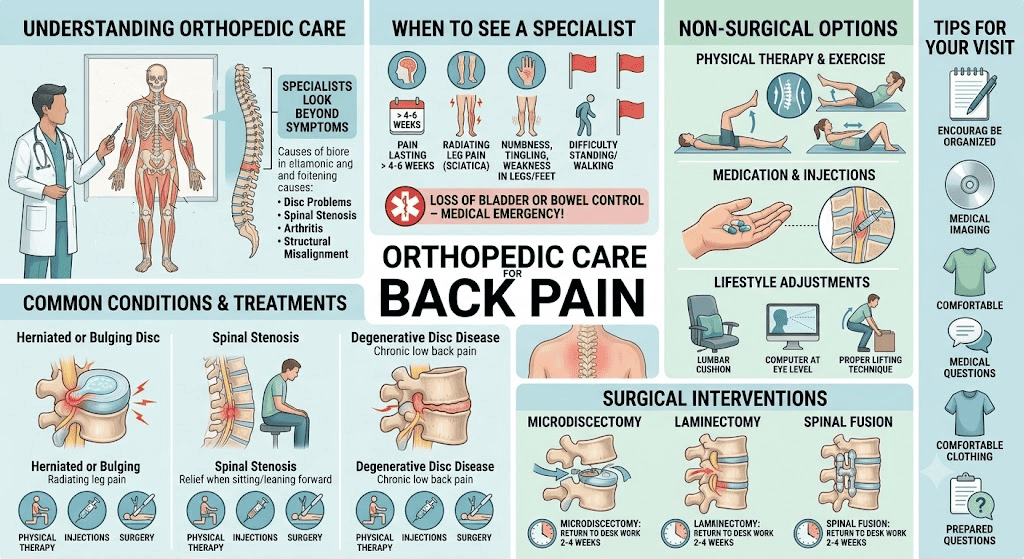
Orthopedic specialists are medical doctors trained to diagnose and treat conditions of the musculoskeletal system. When it comes to back pain, they look beyond the symptom and search for the underlying cause, such as disc problems, spinal stenosis, arthritis, or structural misalignment. General practitioners manage many back pain cases, but an orthopedist brings deeper expertise in surgical and non-surgical spine care.
- Orthopedic surgeons also perform conservative treatments like injections and physical therapy before considering surgery.
- Seeing a specialist early can prevent chronic pain and long-term disability.
- Many insurance plans allow direct access to an orthopedic clinic without a referral, though checking your policy is wise.
“An orthopedic consultation does not mean you need surgery. It means you deserve a clear diagnosis and a personalized plan to get your life back.” – Dr. Elena Vargas, spine specialist
When to See an Orthopedic Specialist for Back Pain
Not every backache requires a specialist visit. But certain red flags make it important to book an appointment sooner rather than later. The following scenarios indicate that orthopedic care for back pain may be necessary.
- Pain that lasts longer than four to six weeks without improving despite rest and home remedies.
- Pain that radiates down one leg (sciatica) or into the groin area.
- Numbness, tingling, or weakness in your legs or feet.
- Difficulty standing up straight or walking even short distances.
- Loss of bladder or bowel control – this is a medical emergency requiring immediate care.
- Back pain after a fall, car accident, or sports injury.
- A history of cancer, osteoporosis, or immune system disorders.
Examples of When to Act Quickly
Consider a patient who develops sudden sharp lower back pain after lifting a heavy box. If the pain radiates down the leg and is accompanied by foot drop (difficulty lifting the front of the foot), that person needs an orthopedic evaluation for a possible herniated disc compressing a nerve. Another example: a middle‑aged adult with gradual worsening back pain and stiffness in the morning that eases with activity may have spinal arthritis – an orthopedic assessment can confirm this and guide early management.
Common Causes of Back Pain That Orthopedics Addresses
Orthopedic specialists treat a wide range of back pain causes. Understanding these can help you describe your symptoms more accurately during a visit.
| Condition | Typical Symptoms | Common Treatment |
|---|---|---|
| Herniated or bulging disc | Sharp pain radiating to leg, numbness, muscle weakness | Physical therapy, epidural steroid injections, possibly microdiscectomy |
| Spinal stenosis | Leg pain while walking, relief when sitting or leaning forward | Activity modification, nerve blocks, decompression surgery |
| Degenerative disc disease | Chronic low back pain, stiffness after sitting, worse with bending | Core strengthening, anti‑inflammatory medications, spinal fusion in severe cases |
| Sacroiliac joint dysfunction | Deep pain in one side of the lower back or buttock, often when standing | Manual therapy, SI joint injections, radiofrequency ablation |
| Facet joint arthritis | Pain when leaning backward, localized tenderness near the spine | Facet injections, physical therapy, nerve blocks |
Non‑Surgical Options in Orthopedic Care for Back Pain
Most orthopedic specialists start with conservative treatments. These options are effective for many patients and avoid the risks of surgery.
Physical Therapy and Exercise
A tailored physical therapy program strengthens the muscles supporting your spine, improves flexibility, and corrects posture. The therapist may use manual techniques, traction, or specialized equipment. Consistent home exercises are crucial for long‑term relief.
Medication and Injections
Over‑the‑counter anti‑inflammatories like ibuprofen or naproxen can reduce pain and swelling. If those are insufficient, your orthopedist might prescribe muscle relaxants or nerve pain medications. Corticosteroid injections delivered near the affected nerve or joint can provide weeks to months of relief, allowing you to engage in rehabilitation.
Lifestyle and Ergonomic Adjustments
Small changes at work and home can make a big difference. Examples include using a lumbar support cushion while driving, setting up your computer monitor at eye level, sleeping on a medium‑firm mattress, and avoiding prolonged sitting without breaks. An orthopedic specialist can recommend specific adjustments based on your condition.
“I tell my patients: your spine is like a suspension bridge. The muscles are the cables. Weak cables put stress on the bones. Strengthen the cables, and the bridge lasts longer.” – Dr. Marcus Chen, orthopedic surgeon
When Surgery Becomes Part of Orthopedic Care for Back Pain
Surgery is never the first option, but it becomes necessary when conservative treatments fail or when there is progressive nerve damage, loss of bowel/bladder control, or structural instability that threatens long‑term health.
- Microdiscectomy: removing the part of a herniated disc that presses on a nerve. Typically done for leg pain more than back pain.
- Laminectomy: removing the bony arch of a vertebra to create more space in the spinal canal, often for spinal stenosis.
- Spinal fusion: joining two or more vertebrae to stabilize a segment, used for fractures, severe degeneration, or deformity.
- Artificial disc replacement: preserving motion while replacing a damaged disc, suitable for certain patients with single‑level disease.
Recovery times vary. For a microdiscectomy, most patients go home the same day and return to desk work in two to four weeks. Spinal fusion usually requires a longer recovery, with restrictions on bending and lifting for several months.
How to Prepare for Your Orthopedic Appointment
Taking a few steps before your visit can make the consultation more productive and help the specialist reach an accurate diagnosis faster.
- Bring a list of your symptoms: when they started, what makes them worse, and what relieves them.
- Note any history of accidents, surgeries, or prior treatments for back pain.
- Bring your current medications, including over‑the‑counter drugs and supplements.
- If you have had imaging (X‑ray, MRI, CT scan) from another provider, request the actual images on a CD or digital link – not just the written report.
- Wear comfortable clothing that allows easy access to your back (avoid one‑piece outfits or tight tops).
- Write down questions you want to ask, such as: “What is the exact cause of my pain?” and “What are the pros and cons of each treatment option?”
Lifestyle Habits That Support Your Spine Between Visits
Even after you see a specialist, what you do daily matters enormously. Orthopedic care for back pain extends beyond the clinic.
- Maintain a healthy weight. Extra pounds, especially around the abdomen, increase stress on the lower back.
- Practice good posture. When standing, keep your ears, shoulders, hips, and ankles aligned. When sitting, keep both feet flat on the floor and your knees at or below hip level.
- Stay active. Low‑impact activities like walking, swimming, or cycling help keep the back muscles conditioned without jarring the spine.
- Avoid prolonged bed rest. Unless your orthopedist specifically advises it, staying in bed for more than two days can weaken muscles and delay recovery.
- Learn proper lifting technique. Bend at your knees, not your waist, and keep the object close to your body.
Conclusion
Orthopedic care for back pain offers a structured, evidence‑based path from initial discomfort to lasting relief. Recognizing the right time to see a specialist can prevent months or years of unnecessary suffering. Whether your pain fades with physical therapy and simple lifestyle changes or requires advanced procedures, an orthopedic team can guide you with clarity and compassion. Listen to your body – persistent or worsening back pain deserves a thorough evaluation, not more waiting.
Frequently Asked Questions
1. What is the difference between an orthopedist and a chiropractor for back pain?
An orthopedist is a medical doctor (MD or DO) who can prescribe medication, order advanced imaging, and perform surgery. Chiropractors focus on spinal manipulation and alignment but do not perform surgery or prescribe drugs. For serious structural issues, an orthopedic evaluation is usually the safer first step.
2. Do I need an MRI before seeing an orthopedic specialist?
Not necessarily. Many orthopedists begin with a physical exam and may order X‑rays. MRI is reserved for cases where nerve involvement is suspected or when conservative treatments fail. Your specialist will decide which imaging is needed.
3. Can orthopedic care for back pain help with sciatica without surgery?
Yes. Most cases of sciatica improve with physical therapy, stretching, anti‑inflammatory medication, and sometimes epidural steroid injections. Surgery is considered only after six to twelve weeks of non‑surgical treatment if the pain remains severe or if weakness progresses.
4. How long does it take to recover from a microdiscectomy?
Many patients go home the same day and feel significantly less leg pain immediately. Light activities can resume within two weeks, but heavy lifting (over ten to fifteen pounds) is typically restricted for six to eight weeks. Full recovery varies by individual.
5. What if my back pain goes away on its own – should I still see an orthopedist?
If the pain resolves completely within a few weeks and does not recur, you may not need a specialist. However, if you had red flags like numbness or weakness that later disappeared, it is wise to get an evaluation to rule out an underlying condition that could return.
6. Are spinal injections painful?
Most patients report only mild discomfort. The area is numbed with local anesthetic, and the injection itself lasts less than a minute. A temporary increase in pain for a day or two is common, but many people experience significant relief within a week.
7. Can exercise make back pain worse?
Improper exercise can aggravate back pain. That is why it is important to work with a physical therapist or follow a program designed by your orthopedist. Gentle movement like walking or swimming is safe for most conditions, but high‑impact activities should be avoided until cleared.
8. What is the best sleeping position for lower back pain?
Sleeping on your side with a pillow between your knees helps keep your spine aligned. If you sleep on your back, place a pillow under your knees to reduce the curve in your lower back. Stomach sleeping often stresses the neck and lower back and is not recommended.
9. Do I need to see a spine surgeon for every back problem?
No. Many orthopedic surgeons also provide non‑surgical care. You can see a general orthopedist first. If surgery is required, they will either perform it themselves or refer you to a spine‑focused colleague. Always get a second opinion if you are unsure about a recommended procedure.
10. How do I know if my back pain is muscular or related to a disc?
Muscular pain tends to be a dull ache that is localized and often improves with massage or heat. Disc pain usually radiates into one leg, may be sharp or burning, and is often accompanied by numbness or tingling. An orthopedic exam and imaging can confirm the source.