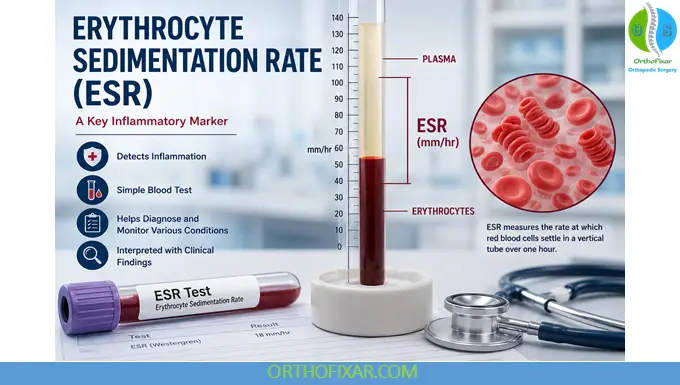
The erythrocyte sedimentation rate (ESR) is one of the oldest and most widely used laboratory tests in clinical medicine. Also known as the sed rate blood test, ESR is a simple, inexpensive, and non-specific marker of inflammation that measures how quickly red blood cells settle in a vertical tube over one hour.
Although newer inflammatory biomarkers such as C-reactive protein (CRP) are often preferred in many clinical settings, the erythrocyte sedimentation rate remains an important diagnostic and monitoring tool for numerous inflammatory, infectious, autoimmune, and malignant conditions.
This article provides a comprehensive review of ESR, including its physiology, testing methodology, clinical significance, interpretation, limitations, and current applications in medical practice.
What is the Erythrocyte Sedimentation Rate (ESR)?
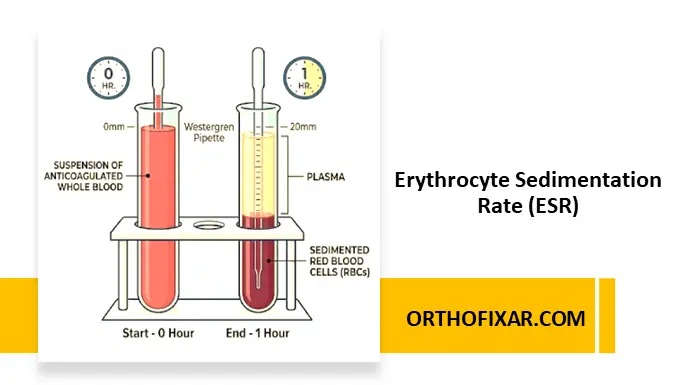
The erythrocyte sedimentation rate (ESR) is a laboratory test that measures the distance red blood cells (erythrocytes) fall through plasma in a standardized tube during a period of one hour.
The result is reported in millimeters per hour (mm/hr).
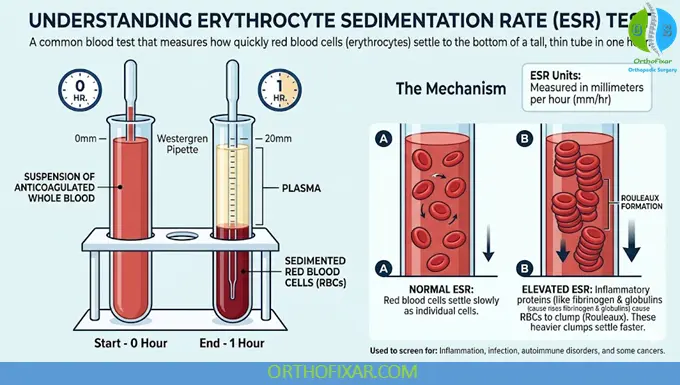
Under normal conditions, red blood cells settle slowly. During inflammation, elevated plasma proteins promote the aggregation of erythrocytes into stacks known as rouleaux formations, causing the cells to settle more rapidly and resulting in an elevated ESR.
Key Point
ESR is an indirect measure of inflammation rather than a test that identifies a specific disease.
How Does the ESR Test Work?
The ESR lab procedure is based on the principle that inflammation alters plasma protein composition.
Inflammatory proteins such as:
- Fibrinogen
- Immunoglobulins
- Acute-phase reactants
reduce the normal negative charge that keeps red blood cells apart. As a result, erythrocytes aggregate and settle faster under the influence of gravity.
The Westergren Method
The Westergren method is considered the international reference standard for ESR measurement.
Steps include:
- Collection of anticoagulated venous blood.
- Placement of the sample into a calibrated Westergren tube.
- Vertical positioning of the tube.
- Measurement of the distance the red blood cells descend after one hour.
The final measurement is reported in mm/hr.
Normal ESR Values
Reference ranges vary among laboratories and are influenced by age and sex.
Typical adult reference values include:
| Population | Normal ESR (mm/hr) |
|---|---|
| Adult men | 0–15 |
| Adult women | 0–20 |
| Men over 50 years | 0–20 |
| Women over 50 years | 0–30 |
| Children | 0–10 |
Mild increases may occur with aging and pregnancy.
Factors Affecting ESR
Numerous physiological and pathological factors can influence the sed rate blood test.
Factors That Increase ESR
- Acute infections
- Chronic inflammatory diseases
- Autoimmune disorders
- Pregnancy
- Anemia
- Chronic kidney disease
- Malignancies
- Tissue injury and trauma
Factors That Decrease ESR
- Polycythemia
- Sickle cell disease
- Hereditary spherocytosis
- Extreme leukocytosis
- Congestive heart failure
- Hypofibrinogenemia
Why Is ESR Ordered?
Healthcare providers frequently request an ESR lab test when evaluating patients with suspected inflammatory conditions.
Common indications include:
- Unexplained fever
- Persistent fatigue
- Chronic pain
- Weight loss
- Suspected infection
- Autoimmune diseases
- Monitoring inflammatory disorders
Because ESR is non-specific, it is generally interpreted alongside clinical findings and other laboratory tests.
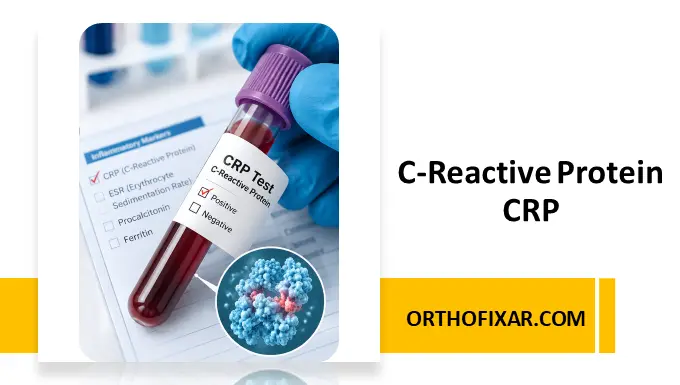
See Also: C-Reactive Protein (CRP Blood Test)
ESR and Inflammation
The ESR is commonly categorized among the inflammatory markers sed rate tests used in routine clinical practice.
Inflammation stimulates the liver to produce acute-phase proteins, particularly fibrinogen. Increased concentrations of these proteins accelerate red blood cell sedimentation.
For this reason, ESR is frequently elevated in:
- Bacterial infections
- Autoimmune diseases
- Vasculitis
- Chronic inflammatory conditions
However, ESR does not identify the source or severity of inflammation.
Clinical Uses of ESR
Rheumatoid Arthritis
ESR is widely used in the diagnosis and monitoring of rheumatoid arthritis.
Higher ESR values often correlate with increased disease activity and may help assess treatment response.
Giant Cell Arteritis
A markedly elevated ESR is a classic finding in giant cell arteritis.
Patients often present with:
- Headache
- Jaw claudication
- Visual disturbances
- Scalp tenderness
Prompt diagnosis is critical because untreated disease may result in permanent blindness.
Polymyalgia Rheumatica
Most patients with polymyalgia rheumatica demonstrate significantly elevated ESR levels.
Monitoring ESR can assist in evaluating therapeutic response to corticosteroids.
Systemic Lupus Erythematosus
ESR may be elevated during disease flares, although CRP may remain normal unless infection is present.
Osteomyelitis
The erythrocyte sedimentation rate is frequently used in the evaluation and follow-up of bone infections.
Persistent elevation may indicate ongoing inflammation or treatment failure.
Inflammatory Bowel Disease
ESR can help assess inflammatory activity in:
- Crohn disease
- Ulcerative colitis
Malignancy
Elevated ESR may occur in various cancers, particularly:
- Multiple myeloma
- Lymphoma
- Metastatic malignancies
Extremely high ESR values should prompt investigation for serious underlying disease.
Interpretation of ESR Results
Mild Elevation (20–40 mm/hr)
May occur in:
- Minor infections
- Early inflammatory disease
- Pregnancy
- Older adults
Moderate Elevation (40–100 mm/hr)
Common causes include:
- Active autoimmune disease
- Significant infection
- Chronic inflammatory disorders
- Some cancers
Marked Elevation (>100 mm/hr)
An ESR greater than 100 mm/hr is often associated with serious pathology such as:
- Severe infection
- Giant cell arteritis
- Multiple myeloma
- Advanced malignancy
- Systemic vasculitis
Further investigation is usually warranted.
ESR Versus C-Reactive Protein (CRP)
Both ESR and CRP are inflammatory markers, but they differ significantly.
| Feature | ESR | CRP |
|---|---|---|
| Response speed | Slow | Rapid |
| Normalization | Slow | Rapid |
| Influenced by age and anemia | Yes | Minimal |
| Specificity for acute inflammation | Lower | Higher |
| Cost | Low | Low |
Many clinicians order both tests because they provide complementary information.
Limitations of ESR
Despite its widespread use, ESR has several limitations.
Non-Specific Nature
An elevated ESR does not identify a specific disease.
Delayed Response
ESR may remain elevated for days or weeks after inflammation resolves.
Multiple Confounding Factors
Age, sex, pregnancy, anemia, and various blood disorders can alter ESR values independent of inflammation.
Normal ESR Does Not Exclude Disease
Some patients with active inflammatory conditions may have normal ESR results.
Therefore, ESR should never be interpreted in isolation.
Conditions Associated With Elevated ESR
Common causes include:
Infectious Diseases
- Tuberculosis
- Osteomyelitis
- Endocarditis
- Pneumonia
Autoimmune Disorders
- Rheumatoid arthritis
- Systemic lupus erythematosus
- Vasculitis
- Polymyalgia rheumatica
Malignancies
- Multiple myeloma
- Lymphoma
- Metastatic cancer
Chronic Diseases
- Chronic kidney disease
- Chronic inflammatory disorders
Preparing for an ESR Test
The sed rate blood test typically requires no special preparation.
Patients can usually:
- Eat normally
- Continue regular hydration
- Undergo testing during routine blood collection
However, clinicians should be informed of all medications because some drugs may influence test results.
Future Role of ESR
Although advanced biomarkers continue to emerge, the erythrocyte sedimentation rate remains an important diagnostic tool because it is:
- Inexpensive
- Widely available
- Easy to perform
- Valuable for monitoring chronic inflammatory disorders
ESR is likely to remain a useful component of laboratory medicine, particularly when interpreted alongside CRP and clinical findings.
Conclusion
The erythrocyte sedimentation rate (ESR) is a simple and widely used laboratory marker of inflammation. The sed rate blood test measures how rapidly erythrocytes settle in plasma and serves as an indirect indicator of inflammatory activity. As one of the most commonly ordered inflammatory markers sed rate tests, ESR assists clinicians in the diagnosis and monitoring of autoimmune diseases, infections, vasculitis, malignancies, and chronic inflammatory conditions.
Although ESR lacks specificity and may be affected by numerous physiological factors, it remains a valuable tool when interpreted in conjunction with patient history, physical examination, imaging findings, and other laboratory investigations. Understanding the strengths and limitations of the ESR lab test is essential for accurate clinical decision-making.
References & More
- Tishkowski K, Zubair M. Erythrocyte Sedimentation Rate. [Updated 2025 Jul 7]. In: StatPearls [Internet]. Treasure Island (FL): StatPearls Publishing; 2026 Jan-. Available from: https://www.ncbi.nlm.nih.gov/books/NBK557485/
- ICSH recommendations for measurement of erythrocyte sedimentation rate. International Council for Standardization in Haematology (Expert Panel on Blood Rheology). J Clin Pathol. 1993 Mar;46(3):198-203. PubMed
- Bray C, Bell LN, Liang H, Haykal R, Kaiksow F, Mazza JJ, Yale SH. Erythrocyte Sedimentation Rate and C-reactive Protein Measurements and Their Relevance in Clinical Medicine. WMJ. 2016 Dec;115(6):317-21. PMID: 29094869. Pubmed
- Tishkowski K, Zubair M. Erythrocyte Sedimentation Rate. 2025 Jul 7. In: StatPearls [Internet]. Treasure Island (FL): StatPearls Publishing; 2026 Jan–. PMID: 32491417. Pubmed