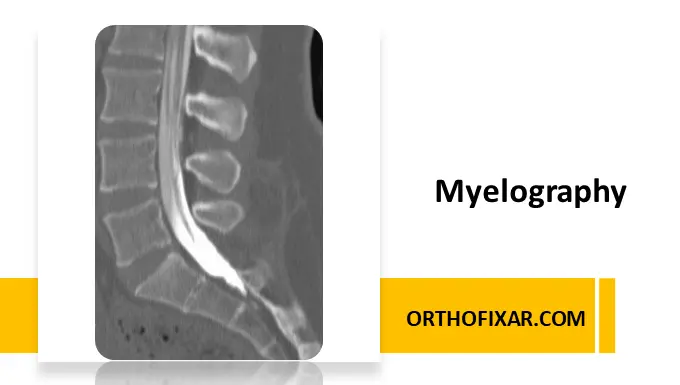
Myelography is a specialized radiographic examination of the spinal canal performed after the injection of a contrast medium into the subarachnoid space. The procedure allows visualization of the spinal cord, nerve roots, and surrounding cerebrospinal fluid (CSF), helping identify abnormalities that distort the normal flow of contrast material.
Historically, myelography was widely used for diagnosing spinal disorders such as intervertebral disc prolapse, spinal stenosis, nerve root compression, and intrathecal tumors. Although modern imaging techniques such as computed tomography (CT) and magnetic resonance imaging (MRI) have largely replaced conventional myelography, it continues to play an important role in selected clinical situations.
Historical Background of Myelography
Myelography was one of the most important diagnostic tools for spinal disorders before the widespread availability of MRI and high-resolution CT scanning. By outlining the subarachnoid space with contrast material, physicians could detect distortions caused by:
- Herniated intervertebral discs
- Spinal tumors
- Nerve root compression
- Spinal canal narrowing
- Traumatic lesions
- Congenital abnormalities
Today, MRI is generally considered the first-line imaging modality for most spinal conditions because it is noninvasive and provides superior soft-tissue visualization. However, myelography remains valuable when MRI findings are inconclusive or when MRI cannot be performed.
See Also: Arthrography: Indications, Technique, Uses & Interpretation
Principles of Myelography
The procedure involves introducing a radiopaque contrast agent into the cerebrospinal fluid through lumbar puncture.
The contrast medium mixes with CSF and outlines:
- The spinal cord
- The nerve root sleeves
- The subarachnoid space
- The spinal canal
Radiographs, fluoroscopy, CT scans, or a combination of these techniques are then used to evaluate the distribution of contrast.
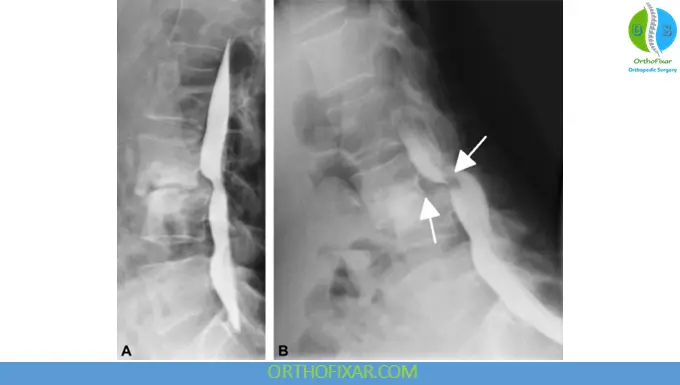
Any lesion occupying space within the spinal canal may alter the normal contour of the contrast column, creating characteristic filling defects or distortions.
Indications for Myelography
Although less common than in the past, myelography remains useful in several clinical settings.
Evaluation of Nerve Root Compression
Myelography is particularly effective in demonstrating:
- Lumbar radiculopathy
- Cervical radiculopathy
- Foraminal stenosis
- Nerve root sleeve abnormalities
The examination can clearly delineate nerve root compression when MRI findings are equivocal.
Assessment of Spinal Stenosis
Patients with suspected spinal canal narrowing may benefit from myelography, especially when symptoms and MRI findings do not correlate.
Investigation of Disc Herniation
A protruding or herniated intervertebral disc may compress the contrast column and produce a characteristic defect on the myelogram.
Detection of Intrathecal Tumors
Tumors located within the dural sac can alter the flow of contrast material and create distinctive imaging appearances.
Postoperative Spine Evaluation
Myelography can help assess:
- Recurrent disc herniation
- Scar tissue formation
- Persistent nerve root compression
- Failed back surgery syndrome
Patients Unable to Undergo MRI
Myelography may be indicated in patients with:
- Certain implanted medical devices
- Severe claustrophobia
- MRI contraindications
Contrast Media Used in Myelography
Early Contrast Agents
Historically, oily contrast agents were commonly used. These agents provided adequate visualization but were associated with significant complications and were difficult to remove from the subarachnoid space.
As a result, oily contrast media are no longer used in modern practice.
Water-Soluble Contrast Agents
Water-soluble iodinated contrast agents replaced oily media and improved safety. However, early ionic water-soluble agents were associated with substantial adverse effects, including neurotoxicity and irritation of the meninges.
Metrizamide
Metrizamide represented a major advance in myelographic imaging.
Advantages of metrizamide include:
- Low neurotoxicity
- Near-isotonicity with cerebrospinal fluid
- Improved visualization of nerve roots
- Ability to image the entire spinal canal
Because of these characteristics, metrizamide enabled detailed radiculography, allowing superior assessment of spinal nerve roots.
Modern Nonionic Contrast Agents
Modern nonionic agents such as iohexol and iopamidol have largely replaced metrizamide because they provide comparable image quality with fewer adverse reactions. Studies demonstrated lower rates of complications compared with metrizamide myelography.
Myelography Procedure
Patient Preparation
Before the examination:
- Medical history is reviewed
- Allergies are assessed
- Coagulation status may be evaluated
- Informed consent is obtained
Patients are often advised to maintain adequate hydration before and after the procedure.
Lumbar Puncture
The procedure is usually performed through a lumbar puncture at the lower lumbar level.
After local anesthesia:
- A spinal needle is inserted into the subarachnoid space.
- Cerebrospinal fluid location is confirmed.
- Contrast material is injected slowly.
Contrast Distribution
The patient may be positioned to allow contrast movement to the region of interest.
Fluoroscopy helps guide the distribution of contrast material throughout the spinal canal.
Image Acquisition
Imaging may include:
- Conventional radiographs
- Fluoroscopic imaging
- CT myelography
CT myelography often provides additional detail regarding bony anatomy and nerve root compression.
Interpretation of Myelographic Findings
Normal Myelogram
A normal study demonstrates:
- Smooth flow of contrast
- Symmetrical nerve root sleeves
- Uniform filling of the subarachnoid space
Disc Prolapse
A bulging or herniated disc may produce:
- Ventral indentation of the contrast column
- Partial block of contrast flow
- Nerve root displacement
Intrathecal Tumors
Intradural lesions can create:
- Filling defects
- Contrast displacement
- Complete or partial blockage
Spinal Stenosis
Characteristic findings include:
- Narrowing of the contrast column
- Constriction of nerve root sleeves
- Reduced subarachnoid space
Nerve Root Lesions
Radiculography can demonstrate:
- Root sleeve distortion
- Root amputation
- Compression defects
CT Myelogram
What Is CT Myelogram?
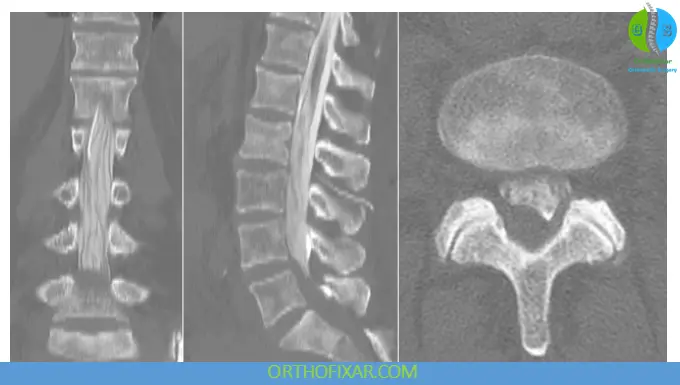
CT Myelogram combines intrathecal contrast injection with computed tomography.
This technique offers:
- Excellent spatial resolution
- Detailed evaluation of bone structures
- Precise localization of nerve root compression
Advantages of CT Myelogram
Benefits include:
- Better assessment of osseous stenosis
- High-resolution imaging
- Useful postoperative evaluation
- Alternative when MRI is contraindicated
Limitations
Limitations include:
- Invasive nature
- Radiation exposure
- Potential contrast-related complications
Complications of Myelography
Although modern contrast agents have significantly improved safety, complications may still occur.
Post-Lumbar Puncture Headache
The most common complication is a low-pressure headache, resulting from cerebrospinal fluid leakage after lumbar puncture.
Symptoms often include:
- Positional headache
- Neck stiffness
- Nausea
- Dizziness
Nausea and Vomiting
These are relatively common adverse reactions following intrathecal contrast administration.
Neurotoxic Reactions
Earlier contrast agents were associated with:
- Muscle spasms
- Myoclonus
- Confusion
- Seizures
These complications were related to neurotoxicity and intracranial migration of contrast material.
Arachnoiditis
Arachnoiditis may occur due to meningeal irritation and inflammatory responses to contrast agents.
Potential manifestations include:
- Chronic pain
- Neurological deficits
- Persistent radicular symptoms
Rare Serious Neurological Complications
Although uncommon, severe neurological complications have been reported, including permanent neurological deficits and seizures. Risk factors may include dehydration, high contrast concentrations, and technical factors during the procedure.
Precautions After Myelography
Following the procedure, patients are often advised to:
- Remain adequately hydrated
- Limit strenuous activity
- Follow post-procedural positioning instructions
- Monitor for neurological symptoms
Historically, patients were frequently kept in an upright position after myelography to reduce complications associated with contrast migration and headache.
Myelography Versus MRI
| Feature | Myelography | MRI |
|---|---|---|
| Invasiveness | Invasive | Noninvasive |
| Radiation | Yes (with CT) | No |
| Soft-tissue detail | Moderate | Excellent |
| Nerve root visualization | Excellent | Excellent |
| Intrathecal contrast | Required | Not usually required |
| Postoperative evaluation | Useful | Useful |
| MRI contraindications | Suitable alternative | Limited |
MRI has largely replaced conventional myelography for routine spinal imaging because of its superior soft-tissue contrast and noninvasive nature. However, myelography continues to provide valuable diagnostic information in selected patients.
Current Clinical Role of Myelography
Modern indications include:
- MRI contraindications
- Complex spinal stenosis
- Persistent radiculopathy
- Postoperative spinal assessment
- Dynamic nerve root evaluation
- CT myelography planning
In these settings, myelography remains a useful adjunct to MRI and CT imaging.
Key Points
- Myelography is an imaging technique that visualizes the spinal canal after intrathecal contrast injection.
- It was once the primary method for diagnosing disc herniation and spinal canal lesions.
- MRI has largely replaced myelography because it is noninvasive and provides superior soft-tissue imaging.
- Myelography remains valuable for evaluating nerve root lesions, spinal stenosis, and patients who cannot undergo MRI.
- Metrizamide improved safety compared with older agents, but modern nonionic contrast media offer even fewer complications.
- Common complications include headache, nausea, and vomiting, while serious neurological complications are rare.
- CT myelography remains an important diagnostic tool in selected spinal disorders.
References & More
- Killebrew K, Whaley RA, Hayward JN, Scatliff JH. Complications of metrizamide myelography. Archives of Neurology. 1983. Pubmed
- Meador K, Hamilton WJ, El Gammal TA, et al. Irreversible neurologic complications of metrizamide myelography. Neurology. 1984. Pubmed
- Pomerantz SR. Myelography: modern technique and indications. Handb Clin Neurol. 2016;135:193-208. doi: 10.1016/B978-0-444-53485-9.00010-6. PMID: 27432666. Pubmed
- Miller GM, Krauss WE. Myelography: still the gold standard. AJNR Am J Neuroradiol. 2003 Mar;24(3):298. PMID: 12637270; PMCID: PMC7973597. Pubmed