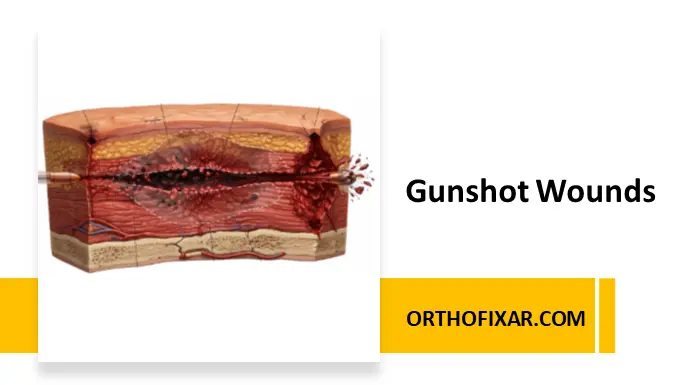
Gunshot wounds (GSWs) represent complex traumatic injuries with highly variable clinical presentations. Their severity depends on ballistic characteristics, tissue interaction, and anatomical location. Understanding the physics of injury and evidence-based management principles is essential for optimal patient outcomes.
Ballistics and Classification
Velocity Categories
- Low-velocity (< 2,000 ft/s)
- Typically handguns
- Cause localized tissue damage
- High-velocity (> 2,000 ft/s)
- Military and most hunting rifles
- Produce extensive tissue destruction due to higher energy transfer
Shotgun Injuries
Wounding potential depends on:
- Choke (dispersion pattern)
- Load (pellet size)
- Distance from target (critical determinant of spread and penetration)
Energy Transfer and Wound Mechanics
The severity of a gunshot wound is governed by kinetic energy (KE):
KE=1/2*mv2
Where:
- m = mass of projectile
- v = velocity
Key Determinants of Energy Transfer
- Striking energy (energy at impact)
- Exit energy (residual energy after passage)
- Projectile behavior:
- Tumbling
- Deformation
- Fragmentation
High-velocity projectiles transfer significantly more energy due to the squared relationship with velocity, resulting in disproportionately greater tissue injury.
Tissue Interaction and Cavitation
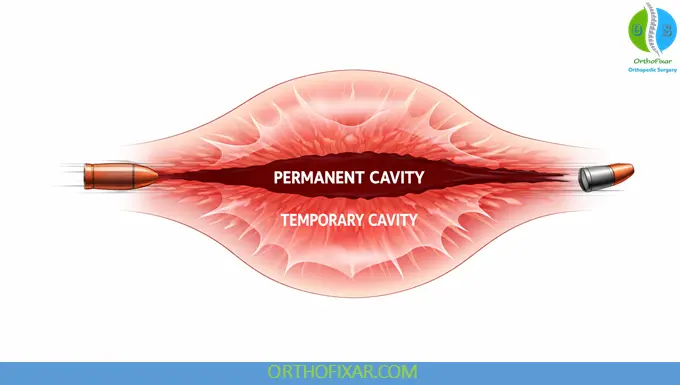
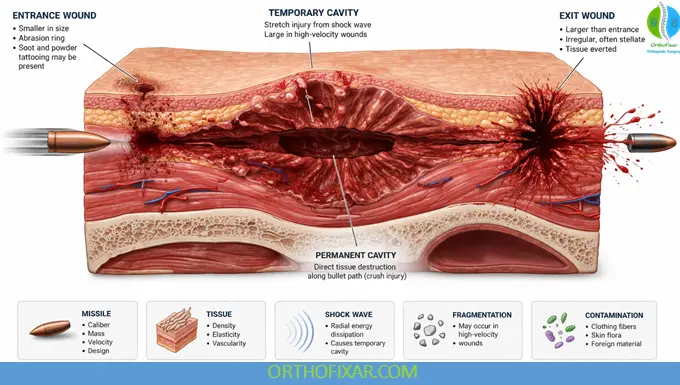
Permanent Cavity
- Direct tissue destruction along the bullet path
- Caused by crush injury
- Typically narrow and well-defined
Temporary Cavity
- Produced by shock wave and energy dissipation
- Causes radial tissue stretching
- Much larger in high-energy injuries
Tissue-Specific Effects
- High-density tissues (e.g., bone, liver) → greater damage
- Air-filled structures (e.g., lungs) → injury often limited to direct path
- Fluid-rich tissues (e.g., muscle, liver) → extensive cavitation and distant damage
A transient vacuum effect may draw debris (e.g., clothing, bacteria) into the wound, contributing to contamination.
See Also: Soft Tissue Injury
Clinical Evaluation
Management follows Advanced Trauma Life Support principles:
Primary Considerations
- Airway, breathing, circulation stabilization
- Hemodynamic assessment
Local Examination
- Neurovascular evaluation is critical
Wound Characteristics
- Entrance wound:
- Small, circular
- Surrounding abrasion ring
- Possible soot, tattooing, or muzzle imprint
- Exit wound:
- Larger, irregular
- Stellate or slit-like appearance
Radiographic Evaluation
- Standard anteroposterior (AP) and lateral radiographs
- CT imaging if:
- Complex fractures
- Suspected vascular or visceral injury
Fracture Patterns
- Low-velocity injuries: nondisplaced or minimally displaced fractures
- High-velocity injuries: comminuted, unstable fractures
Orthopedic Treatment of Gunshot Wounds
A. Low-Velocity Injuries
Initial Management
- First-generation cephalosporin antibiotics
- Tetanus prophylaxis
- Irrigation and local wound debridement
Indications for Operative Debridement
- Intra-articular involvement
- Vascular injury
- Gross contamination
- Compartment syndrome
- Retained fragments in critical locations (e.g., subarachnoid space)
- Severe soft tissue damage
Fracture Treatment
- Stable → conservative management
- Unstable → surgical fixation
B. High-Velocity and Shotgun Injuries
Managed as high-energy trauma:
- Broad antibiotic coverage
- Extensive and repeated surgical debridement
- Fracture stabilization (external or internal fixation)
- Delayed wound closure
- Skin grafts
- Flap reconstruction
Special Scenario: Abdominal Gunshot Wounds
- Require:
- Debridement of missile tract
- Broad-spectrum antibiotics (gram-negative + anaerobic coverage)
Complications
Retained Bullet Fragments
- Usually well tolerated
- Removal indicated if:
- Symptomatic
- Intra-articular
- Infected
- Located in palms/soles
Infection
- Not sterile injuries
- Sources:
- Skin flora
- Clothing debris
- Gastrointestinal contamination
Complications include:
- Abscess
- Osteomyelitis
Neurovascular Injury
- More common in high-velocity wounds
- Mechanisms:
- Direct disruption
- Cavitation-induced traction or avulsion
Clinical spectrum:
- Neuropraxia → complete vascular transection
Lead Toxicity
- Occurs with retained fragments in:
- Joints
- Cerebrospinal fluid
Effects:
- Chronic synovitis
- Systemic lead poisoning
→ Indication for surgical removal
Key Clinical Pearls
- Velocity is the dominant determinant of injury severity
- Temporary cavitation explains damage beyond the bullet track
- All gunshot wounds should be considered contaminated
- Surgical decision-making depends on energy transfer, tissue damage, and anatomical involvement
- Early debridement and appropriate antibiotics significantly reduce complications
References & More
- Baum GR, Baum JT, Hayward D, MacKay BJ. Gunshot Wounds: Ballistics, Pathology, and Treatment Recommendations, with a Focus on Retained Bullets. Orthop Res Rev. 2022 Sep 5;14:293-317. doi: 10.2147/ORR.S378278. PMID: 36090309; PMCID: PMC9462949. Pubmed
- Shrestha R, Kanchan T, Krishan K. Gunshot Wounds Forensic Pathology. [Updated 2023 Apr 17]. In: StatPearls [Internet]. Treasure Island (FL): StatPearls Publishing; 2026 Jan-. Available from: Pubmed
- Egol KA. Handbook of fractures. 6th ed. Philadelphia: Lippincott Williams & Wilkins; 2019.