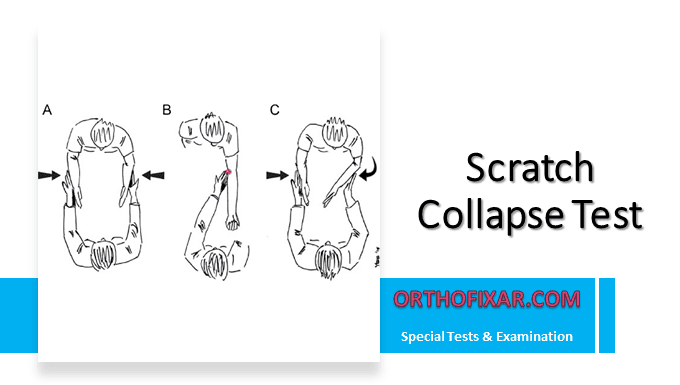
The Scratch Collapse Test (SCT) represents an innovative diagnostic technique in identifying nerve compression syndromes. First described by Susan E. Mackinnon and colleagues in 2008, this test offers a relatively simple yet powerful clinical assessment tool that can supplement traditional diagnostic methods for various nerve entrapment conditions.
The clinical applications of the Scratch Collapse Test extend across a variety of nerve compression syndromes. Carpal tunnel syndrome represents perhaps the most common application, where the median nerve is assessed at the wrist. However, the test demonstrates remarkable versatility in identifying other entrapment neuropathies including cubital tunnel syndrome (ulnar nerve at the elbow), tarsal tunnel syndrome (tibial nerve at the ankle), and even thoracic outlet syndrome. This broad applicability makes it a valuable addition to the diagnostic toolkit for medical professionals specializing in neurology, orthopedics, physical medicine, and rehabilitation.
How to perform the Scratch Collapse Test?
The principle underlying the Scratch Collapse Test is remarkably straightforward, yet its clinical utility is substantial. During the examination, the patient sits with their arms flexed at the elbows and their wrists in neutral position, while actively resisting internal rotation pressure applied by the examiner. The clinician then lightly scratches or strokes the skin over the suspected area of nerve compression.
A positive test is indicated by a momentary loss of resistance to external rotation pressure immediately following stimulation of the compressed nerve segment.
What distinguishes the Scratch Collapse Test from conventional assessment methods is its proposed neurophysiological basis. The test likely functions through cutaneous afferent stimulation that temporarily augments the inhibitory effect of the compressed nerve segment. This phenomenon results in a brief reduction in muscle strength that manifests as the characteristic “collapse” response. This mechanism differs fundamentally from tests like Tinel’s sign or Phalen’s maneuver, providing complementary diagnostic information.

Scratch Collapse Test for the Radial Nerve
Scratch Collapse Test for the Radial Nerve is performed with the patient is in sitting with the upper arm by the side, elbow flexed to 90°, and the forearm and wrist in neutral. The examiner faces the patient and applies an isometric force to resist the patient who attempts to do wrist extension and thumb/ index finger extension. The amount of resistance by the examiner is just enough to “balance” the contractions of the patient.
The patient then relaxes while the examiner strokes or scratches where the radial nerve moves from the posterior to the anterior compartment at the lateral elbow as it passes through the lateral intermuscular septum or fascia. Following the stroking, the examiner quickly tests the patient’s wrist extension and thumb/index finger extension isometric strength again. If they are weak, it is a positive sign of radial neuropathy.
Scratch Collapse Test for the Ulnar Nerve
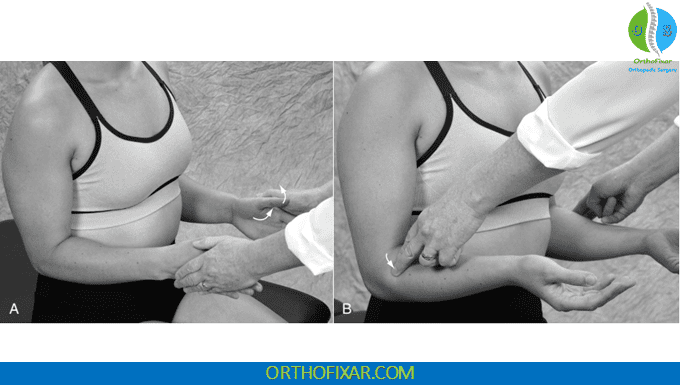
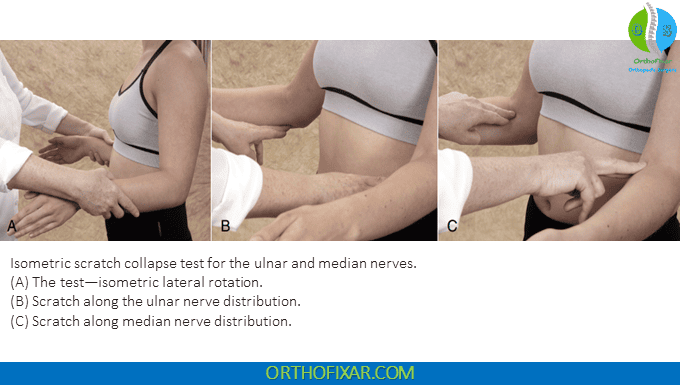
Scratch Collapse Test for the Ulnar and Median Nerves (MacKinnon’s Scratch Collapse Test) is performed with the patient stands with the elbows flexed to 90° by the side (i.e., the shoulders in neutral at the side of the body and forearms and wrists in neutral), fingers in full extension, and the patient’s back not leaning against anything. The patient is asked to laterally rotate and abduct the forearms against isometric resistance provided by the examiner, which is a balanced force; the patient then relaxes.
The examiner then scratches along the course of the ulnar nerve at the elbow or anywhere along its path and then asks the patient to again resist the movement against isometric resistance for at least 2 to 3 seconds.
If the patient shows weakness on the second isometric lateral rotation movement on the affected side, the test is considered positive for an ulnar nerve neuropathy. It is important that the patient keep the elbows tight against the sides. If the patient starts to abduct the arms, the patient is trying too hard or the resisting force by the examiner is too great.
Scratch Collapse Test for the Median Nerve
A similar test may be used to test the median nerve in the forearm, especially if anterior interosseous nerve syndrome, pronator syndrome, or carpal tunnel syndrome are suspected. In this case, the stroking is over the median nerve distribution. Davidge et al. put forth the idea of a “hierarchical” scratch collapse test. The idea of the test was to try to determine where the nerve was compromised. For example, the ulnar nerve may be compromised in the cubital tunnel, when passing through flexor carpi ulnaris, in Guyon canal (antebrachial fascia), in the hand (deep motor branch of the ulnar nerve), in the Arcade of Struthers, at the brachial plexus (thoracic outlet), and parascapular muscles.
If the examiner did the test at each site and sprayed ethyl chloride (i.e., freeze spray) over each site after finding a positive test, the test at that position would become negative. By testing each site, the examiner could determine where the problem is.
Test Reliability
The sensitivity and specificity of the Scratch Collapse Test have been evaluated in several clinical studies. Research suggests that when properly performed, the test demonstrates commendable diagnostic accuracy, particularly when combined with other clinical assessments. A 2014 study by Makanji and colleagues reported that the Scratch Collapse Test exhibited 82% sensitivity and 73% specificity for carpal tunnel syndrome, comparing favorably with traditional tests. For cubital tunnel syndrome, some studies have suggested even higher sensitivity values approaching 89%, though specificity tends to be somewhat lower.
Correct technique is essential for maximizing the diagnostic value of the Scratch Collapse Test. The patient should be positioned with shoulders in neutral rotation, elbows flexed to approximately 90 degrees, and forearms in neutral pronation-supination. The examiner must apply consistent, moderate external rotation force before and after scratching the area of suspected compression. The scratch stimulus should be delivered as a single, firm stroke rather than repetitive light touches. Additionally, the examiner should avoid providing visual cues to the patient regarding the timing of the scratch stimulus, as this may inadvertently influence the response.
Several practical considerations merit attention when incorporating the Scratch Collapse Test into clinical practice:
- First, the test requires proper patient understanding and cooperation, as active muscle resistance is necessary.
- Second, examiner experience significantly influences test reliability, suggesting a learning curve that practitioners should acknowledge.
- Third, the test may occasionally yield false-positive results in anxious patients or those with poor concentration.
- Finally, like all clinical assessments, the Scratch Collapse Test should be interpreted within the broader context of the patient’s history, physical examination findings, and appropriate diagnostic studies.
Despite its clinical utility, the Scratch Collapse Test has certain limitations. The test is inherently subjective, depending on both the examiner’s perception of resistance changes and the patient’s ability to maintain consistent muscle effort. Furthermore, the neurophysiological mechanisms underlying the test remain incompletely characterized, warranting additional basic science research. Some practitioners have also noted variable reproducibility between examiners, suggesting that standardization of technique remains an important consideration for widespread adoption.
Integration of the Scratch Collapse Test with electrodiagnostic studies represents an important clinical consideration. While the SCT provides valuable information about the anatomical location of nerve compression, electrodiagnostic testing offers complementary data regarding the severity and chronicity of neural dysfunction. Research suggests that combining these approaches may enhance diagnostic accuracy and help guide treatment decisions, particularly in cases where multiple compression sites are suspected or when clinical findings are equivocal.
The Scratch Collapse Test demonstrates particular value in certain clinical scenarios: identifying the primary site of compression in patients with double-crush syndrome or multiple potential entrapment points; differentiating between various etiologies of extremity pain or paresthesia; monitoring treatment response in conservatively managed compression neuropathies; and determining the specific location for targeted interventions such as corticosteroid injections or surgical release.
Future directions for research on the Scratch Collapse Test include further elucidation of its neurophysiological basis, development of standardized protocols to enhance inter-examiner reliability, assessment of its prognostic value in predicting treatment outcomes, and exploration of its utility in less common compression neuropathies. As our understanding of this clinical tool continues to evolve, its role in the diagnostic algorithm for nerve compression syndromes will likely become increasingly refined.
The Scratch Collapse Test represents an important addition to the physical examination repertoire for medical professionals who evaluate and treat nerve compression syndromes. By incorporating this straightforward yet insightful assessment into routine clinical practice, practitioners can enhance their diagnostic capabilities and potentially improve patient outcomes through more precise identification of nerve entrapment sites. As with any clinical assessment tool, its greatest value emerges when thoughtfully integrated with comprehensive history-taking, thorough physical examination, and judicious use of confirmatory studies.
Resources
- Cheng CJ, Mackinnon-Patterson B, Beck JL, Mackinnon SE. Scratch collapse test for evaluation of carpal and cubital tunnel syndrome. J Hand Surg Am. 2008;33(9):1518-1524. Pubmed
- Makanji HS, Becker SJ, Mudgal CS, Jupiter JB, Ring D. Evaluation of the scratch collapse test for the diagnosis of carpal tunnel syndrome. J Hand Surg Eur Vol. 2014;39(2):181-186. Pubmed
- Brown JM, Yee A, Mackinnon SE. Distal median to ulnar nerve transfers to restore ulnar motor and sensory function within the hand: technical nuances. Neurosurgery. 2009;65(5):966-978. Pubmed
- Gillenwater J, Cheng J, Mackinnon SE. Evaluation of the scratch collapse test in peroneal nerve compression. Plast Reconstr Surg. 2011;128(3):933-939. Pubmed
- Hagert E, Hagert C-G. Upper extremity nerve entrapments: the axillary and radial nerves – clinical diagnosis and surgical treatment. Plast Reconstr Surg. 2014;134(1):71–80. PubMed
- Hagert E, Curtin C. Failed carpal tunnel release: recognizing the patterns and causes. J Hand Surg Am. 2021;46(8):697-707.