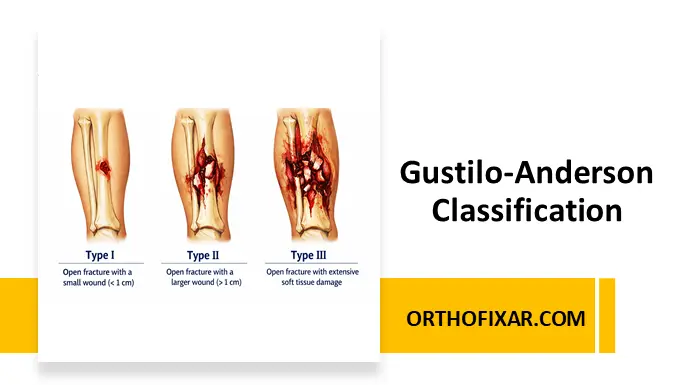
The Gustilo-Anderson classification remains the most widely used system for categorizing open fractures based on wound size, soft tissue damage, and fracture pattern. Open fractures, also known as compound fractures, occur when a broken bone communicates with the external environment through a wound in the skin. These injuries are associated with an increased risk of infection, non-union, and soft tissue complications, making proper classification essential for guiding treatment.
Overview of the Gustilo Classification
The Gustilo-Anderson system, first described in 1976 and later refined, stratifies open fractures into three main types with further subdivisions, guiding both surgical management and prognosis.
Gustilo Type I
- Definition: Clean wound, less than 1 cm in length.
- Characteristics: Minimal soft tissue damage, low-energy trauma.
- Fracture pattern: Usually simple (transverse or short oblique).
- Risk of infection: Low (approximately 0–2%).
- Management: Early debridement and stabilization; primary closure is often possible.
Gustilo Type II
- Definition: Wound greater than 1 cm, without extensive soft tissue damage.
- Characteristics: Moderate trauma; no significant contamination.
- Fracture pattern: Usually simple or moderate comminution.
- Risk of infection: Moderate (2–7%).
- Management: Thorough debridement, stabilization, delayed or primary closure depending on tissue viability.
Gustilo Type III
- Definition: High-energy injuries with extensive soft tissue damage, often highly contaminated.
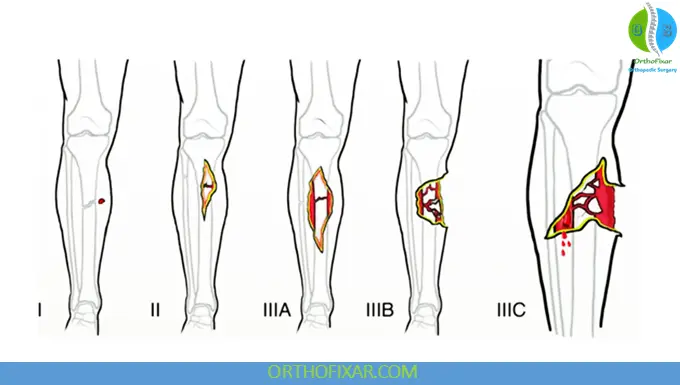
- Subtypes:
- Type IIIA: Adequate soft tissue coverage despite extensive fracture.
- Type IIIB: Extensive periosteal stripping and soft tissue loss requiring flap coverage.
- Type IIIC: Open fracture with associated arterial injury requiring repair.
- Risk of infection: High (10–50%), especially in IIIB and IIIC.
- Management: Aggressive irrigation and debridement, skeletal stabilization, and soft tissue reconstruction (e.g., skin grafts or flaps). Vascular repair is critical in IIIC fractures.
See Also: Open Fractures
| Type | Characteristics |
|---|---|
| I | <1 cm, clean, minimal damage |
| II | >1 cm, moderate soft tissue injury |
| IIIA | Severe injury but adequate bone coverage |
| IIIB | Bone exposed, requires flap coverage |
| IIIC | Associated vascular injury requiring repair |
Clinical Importance
The Gustilo-Anderson classification helps guide:
- Surgical timing and approach: Type I and II fractures may be managed with early closure; Type III often requires staged procedures.
- Antibiotic therapy: The classification informs the duration and spectrum of antibiotics.
- Prognosis: Infection rates and healing potential correlate strongly with fracture type.
Evidence: Studies published on PubMed consistently demonstrate that higher Gustilo Classification types are associated with increased risk of infection, non-union, and prolonged recovery, emphasizing the need for accurate classification at initial assessment.
References
- Gustilo RB, Anderson JT. Prevention of infection in the treatment of one thousand and twenty-five open fractures of long bones: Retrospective and prospective analyses. J Bone Joint Surg Am. 1976;58:453–458. Pubmed
- Gustilo RB, Mendoza RM, Williams DN. Problems in the management of type III (severe) open fractures: A new classification of type III open fractures. J Trauma. 1984;24:742–746. Pubmed
- Court-Brown CM, McQueen MM. Infection after open fractures: A review of 70 cases. Injury. 2008;39:1387–1393.
- Patzakis MJ, Wilkins J. Factors influencing infection rate in open fracture wounds. Clin Orthop Relat Res. 1989;243:36–40. Pubmed
- Egol KA. Handbook of fractures. 6th ed. Philadelphia: Lippincott Williams & Wilkins; 2019.

[…] See Also: Gustilo-Anderson Classification […]
청주출장마사지