Standing flexion test (also called Piedallu test) is used to assess sacroiliac joint dysfunction. It is designed to evaluate relative motion between the innominates and the sacrum during trunk flexion to detect asymmetry that may indicate altered pelvic or SI joint mobility.
The test is widely used in orthopedic, physiotherapy, osteopathic, and manual therapy examinations. While not diagnostic on its own, it helps identify which SI joint may be hypomobile or dysfunctional and guides further assessment.
Clinical Purpose of the Standing Flexion Test
The Standing Flexion Test helps clinicians:
- Detect asymmetrical SI joint motion
- Identify the side of pelvic restriction
- Screen for sacroiliac joint dysfunction
- Guide manual therapy or further provocation testing
It is considered a motion test, not a pain-provocation test.
How do you do the Standing Flexion Test?
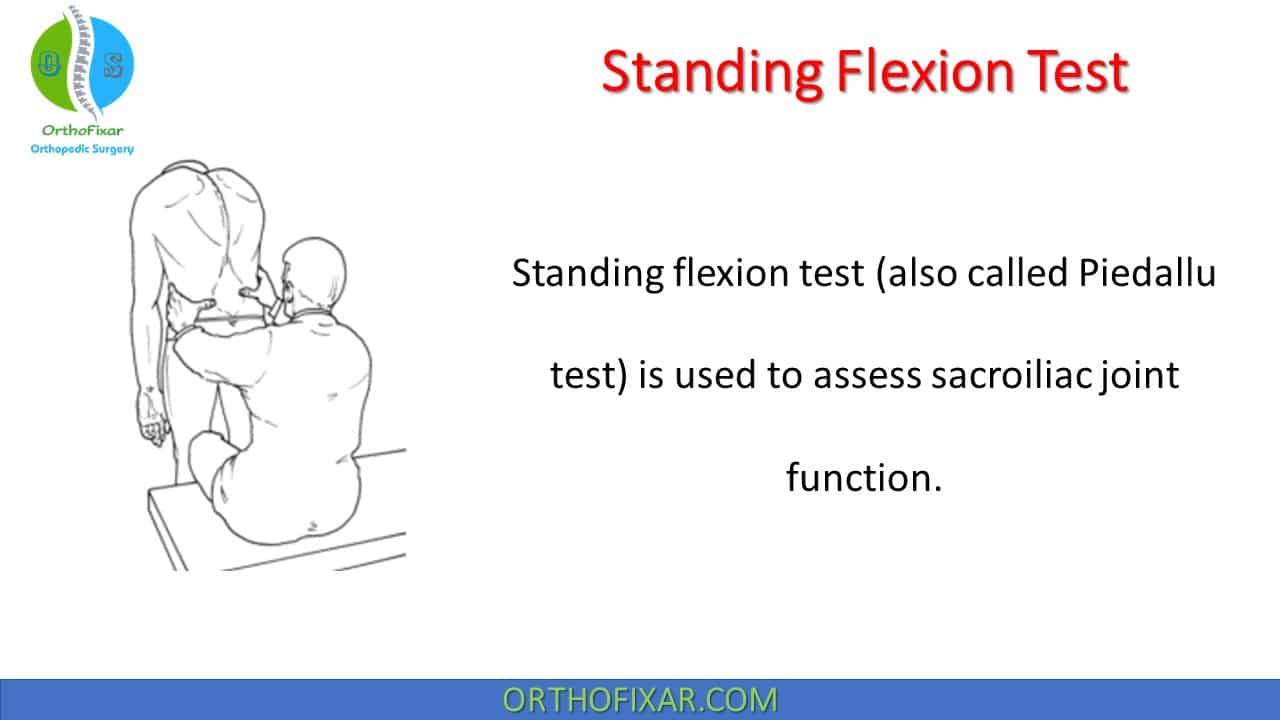
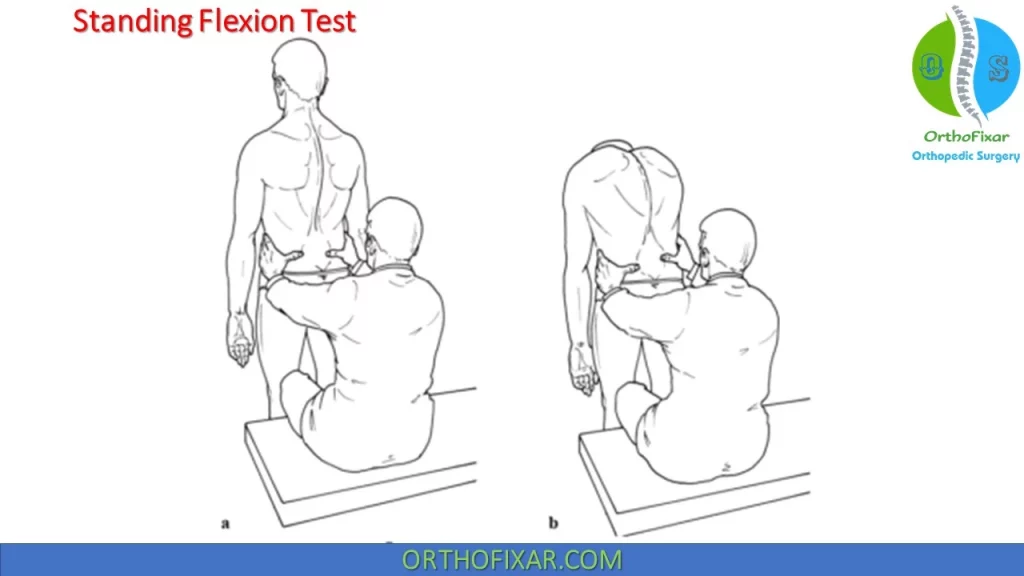
- Standing flexion test is done with the patient stands with his or her back to the examiner.
- The examiner’s thumbs simultaneously palpate both posterior superior iliac spines.
- The patient is asked to slowly bend over while keeping both feet in contact with the floor and the knees extended.
- The examiner observes the position and/or motion of both iliac spines as the patient’s torso bends forward.
See Also: Three-Phase Hyperextension Test
Biomechanical Basis of the Standing Flexion Test
- The sacrum rotates relative to the ilia around a horizontal axis in the sacroiliac joints, this motion is referred to as “nutation.”
- In normal patients with mobile sacroiliac joints, the two posterior superior iliac spines will be level with each other throughout the range of motion when the patient bends over.
- If nutation does not occur in the sacroiliac joint on one side, the posterior superior iliac spine on that side will come to rest farther superior with respect to the sacrum than the spine on the contralateral side.
- Where nutation fails to occur or this relative superior advancement is observed, this is usually a sign of a blockade in the ipsilateral sacroiliac joint.
- Bilateral superior advancement can be simulated by bilateral shortening of the hamstrings.
See Also: Seated Flexion Test
What does a positive Standing Flexion Test mean?
Normal Finding
- Both PSIS move symmetrically and simultaneously upward
Positive Standing Flexion Test
- One PSIS moves earlier or higher than the other
- The side that moves first is interpreted as the restricted or dysfunctional SI joint
This occurs because limited SI mobility forces that hemipelvis to move prematurely during trunk flexion.
Standing Flexion Test Accuracy
The sensitivity and specificity of the standing flexion were poor.
Notes
- When evaluating this superior advancement phenomenon, the examiner must consider or exclude possible asymmetry of the pelvis and hips.
- Pelvic obliquity due to a difference in leg length should be compensated for by placing shims under the shorter leg.
Reference
- Nejati P, Sartaj E, Imani F, Moeineddin R, Nejati L, Safavi M. Accuracy of the Diagnostic Tests of Sacroiliac Joint Dysfunction. J Chiropr Med. 2020 Mar;19(1):28-37. doi: 10.1016/j.jcm.2019.12.002. Epub 2020 Sep 12. PMID: 33192189; PMCID: PMC7646135. Pubmed
- Levangie PK. Four clinical tests of sacroiliac joint dysfunction: the association of test results with innominate torsion among patients with and without low back pain. Phys Ther. 1999 Nov;79(11):1043-57. PMID: 10534797. Pubmed
- Ribeiro RP, Guerrero FG, Camargo EN, Pivotto LR, Aimi MA, Loss JF, Candotti CT. Construct validity and reliability of tests for sacroiliac dysfunction: standing flexion test (STFT) and sitting flexion test (SIFT). J Osteopath Med. 2021 Sep 22;121(11):849-856. doi: 10.1515/jom-2021-0025. PMID: 34551460. Pubmed
- Clinical Tests for the Musculoskeletal System 3rd Edition.
- Dutton’s Orthopaedic Examination, Evaluation, And Intervention 3rd Edition.