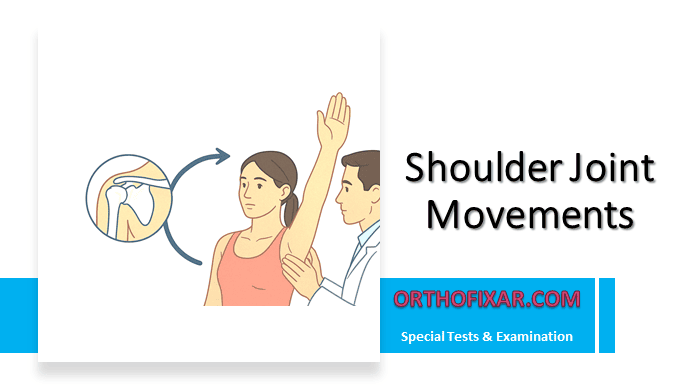
Shoulder joint movements are usually performed with the patient lying supine. The examiner compares the amount of available movement and end feel on the affected side with the movement on the unaffected side and notes whether the movements affect the patient’s symptoms.
Shoulder Joint Movements Techniques
Backward Movement of the Humerus
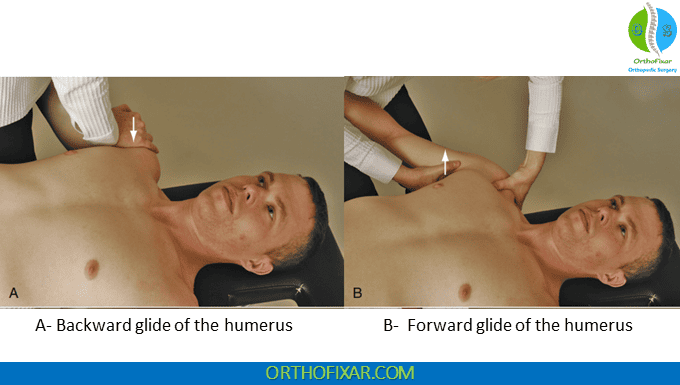
To perform the backward shoulder joint movement of the humerus, the examiner grasps the patient’s upper limb, placing one hand over the anterior humeral head. The other hand is placed around the humerus above and near the elbow while the patient’s hand is held against the examiner’s thorax by the examiner’s arm. The examiner then applies a backward force (similar to a posterior shift), keeping the patient’s arm parallel to the patient’s body so that no rotation or torsion occurs at the glenohumeral joint.
See Also: Shoulder Range of Motion
Forward Movement of the Humerus
Forward shoulder joint movement of the humerus is carried out in a similar fashion with the examiner’s hands positioned appropriately. The examiner applies an anterior force (anterior drawer), keeping the patient’s arm parallel to the body so that no rotation or torsion occurs at the glenohumeral joint.
Lateral Distraction Movement
To apply a lateral distraction shoulder joint movement to the humerus, the examiner positions their hands appropriately and applies a lateral distraction force to the glenohumeral joint with the patient’s arm kept parallel to the body so that no rotation or torsion occurs at the glenohumeral joint. The examiner must be careful to apply the lateral distraction force with the flat of the hand, because one sometimes has a tendency, in applying a force, to turn the hand so that the distraction is applied through the side of the index finger. This is uncomfortable for the patient.
Caudal Glide (Long Arm Traction)
A caudal glide (long arm traction) shoulder joint movement is performed with the patient in the same supine position. The examiner grasps the arm above the patient’s wrist with one hand and palpates with the other hand below the distal spine of the scapula posteriorly and below the distal clavicle anteriorly over the glenohumeral joint line. The examiner then applies a traction force to the shoulder while palpating to see whether the head of the humerus drops down (moves distally) in the glenoid cavity, as it normally should.
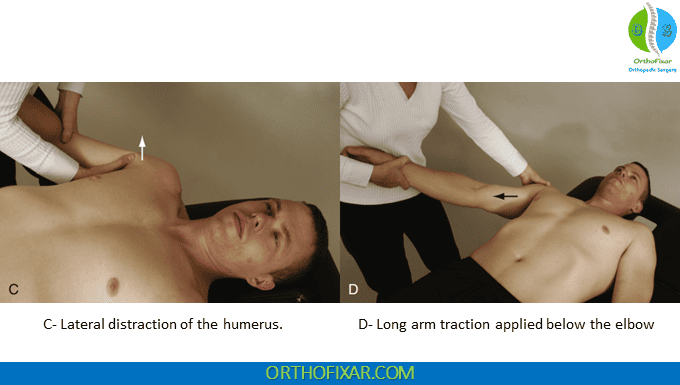
Shoulder Joint Movement in Abduction
The examiner then abducts the patient’s arm to 90°, grasping the arm above the patient’s wrist with one hand while stabilizing the thorax with the other hand. The examiner applies a long arm traction force to determine shoulder joint movement in this position.
With the patient’s arm abducted to 90°, the examiner places one hand over the anterior humerus while stabilizing the patient’s arm with the other hand and stabilizing the patient’s hand against the thorax with the same arm. A backward force is then applied, keeping the patient’s arm parallel to the body. This is a backward shoulder joint movement of the humerus in abduction.
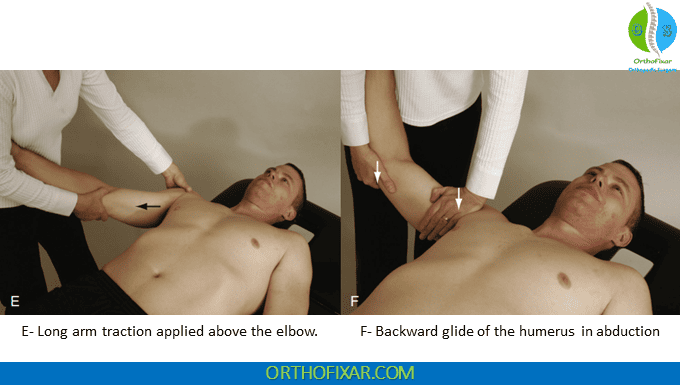
Comprehensive List of Shoulder Joint Movements
Primary Shoulder Joint Movements
- Backward glide of the humerus
- Forward glide of the humerus
- Lateral distraction of the humerus
- Caudal glide of the humerus (long arm traction)
- Backward glide of the humerus in abduction
- Lateral distraction of the humerus in abduction
Associated Joint Movements
- Anteroposterior and cephalocaudal movements of the clavicle at the acromioclavicular joint
- Anteroposterior and cephalocaudal movements of the clavicle at the sternoclavicular joint
- General movement of the scapula to determine mobility
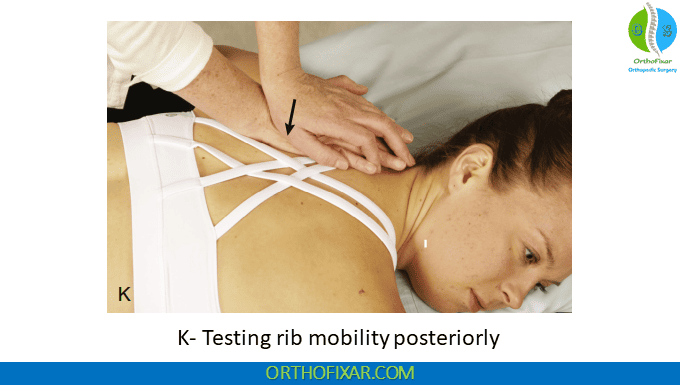
- Ribs – anteroposterior glide, springing
- Thoracic spine – posteroanterior central vertebral pressure (PACVP), posteroanterior unilateral vertebral pressure (PAUVP), transverse vertebral pressure (TVP)
Assessment of Acromioclavicular Joint Movement
To assess the sternoclavicular and acromioclavicular joint movements, the examiner gently grasps the clavicle as close to the joint to be tested as possible and moves it in and out or up and down while palpating the joint with the other hand. Because the bone lies just under the skin, these techniques are uncomfortable for the patient where the examiner grasps the clavicle. The examiner should warn the patient before attempting this technique. A comparison of the amount of movement available is made between the two sides. Care should be taken not to squeeze the clavicle, because this too may cause pain.
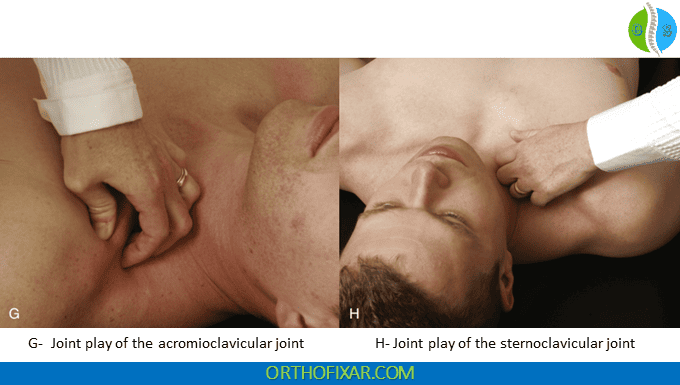
Scapular Movement Assessment
For a determination of mobility of the scapula, the patient lies on one side to fixate the thorax with the arm relaxed and resting behind the low back (hand by opposite back pocket). The uppermost scapula is tested in this position. The examiner faces the patient, placing the lower hand along the medial border of the patient’s scapula. The hand of the examiner’s other arm holds the upper (cranial) dorsal surface of the patient’s scapula.
To relax the scapula further, the patient is asked to relax against the examiner and the examiner uses his or her body to push the patient’s test shoulder posteriorly, retracting it to obtain a better hold on the scapula. By holding the scapula in this way, the examiner is able to move it medially, laterally, caudally, cranially, and away from the thorax.
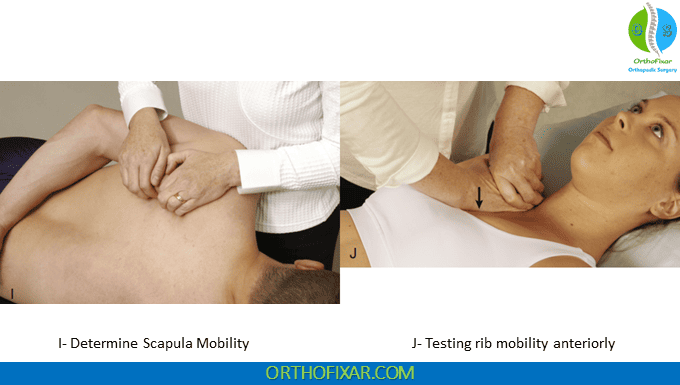
Complementary Assessments
With any shoulder examination, the ribs and spine should be checked for normal mobility, as restrictions in these areas can restrict shoulder movement. To test the mobility of the ribs generally, the examiner can apply anterior rib springing using the side of the thenar eminence of the hand. By pressing down several times, the examiner can compare the bilateral mobility of the ribs.
References & More
- McCausland C, Sawyer E, Eovaldi BJ, et al. Anatomy, Shoulder and Upper Limb, Shoulder Muscles. [Updated 2023 Aug 8]. In: StatPearls [Internet]. Treasure Island (FL): StatPearls Publishing; 2025 Jan-. Available from: https://www.ncbi.nlm.nih.gov/books/NBK534836/
- Kaltenborn EM. Mobilization of the Extremity Joints. Oslo: Olaf Norlis Bokhandle; 1980.
- Gill TK, Shanahan EM, Tucker GR, Buchbinder R, Hill CL. Shoulder range of movement in the general population: age and gender stratified normative data using a community-based cohort. BMC Musculoskelet Disord. 2020 Oct 12;21(1):676. doi: 10.1186/s12891-020-03665-9. PMID: 33046038; PMCID: PMC7549223. Pubmed