Sharpey’s Test is a provocative clinical examination technique used to assess the integrity of the triangular fibrocartilage complex (TFCC) and evaluate for ulnocarpal abutment syndrome. This test is particularly valuable in diagnosing wrist pain originating from the ulnar side of the wrist joint.
The TFCC is a stabilizing structure located on the ulnar aspect of the wrist, consisting of fibrocartilaginous tissue that acts as a shock absorber between the ulna and the carpal bones. Ulnocarpal abutment occurs when there is excessive contact between the ulnar head and the carpus, often due to positive ulnar variance or TFCC tears.
How to Perform the Sharpey’s Test?
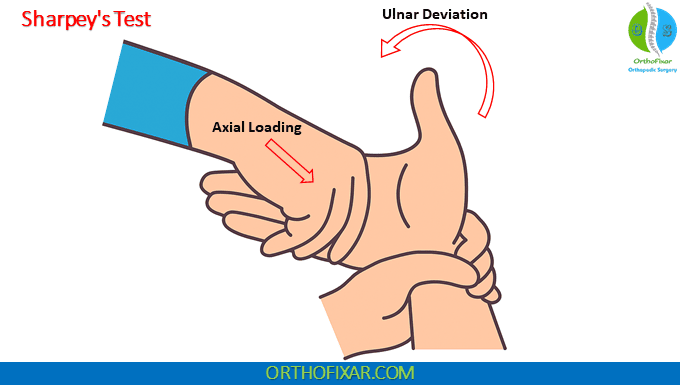
The patient should be seated comfortably with their arm extended and forearm in neutral rotation, with the elbow supported on the examination table for stability. The examiner establishes control using both hands, with one hand firmly grasping the patient’s forearm around the distal radius and ulna, while the other hand holds the patient’s hand securely.
The examiner applies axial loading by compressing along the long axis of the forearm while moving the wrist into ulnar deviation. During this maneuver, the wrist is moved through dorsal and palmar flexion, and the forearm is rotated between pronation and supination. These movements are performed dynamically and in various combinations to stress the TFCC and ulnocarpal joint effectively.
What does a Positive Sharpey’s Test?
A positive Sharpey’s Test is characterized by the reproduction of pain, clicking, or crepitus in the TFCC or ulnocarpal region. The pain may present as sharp, aching, or grinding sensations, while clicking manifests as audible or palpable sounds during the maneuver. Crepitus presents as a grinding or grating sensation felt by both the examiner and patient during the test movements.
This test helps identify TFCC tears or degeneration and assists in diagnosing ulnocarpal abutment syndrome, making it useful for differentiating ulnar-sided wrist pain from other causes. However, the test is not pathognomonic for any single condition and should always be interpreted alongside other clinical findings. It may produce false positives in patients with generalized joint hypermobility and requires correlation with imaging studies for definitive diagnosis.
See Also: Wrist Pain Causes
Sharpey’s Test should be performed as part of a comprehensive wrist examination that begins with a thorough history including the mechanism of injury, duration of symptoms, and aggravating factors. Physical examination should include inspection for swelling, deformity, or muscle atrophy, followed by systematic palpation with particular attention to point tenderness over the TFCC. Range of motion assessment, both active and passive, should be documented, and additional special tests such as the TFCC compression test, piano key sign, and ECU synergy test may provide complementary diagnostic information.
See Also: Wrist & Hand Examination
When Sharpey’s Test is positive, further evaluation typically involves imaging studies, with MRI arthrography serving as the gold standard for TFCC evaluation. Plain radiographs help assess for ulnar variance and bony pathology, while diagnostic injection into the ulnocarpal joint may provide both diagnostic and therapeutic value.
References & More
- Orthopedic Physical Assessment by David J. Magee, 7th Edition.
- Reddy RS, Compson J. Examination of the wrist – soft tissue, joints and special tests. Curr Orthop. 2005;19:180–189.
- Skirven T. Clinical examination of the wrist. J Hand Surg. 1996;9:96–107. PubMed