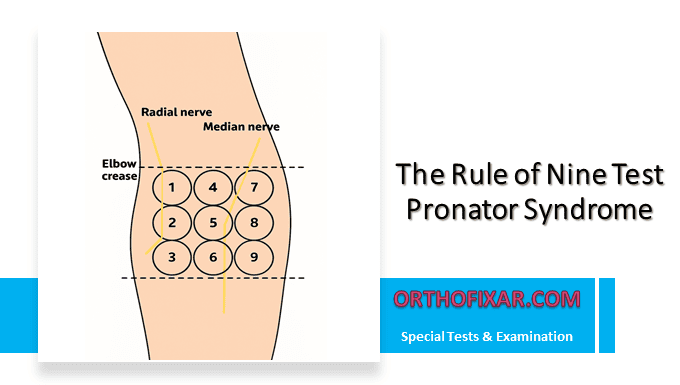
The Rule of Nine Test is a specialized clinical examination technique used to diagnose pronator syndrome, a condition where the median nerve becomes compressed as it passes through the pronator teres muscle in the forearm. This test provides a systematic approach to localizing nerve compression and differentiating it from other causes of forearm pain.
The median nerve travels through the forearm in a predictable pathway, passing between the two heads of the pronator teres muscle. The posterior interosseous nerve runs laterally, while the median nerve follows a central course through the forearm musculature.
How to Perform the Rule of Nine Test?
Patient should be seated comfortably with the affected arm exposed, the elbow must be fully extended and the forearm should be fully supinated (palm facing upward)
- Reference Point: Begin at the elbow crease (antecubital fossa)
- Circle Size: Create nine equal-sized circles using the width of the patient’s fully extended and supinated forearm as the measurement guide
- Grid Layout: Arrange the circles in a 3×3 pattern on the anterior (front) aspect of the forearm
- Three rows extending distally from the elbow
- Three columns: lateral, middle, and medial
- Lateral Column: Contains the pathway of the posterior interosseous nerve
- Middle Column: Contains the pathway of the median nerve
- Medial Column: No major nerve pathway passes through this region
See Also: Median Nerve Anatomy
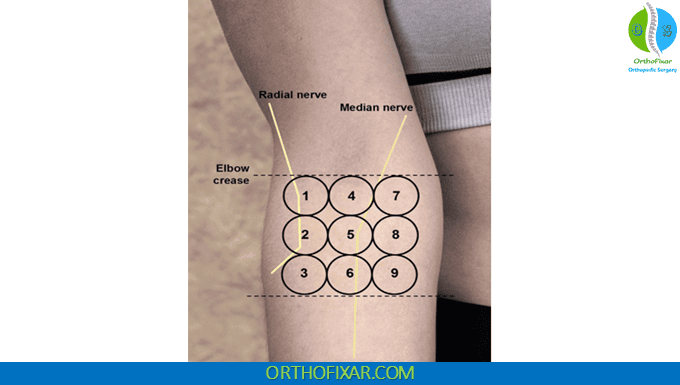
Palpation Technique
- Apply gentle but firm pressure to each of the nine circles systematically
- Hold pressure for up to 30 seconds per circle
- Observe and document patient responses in each location
- Pay particular attention to the middle column where the median nerve travels.
Positive Rule of Nine Test
The Rule of Nine Test becomes positive when palpation along the median nerve pathway (middle column) reproduces:
- Pain matching the patient’s symptoms
- Paresthesia (tingling, numbness, or “pins and needles” sensation)
- Symptoms must appear within 30 seconds of sustained compression
Clinical Interpretation
Pronator Compression Test
When the Rule of Nine Test is positive specifically along the median nerve pathway, it transforms into what is known as the pronator compression test. This indicates probable median nerve compression at the level of the pronator teres muscle.
Differential Diagnosis Considerations
- Lateral column tenderness: May suggest posterior interosseous nerve involvement
- Medial column tenderness: Likely muscular in origin rather than neurological
- Multiple column involvement: May indicate broader pathology requiring further investigation
Clinical Significance
The Rule of Nine Test serves multiple diagnostic purposes:
- Localization: Helps pinpoint the exact location of nerve compression
- Differentiation: Distinguishes between different nerve pathways and their associated pathologies
- Objectivity: Provides a standardized, reproducible examination method
- Documentation: Creates a systematic record of findings for monitoring treatment progress
Limitations and Considerations
Test Limitations
- Requires patient cooperation and accurate symptom reporting
- May be less reliable in patients with generalized forearm tenderness
- Subjective nature of patient responses
- Potential for false positives in hypersensitive patients
Complementary Assessment
The Rule of Nine Test should be used in conjunction with:
- Comprehensive history taking
- Other provocative tests for pronator syndrome
- Neurological examination
- Electrodiagnostic testing when clinically indicated
The Rule of Nine Test represents an elegant, systematic approach to evaluating forearm nerve entrapment syndromes. Its structured methodology allows for consistent application across different examiners while providing valuable diagnostic information. When positive along the median nerve pathway, it becomes the pronator compression test, offering strong evidence for pronator syndrome diagnosis.
References & More
- Smith MV, Lamplot JD, Wright RW, Brophy RH. Comprehensive review of the elbow physical examination. J Am Acad Orthop Surg. 2018;26(19):678–687. PubMed
- Loh YC, Lam WL, Stanley JK, Soames RW. A new clinical test for radial tunnel syndrome–the Ruleof-Nine test: a cadaveric study. J Orthop Surg. 2004;12(1):83–86. PubMed
- Strohl AB, Zelouf DS. Ulnar tunnel syndrome, radial tunnel syndrome, anterior interosseous nerve syndrome and pronator syndrome. J Am Acad Orthop Surg. 2017;25(1):e1–e10. PubMed
- Moradi A, Ebrahimzadeh MH, Jupiter JB. Radial tunnel syndrome, diagnostic and treatment dilemma. Arch Bone Jt Surg. 2015;3(3):156–162. PubMed
- Dang AC, Rodner CM. Unusual compression neuropathies of the forearm, part II: median nerve. J Hand Surg Am. 2009;34(10):1915–1920. PubMed