The McCarthy Test is a clinical maneuver used to evaluate acetabular labral tears and intra-articular hip pathology. It is particularly helpful when assessing patients who present with groin pain, clicking, or mechanical symptoms in the hip.
McCarthy demonstrated that this test mimics normal walking mechanics and can generate up to twice the patient’s body weight across the hip joint. This increased load stresses the acetabular labrum, making it more sensitive for detecting pathology.
See Also: Hip Joint Anatomy
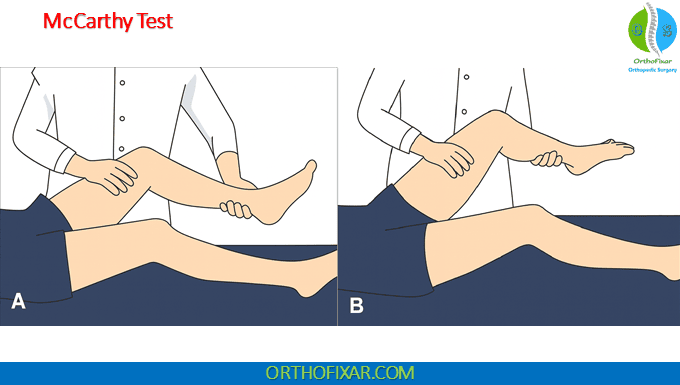
How to perform the McCarthy Test?
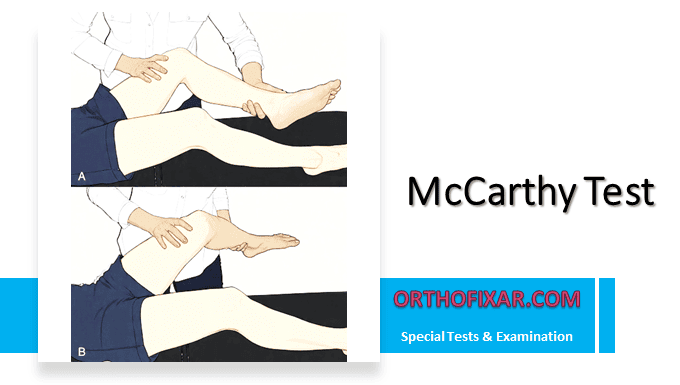
- The patient lies supine on the examination table with both hips fully flexed. This position places the femoral head anteriorly and tensions the acetabular labrum.
- The examiner begins with the unaffected (“good”) hip.
- Keeping the opposite hip fully flexed, the examiner extends the test hip from the flexed position. Extension is performed twice:
- First with the hip in lateral rotation,
- Then with the hip in medial rotation.
- After assessing the good hip, the maneuver is repeated on the affected side using the same sequence:
- Hip flexion → extension in lateral rotation → extension in medial rotation.
- This pattern simulates the arc of movement that occurs during normal gait.
See Also: Hip Range of Motion
What does a Positive McCarthy Test Mean?
The McCarthy test is considered positive when the maneuver reproduces:
- The patient’s characteristic pain (especially groin pain), and/or
- A palpable or audible “pop” during hip extension.
A positive result suggests:
- Possible labral tear
- Intra-articular mechanical dysfunction
- Impingement phenomena within the hip joint.
McCarthy et al. identified three clinical findings that, when positive, strongly suggest acetabular labral involvement:
- Pain with the McCarthy hip extension test: Suggests mechanical irritation of the anterior labrum.
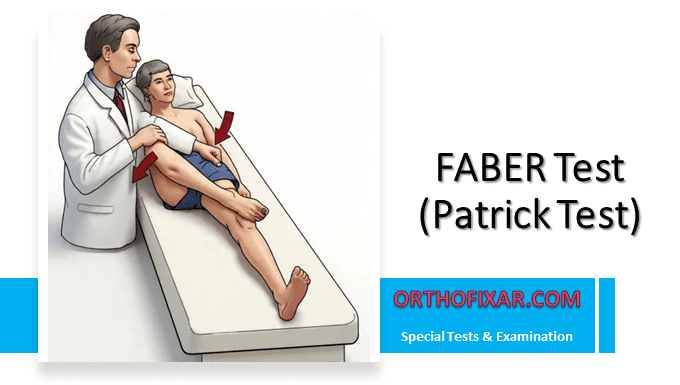
- Painful impingement with hip flexion, abduction, and external rotation: Also known as the Anterior Labral Tear Test or FABER-based impingement test.
- Inguinal pain during resisted straight-leg raising: The Stinchfield Test, indicating intra-articular pain generation.
When these three tests are positive together, the likelihood of an acetabular labral tear is significantly increased.
References & More
- McCarthy JC, Lee J-O. Hip arthroscopy: indications, outcomes, and complications. J Bone Joint Surg Am. 2005;87:1138–1145. PubMed
- Orthopedic Physical Assessment by David J. Magee, 7th Edition.
- Domb BG, Brooks AG, Byrd JW. Clinical examination of the hip joint in athletes. J Sports Rehabil. 2009; 18:3–23.
- Martin HD. Clinical examination of the hip. Oper Techniques Orthop. 2005;15(3):177–181.
- Springer BA, Gill NW, Freedman BA, et al. Acetabular labral tears: diagnostic accuracy of clinical examination by a physical therapist, orthopaedic surgeon, and orthopaedic residents. N Am J Sports Phys Ther. 2009;4(1):38–45. PubMed