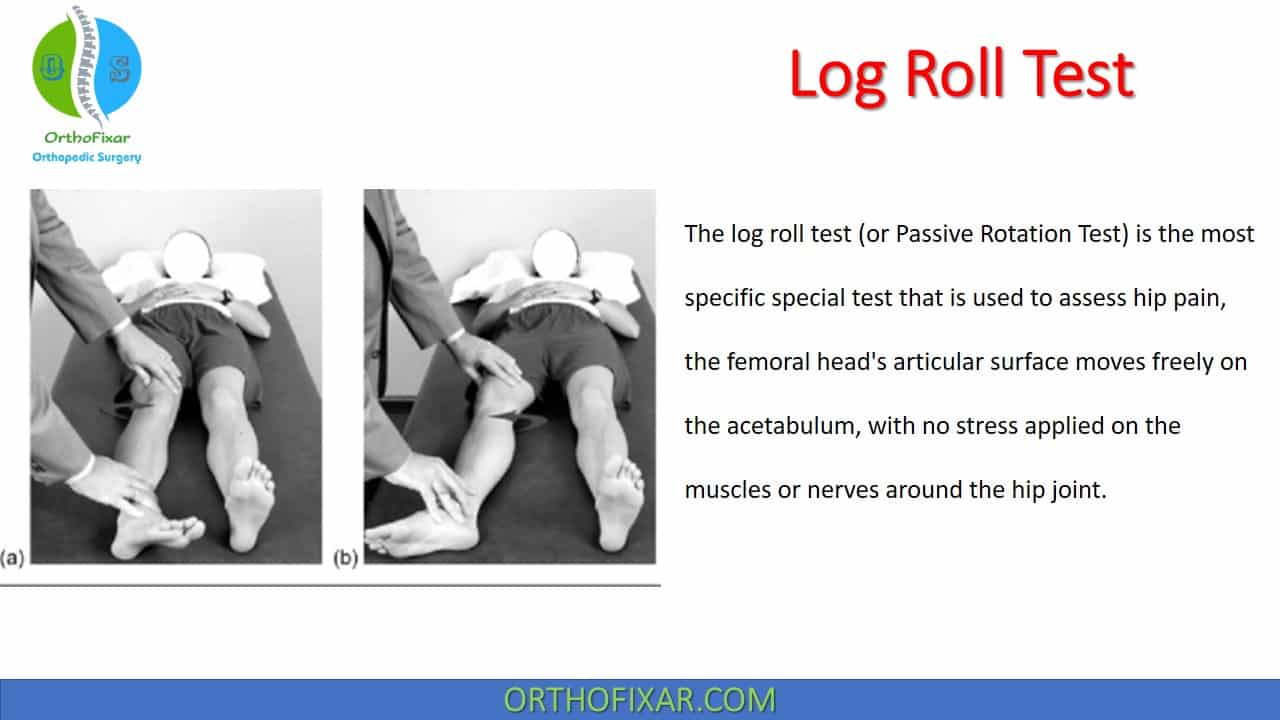
The log roll test (or Passive Rotation Test) is the most specific special test that is used to assess hip pain. This test is often used if an intra-articular problem is suspected, as it does not stress extra-articular tissues, only intra-articular tissues.
The advantage of the test is that only rotation of the femoral head in the acetabulum occurs and only the capsule is stressed but not the surrounding tissues
How do you do the log roll test?
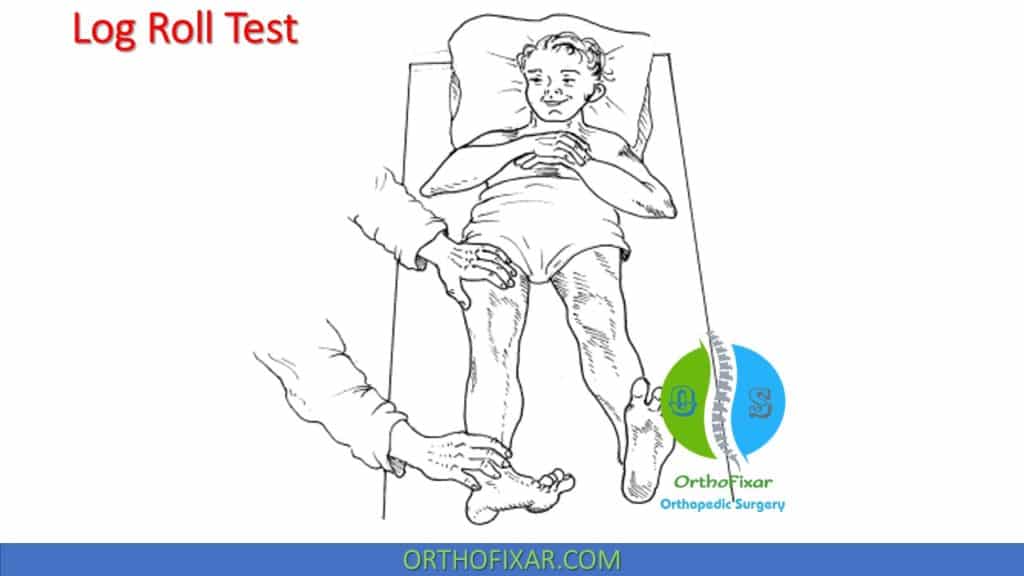
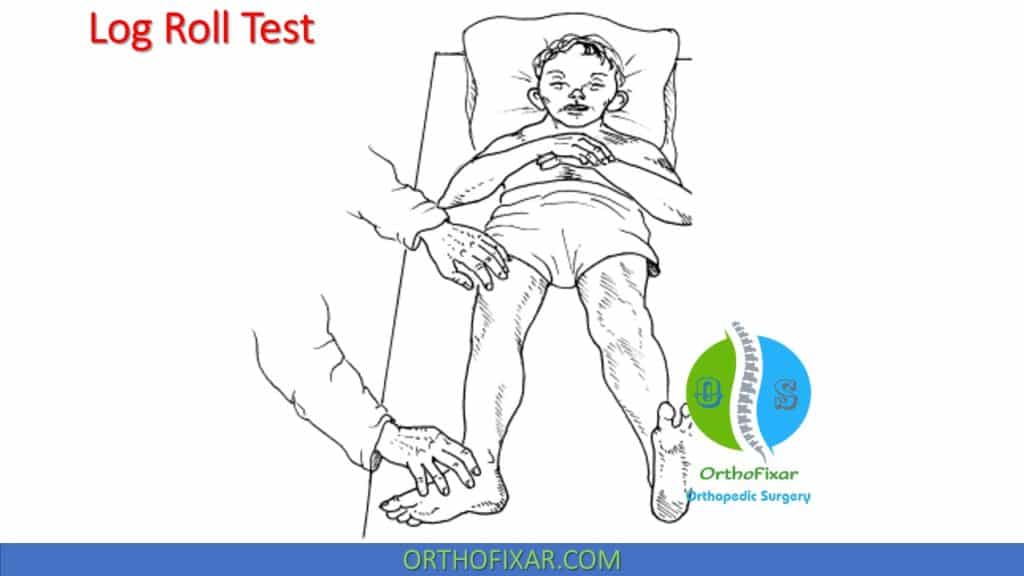
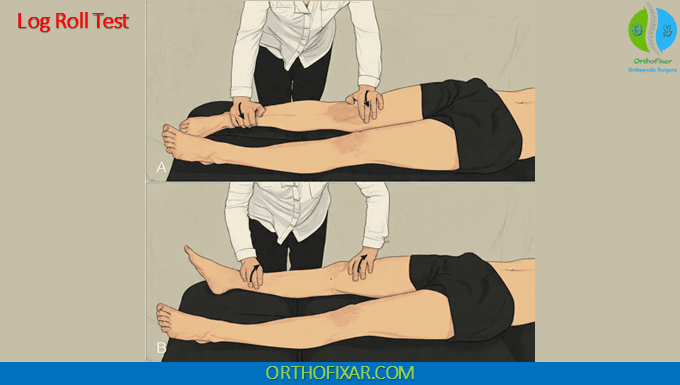
- With the patient supine with both lower extremities extended (i.e., straight),
- the examiner places one hand on the thigh and the other on the ankle and gently rolls the leg back and forth, thus alternately internally and externally rotating the hip,
- During this process, the joint surfaces of the femoral head move within the acetabulum without activating neural or myotendinous structures.
- The log roll test should be compared to the opposite hip.
What does a positive Log Roll Test mean?
Log Roll Test is positive when there is:
- Pain: refers to an intra-articular pathology.
- Clicking: refers to acetabular labral tear.
- Increased range of motion: refers to ligamentous laxity.
Sensitivity & Specificity
A systematic review of the diagnostic physical examination tests of the hip joint found that the log roll test reliability for hip fracture (for femoral neck fractures) was:
- Sensitivity: 100%
- Specificity: 33%
Notes
- The log roll test is used to differentiate the pathologies inside the hip joint from those outside it.
- A negative log roll test does not exclude the hip as a source of symptoms, but a positive test give a high suspicious of hip pathology.
Related Anatomy
The hip articulation is a ball-and-socket joint formed between the head of the femur and the acetabulum of the pelvic bone.
- Structurally, the hip is suited for stability first, then mobility.
- The primary function of the hip is to support the weight of the head, arms, and trunk during the static erect posture and during dynamic activities such as ambulation, running, and stair climbing.
- In addition, the hip joint provides a pathway for the transmission of forces between the pelvis and the lower extremities.
- The hip joint is a marvel of physics, transmitting truly impressive loads, both tensile and compressive. For example,
during walking, the hip supports 1.3–5.8 times the body weight, and 4.5–8 times the body weight while running. - Finally, the hip joint functions to provide a wide range of lower limb movement.
- The hip joint is well designed to provide such an important service, provided that it is permitted to grow and develop normally.
See Also: Pelvic Anatomy
See Also: Hip Joint Anatomy

Reference
- J. W. Thomas Byrd, M.D. Evaluation of the Hip: History and Physical Examination. N Am J Sports Phys Ther. 2007 Nov; 2(4): 231–240. PMID: 21509142.
- Byrd JW. Evaluation of the hip: history and physical examination. N Am J Sports Phys Ther. 2007 Nov;2(4):231-40. PMID: 21509142; PMCID: PMC2953301.
- Rahman LA, Adie S, Naylor JM, Mittal R, So S, Harris IA. A systematic review of the diagnostic performance of orthopedic physical examination tests of the hip. BMC Musculoskelet Disord. 2013 Aug 30;14:257. doi: 10.1186/1471-2474-14-257. PMID: 23987589; PMCID: PMC3766647.
- Clinical Tests for the Musculoskeletal System 3rd Edition.
- Dutton’s Orthopaedic Examination, Evaluation, And Intervention 3rd Edition.
- Orthopedic Physical Assessment by David J. Magee, 7th Edition.