The Lelli Test, also known as the Lever Sign Test, is used to assess the integrity of the anterior cruciate ligament (ACL) of the knee. It is particularly useful in the acute setting, where pain, swelling, or muscle guarding may limit the accuracy of traditional ACL tests such as the Lachman test or Anterior Drawer tests.
The Lelli Test is designed to detect partial or complete tears of the ACL by evaluating the mechanical relationship between the tibia and femur under an applied lever force. Its main advantage lies in its simplicity and reduced dependence on patient relaxation.
How to Perform the Lelli Test?
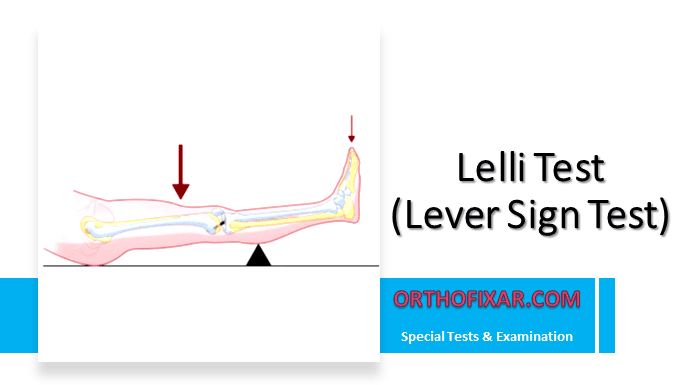
- The patient lies supine on the examination table, and the knee is positioned in full extension. The muscles of the thigh should be as relaxed as possible.
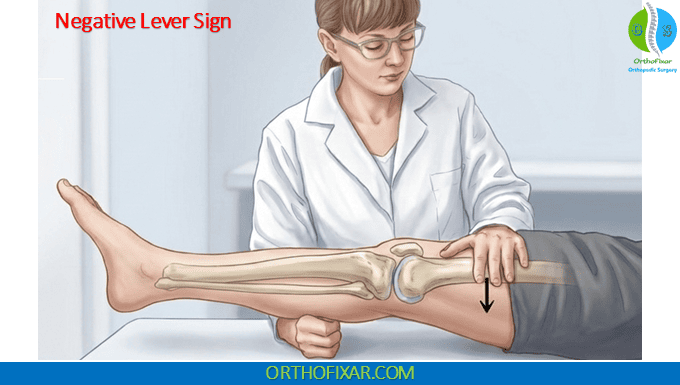
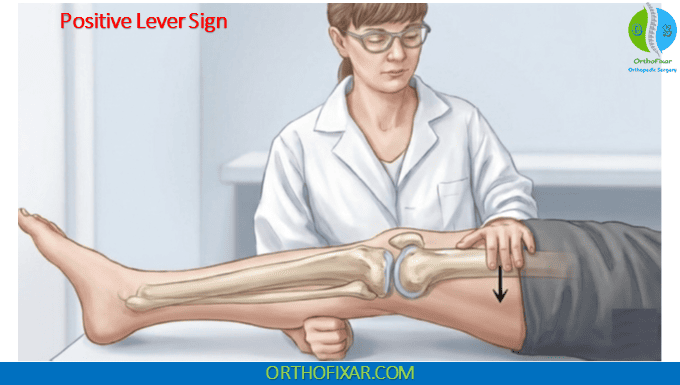
- The examiner places a closed fist under the proximal third of the patient’s calf, creating a slight flexion moment at the knee.
- With the other hand, the examiner applies a slow, moderate downward force to the distal third of the quadriceps, directly over the femur.
- During this maneuver, the examiner carefully observes the relationship between the tibial plateau and the femoral condyles, as well as the movement of the patient’s heel.
See Also: Anterior Drawer Test of the Knee
What does a Positive Lelli Test Mean?
Negative (Normal) Test
- When the ACL is intact, the applied downward force on the femur causes the tibia to act as a lever.
- As a result, the heel lifts off the examination table.
- This indicates normal anterior stability of the knee.
Positive Test
- When the ACL is partially or completely torn, the tibia slides anteriorly relative to the femur.
- The lever mechanism fails, and the heel does not rise from the table.
- This finding is considered a positive Lelli Test, suggesting ACL insufficiency.
Test Accuracy
In one prospective, blinded, diagnostic accuracy study, the Lelli Test has:
- Sensitivity: 38%
- Specificity: 72%
The positive likelihood ratio was 1.4 and negative likelihood ratio was 0.86. The positive predictive value was 47% and the negative predictive value was 63%.
The results of this study suggest that Lever Sign, in isolation, does not accurately detect the status of the ACL. During the clinical examination, the Lever Sign should be used as an adjunct to the gold standard assessment technique of anterior tibial translation assessment as employed in the Lachman tests in either prone or supine position.
In another Cohort study (diagnosis), the overall accuracy of the lever sign test was 77% (63% sensitivity and 90% specificity).
Limitations and Precautions
- The Lelli Test should not be used in isolation to diagnose an ACL tear.
- Results must be correlated with:
- Patient history
- Other physical examination tests (Lachman, Pivot Shift)
- Imaging studies, particularly MRI
- False negatives may occur in partial tears or in patients with altered limb mechanics.
References & More
- Antunes LC, de Souza JM, Cerqueira NB, et al. Evaluation of clinical tests and magnetic resonance imaging for knee meniscal injuries: correlation with video arthroscopy. Rev Bras Ortop. 2017;52(5):582–588. PubMed
- Mulligan EP, Anderson A, Watson S, Dimeff RJ. The diagnostic accuracy of the lever sign for detecting anterior cruciate ligament injury. Int J Sports Phys Ther. 2017;12(7):1057–1067. PubMed
- Jarbo KA, Hartigan DE, Scott KL, et al. Accuracy of the lever sign test in the diagnosis of anterior cruciate ligament injuries. Orthop J Sports Med. 2017;5(10):1–7. PubMed
- Lelli A, Di Turi RP, Spenciner DB, Domini M. The “lever sign”: a new clinical test for the diagnosis of anterior cruciate ligament rupture. Knee Surg Sports Traumatol Arthrosc. 2014;24(9):2794–2797. PubMed
- Lichtenberg MC, Koster CH, Teunissen LP, et al. Does the lever sign test have added value for diagnosing anterior cruciate ligament ruptures? Orthop J Sports Med. 2018;6(3):1–7. PubMed
- Thapa SS, Lamichhane AP, Mahara DP. Accuracy of Lelli test for anterior cruciate ligament tear. J Institute Med. 2015;37(2):91–94.
- Orthopedic Physical Assessment by David J. Magee, 7th Edition.