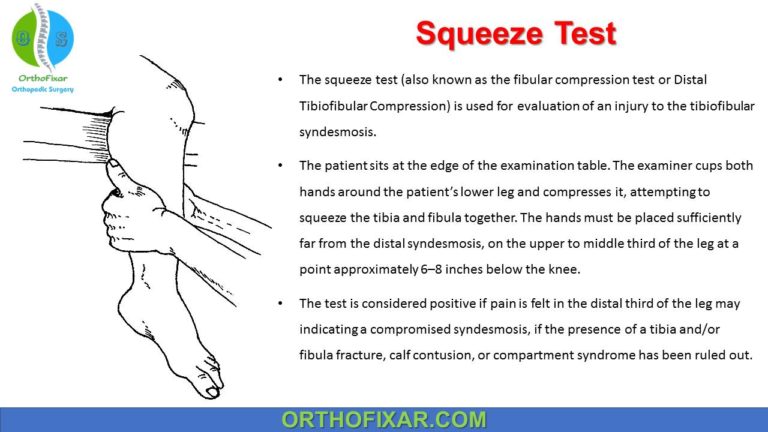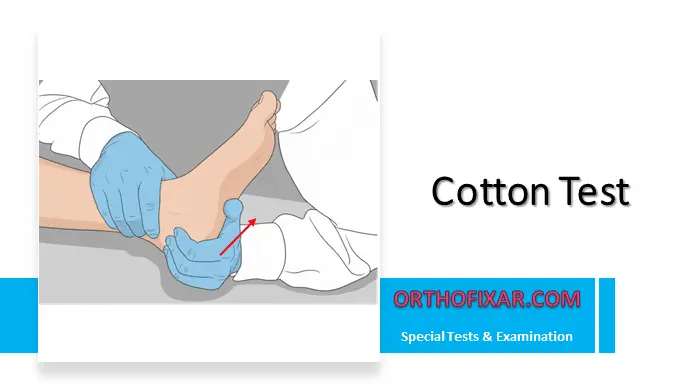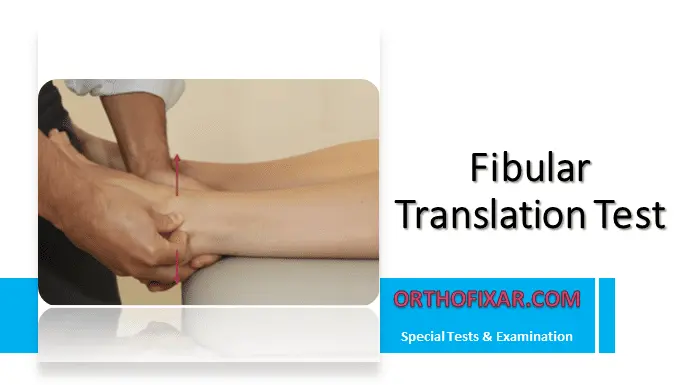
The Fibular Translation Test is a provocative maneuver used to detect instability or injury to the distal tibiofibular syndesmosis. Unlike the Squeeze Test, which relies on proximal compression, this test directly assesses the translation (glide) of the lateral malleolus within the fibular notch of the tibia.
Excessive movement or pain during this translation suggests a tear in the Anterior Inferior Tibiofibular Ligament (AITFL), Posterior Inferior Tibiofibular Ligament (PITFL), or the interosseous membrane.
See Also: Ankle Anatomy
How to Perform the Fibular Translation Test?
- Place the patient in a side-lying position on the unaffected side.
- Stand behind the patient, facing the foot to be examined.
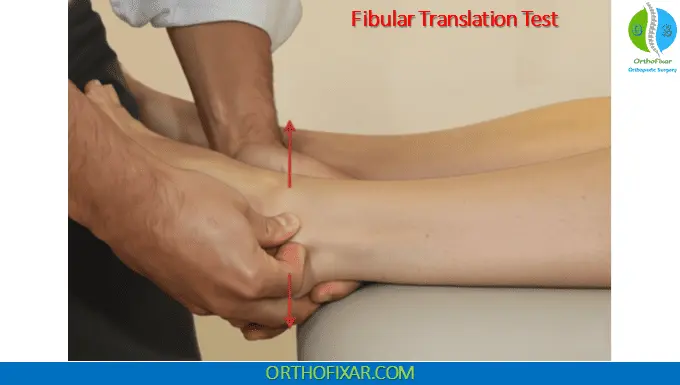
- Use one hand to firmly stabilize the distal tibia.
- With the other hand, grasp the fibular malleolus and translate it anteriorly and posteriorly.
See Also: Syndesmosis Squeeze Test
What is a Positive Fibular Translation Test?
A test is considered positive for a syndesmotic injury if:
- Pain is elicited during the anterior or posterior translation.
- Increased Laxity: There is significantly greater movement (displacement) of the fibula compared to the unaffected contralateral side.
Clinical Note: Always compare bilaterally. Some patients have naturally higher physiological laxity at the distal tibiofibular joint.
Test Accuracy
Research indicates that the Fibular Translation Test is often more sensitive than the Squeeze Test but should be used as part of a “cluster” of tests (including the External Rotation Stress Test and Point Tenderness) to confirm a diagnosis.
- Sensitivity: 75%
- Specificity: 88%
References & More
- Kor A. Dynamic techniques for clinical assessment of the athlete. Clin Podiatr Med Surg. 2015;32(2):217–229. Pubmed
- Beumer A, Swierstra BA, Mulder PG. Clinical diagnosis of syndesmotic ankle instability: evaluation of stress tests behind the curtain. Acta Orthop Scand. 2002;73:667–669. Pubmed
- Cook CE, Hegedus EJ. Orthopedic Physical Examination Tests—An Evidence Based Approach. Upper Saddle River, NJ: Prentice Hall/Pearson; 2008.
- Orthopedic Physical Assessment by David J. Magee, 7th Edition.