The ECU Synergy Test serves as a specialized orthopedic examination technique for evaluating the extensor carpi ulnaris tendon, particularly when tendinitis or instability is suspected. This clinical assessment proves invaluable in diagnosing ECU tendinopathy characterized by dorsal ulnar wrist pain that can substantially compromise grip strength and overall wrist function.
The extensor carpi ulnaris muscle originates from the lateral epicondyle of the humerus and the posterior border of the ulna, with its tendon coursing through the sixth dorsal compartment at the wrist. This tendon is secured within a fibro-osseous tunnel formed by the groove on the ulnar head and the overlying extensor retinaculum. The ECU functions synergistically with the flexor carpi ulnaris to provide both ulnar deviation and essential wrist stabilization during various hand activities.
See Also: Wrist Anatomy: Bones, Ligaments & Joints
How to Perform the ECU Synergy Test?
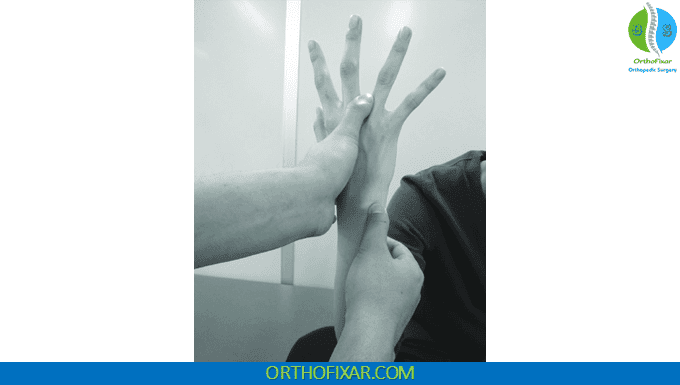
The examination begins with proper patient positioning. The patient sits comfortably with the affected arm supported on an examination table, the elbow flexed to 90 degrees, and the wrist maintained in a neutral position. The examiner’s technique requires careful coordination of both hands—one grasping the patient’s thumb and long fingers while the other palpates the ECU tendon along the dorsal ulnar aspect of the wrist.
During test execution, the patient performs isometric thumb abduction against the examiner’s resistance. This maneuver activates the synergistic relationship between the extensor carpi ulnaris and flexor carpi ulnaris as they contract together to stabilize the wrist joint. The examiner simultaneously palpates the ECU tendon, feeling for tenderness, swelling, or abnormal movement patterns.
What is a positive ECU Synergy Test?
A positive ECU Synergy Test manifests as pain localized along the dorsal ulnar aspect of the wrist, often accompanied by tenderness over the ECU tendon during palpation. The test is considered positive when it reproduces the patient’s primary symptoms, particularly during the isometric thumb abduction phase.
Beyond tendinitis evaluation, the examination must include assessment for ECU tendon subluxation or dislocation, which commonly occurs near the ulnar styloid process. This additional component involves positioning the patient’s wrist in extension and pronation while palpating the ECU tendon. The examiner then guides the wrist through a controlled motion from extension and pronation toward flexion and supination, carefully feeling for any tendon displacement or abnormal movement over bony prominences.
Test Reliability
Chronic ulnar-sided wrist pain is often difficult to diagnose due to overlapping intra- and extra-articular pathologies. Ruland and Hogan introduced the Extensor Carpi Ulnaris synergy test as a simple clinical maneuver to help identify ECU tendonitis.
In a retrospective review of 55 patients with more than 4 months of wrist pain:
- Patients with a negative ECU Synergy test consistently showed intra-articular pathology on MRI or arthroscopy.
- Those with a positive ECU Synergy test only demonstrated marked pain relief after ECU tendon sheath injection, confirming ECU tendonitis in most cases.
- Patients with a positive ECU Synergy test plus other exam findings often had both ECU tendonitis and coexisting intra-articular lesions.
The study concluded that the extensor carpi ulnaris synergy test effectively distinguishes between intra- and extra-articular wrist pain sources. When positive, it supports the diagnosis of ECU tendonitis and can reduce the need for costly imaging and diagnostic arthroscopy.
See Also: Wrist Pain Causes
Differential Diagnosis
The ECU Synergy Test provides crucial diagnostic information that helps differentiate ECU tendinitis from other causes of ulnar-sided wrist pain. These alternative diagnoses include triangular fibrocartilage complex tears, distal radioulnar joint instability, ulnar impaction syndrome, and pisotriquetral arthritis. The specificity of this test lies in its ability to isolate ECU function through the synergistic muscle activation pattern.
Treatment Considerations
When the test proves positive, treatment approaches typically progress from conservative to more aggressive interventions based on symptom severity and patient response. Initial management often focuses on activity modification and rest, combined with anti-inflammatory interventions.
Physical therapy plays a central role, emphasizing ECU strengthening and stabilization exercises. In cases where conservative treatment fails or when significant tendon instability is present, surgical consultation may be warranted for tendon repair or stabilization procedures.
References & More
- Ruland RT, Hogan CJ. The ECU synergy test: an aid to diagnose ECU tendonitis. J Hand Surg Am. 2008;33(10):1777–1782. PubMed
- Campbell D, Campbell R, O’Connor P, Hawkes R. Sports-related extensor carpi ulnaris pathology: a review of functional anatomy, sports injury and management. Br J Sports Med. 2013;47(17):1105–1111. PubMed
- Orthopedic Physical Assessment by David J. Magee, 7th Edition.