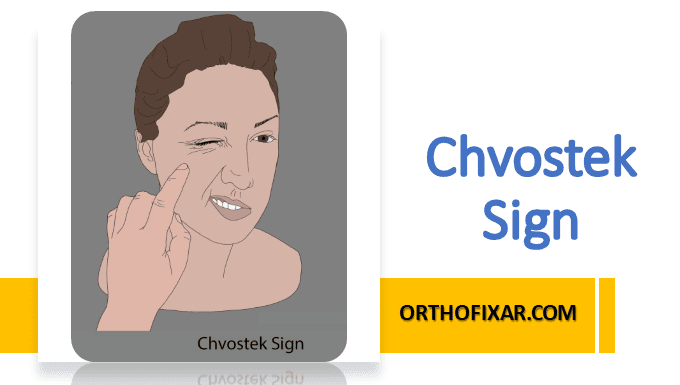
Chvostek sign is a classic physical examination finding used to detect neuromuscular hyperexcitability caused by hypocalcemia (low calcium in the blood). It is a facial muscle twitch triggered by tapping the facial nerve just anterior to the ear at the zygomatic arch. This sign can also be used to determine whether there is pathology involving the seventh cranial (facial) nerve.
The chvostek’s sign was first described in the late 1876 by Austrian neurologist František Chvostek, he noticed that mechanical stimulation of the facial nerve (as with the examiner’s fingertip, for example) could lead to twitching of the ipsilateral facial muscles.
Physiological Basis
A calcium level of less than 8.8 mg/dl is considered deficient. Calcium is an essential electrolyte in the body. It is associated with many functions and of greatest significance, muscle contractions and propagation of nerve impulses. Deficiencies in calcium may lead to seizures, cardiomyopathy, QT prolongation, and congestive heart failure. Secondary to this, patients often receive replacement therapy in the hospital setting. One common cause of hypocalcemia is a complication during thyroidectomies.
See Also: Tinel Test for Nerves Evaluation
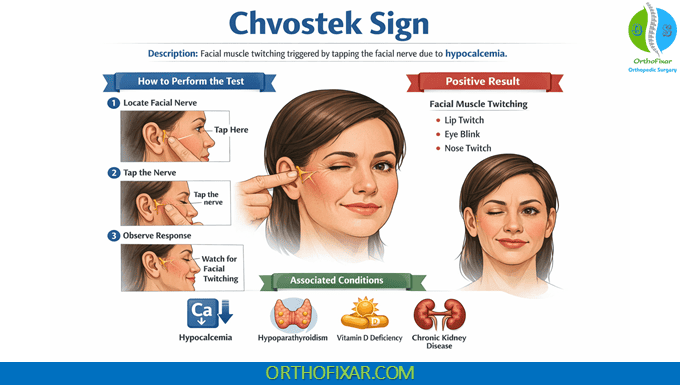
How to Perform the Chvostek Sign Test?
The test is relatively simple to perform:
- Position the Patient: Have the patient sit comfortably, facing the examiner.
- Locate the Facial Nerve: Identify the area just anterior to the ear and below the zygomatic arch.
- Tap the Area: Using a reflex hammer or your finger, gently tap the area over the facial nerve.
- Observe the Response: Watch for any twitching of the facial muscles, particularly around the mouth, nose, or eye.

What is the Positive Chvostek’s Sign?
A positive Chvostek sign is indicated by the twitching of the facial muscles, particularly around the mouth, nose, or eye, in response to the tap.
A positive sign is an important diagnostic tool. It is often one of the first signs that suggest hypocalcemia, although it can also be present in other conditions that increase neuromuscular excitability. These conditions include:
- Hypocalcemia: Low calcium levels are the most common cause of a positive Chvostek sign. Hypocalcemia can result from a variety of causes, including hypoparathyroidism, vitamin D deficiency, and chronic kidney disease.
- Hypomagnesemia: Low magnesium levels can also trigger a positive Chvostek sign. Magnesium is critical for the regulation of calcium, and its deficiency can lead to similar neuromuscular symptoms.
- Respiratory Alkalosis: Conditions that lead to an increase in blood pH, such as hyperventilation, can cause calcium to bind to albumin more readily, lowering the free calcium available in the bloodstream and potentially leading to a positive Chvostek sign.
Studies suggest that a positive Chvostek sign may be present in a significant number of healthy individuals without any underlying pathology. This underscores the importance of using the Chvostek sign in conjunction with other diagnostic tests, such as serum calcium levels, to confirm hypocalcemia or other related conditions.
Additionally, a negative Chvostek sign does not necessarily rule out hypocalcemia, especially in chronic cases where neuromuscular excitability may be less pronounced.
Grading of Chvostek Sign
Some clinical references classify the response into three grades:
| Grade | Response |
|---|---|
| Grade I | Twitching of all facial muscles |
| Grade II | Twitching of nose and lips only |
| Grade III | Twitching limited to the corner of the mouth |
Higher grades may correlate with greater neuromuscular irritability.
Conditions Associated With a Positive Chvostek Sign
Although most commonly linked to hypocalcemia, Chvostek sign may appear in several medical conditions.
Hypocalcemia
The most important association. Causes include:
- Hypoparathyroidism
- Vitamin D deficiency
- Chronic kidney disease
- Acute pancreatitis
- Massive blood transfusion
Other Possible Causes
- Hypomagnesemia
- Respiratory alkalosis
- Tetany
- Post-thyroidectomy hypocalcemia
Chvostek Sign vs Trousseau Sign
Both tests assess latent tetany caused by hypocalcemia, but they are performed differently.
| Feature | Chvostek Sign | Trousseau Sign |
|---|---|---|
| Test method | Tap facial nerve | Inflate blood pressure cuff |
| Response | Facial twitching | Carpal spasm |
| Sensitivity | Lower | Higher |
| Clinical use | Screening sign | More reliable diagnostic sign |
Trousseau sign is generally considered more sensitive for detecting hypocalcemia.
Key Clinical Notes
- Calcium <8.8 mg/dL → deficiency.
- Hypocalcemia can cause seizures, cardiomyopathy, prolonged QT, heart failure.
- Prompt replacement therapy is often required.
Summary
Chvostek sign is a bedside clinical test used to detect neuromuscular hyperexcitability caused primarily by hypocalcemia.
Key points:
- Performed by tapping the facial nerve anterior to the ear
- A positive result causes facial muscle twitching
- Often associated with hypocalcemia and tetany
- Less sensitive than Trousseau sign
- Must be confirmed with laboratory calcium levels
Despite its limitations, Chvostek sign remains a valuable quick screening tool during physical examination.
FAQ
What does a positive Chvostek sign indicate?
It usually suggests hypocalcemia but can also occur with hypomagnesemia or alkalosis.
Is Chvostek sign specific for hypocalcemia?
No, it can appear in other conditions and even in some healthy individuals.
How reliable is the Chvostek sign?
It is a useful bedside indicator but should be confirmed with blood calcium tests.
What is the difference between Chvostek and Trousseau sign?
Chvostek sign causes facial twitching after facial nerve tapping, while Trousseau sign produces carpal spasm after inflating a blood pressure cuff.
References & More
- Orthopedic Physical Assessment by David J. Magee, 7th Edition.
- Omerovic S, Das JM. Chvostek Sign. [Updated 2023 May 1]. In: StatPearls [Internet]. Treasure Island (FL): StatPearls Publishing; 2024 Jan-. Available from: Pubmed
- Omerovic S, Das JM. Chvostek Sign. 2023 May 1. In: StatPearls [Internet]. Treasure Island (FL): StatPearls Publishing; 2025 Jan–. PMID: 31194466. Pubmed