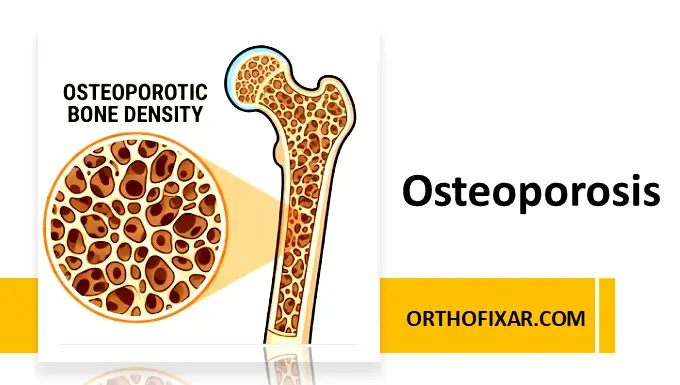
Osteoporosis is defined as a systemic skeletal disorder characterized by low bone mass and microarchitectural deterioration of bone tissue, resulting in increased bone fragility and susceptibility to fracture. The term literally means “porous bone,” reflecting the loss of trabecular connectivity and cortical thinning that occurs as the disease progresses.
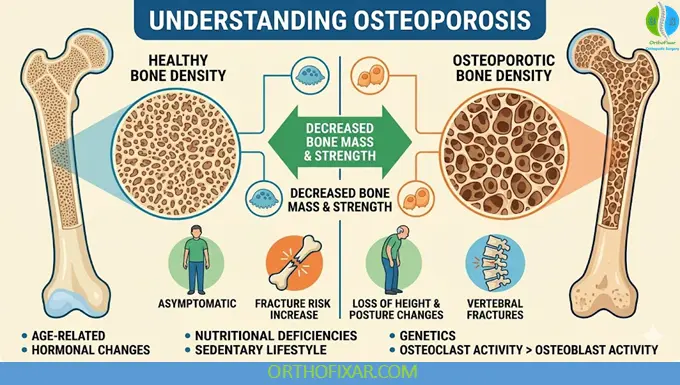
Bone is living tissue that undergoes continuous remodeling throughout life, with osteoclasts resorbing old bone and osteoblasts forming new bone. Osteoporosis results from an imbalance in this remodeling cycle, in which resorption outpaces formation.This imbalance is most pronounced after menopause, when the decline in estrogen removes a key restraint on osteoclast activity, but it can also occur in men and premenopausal women through aging or secondary causes.
Clinical framing: Osteoporosis is frequently asymptomatic until a fragility fracture occurs, most often at the hip, spine, or distal forearm. Because of this silent course, it is often underdiagnosed and undertreated despite well-established screening tools.
Primary vs. Secondary Osteoporosis
Osteoporosis is generally classified as primary or secondary. Primary osteoporosis is related to aging and, in women, the menopausal decline in estrogen; it accounts for the majority of cases in postmenopausal women. Secondary osteoporosis results from an identifiable underlying disease, medication, or lifestyle factor, and it accounts for up to 60% of osteoporosis cases in men.
Common Secondary Causes
Conditions and medications associated with secondary osteoporosis include long-term glucocorticoid use, hyperparathyroidism, hyperthyroidism or overtreated hypothyroidism, chronic kidney disease, malabsorption syndromes, anorexia nervosa, hypogonadism, chronic alcohol use, certain anticonvulsants, and prolonged immobilization.
Epidemiology and Disease Burden
Osteoporosis is one of the most common metabolic bone diseases worldwide. A large systematic review and meta-analysis pooling 86 studies and more than 103 million individuals aged 15 to 105 years estimated the global prevalence of osteoporosis at approximately 18.3%, with a markedly higher prevalence in women (23.1%) than in men (11.7%).
In the United States, an estimated 10.2 million adults over age 50 have osteoporosis, a figure projected to rise by more than 30% by 2030 as the population ages. Globally, osteoporosis affects more than 200 million people, and roughly 30% of postmenopausal women are affected.
Regional and Demographic Variation
Prevalence varies considerably by region and age. Meta-analytic data indicate that osteoporosis prevalence among older adults reaches nearly 40% in some populations, such as Spain and China, and even higher in others, reflecting differences in genetics, diet, physical activity, and healthcare access. A comprehensive continental analysis found the highest reported prevalence in Africa, though epidemiological data from the continent remain comparatively limited.
Burden in Postmenopausal Women
Analysis using Global Burden of Disease 2021 data found that low bone mineral density was responsible for over 219,000 deaths and 7.76 million disability-adjusted life years globally among postmenopausal women, with a disease burden more than 15 times higher than in premenopausal women.
Pathophysiology of Bone Loss
Bone remodeling is governed by the coordinated activity of osteoblasts (bone-forming cells), osteoclasts (bone-resorbing cells), and osteocytes, which act as mechanosensors regulating this balance. Several molecular pathways influence this process, most notably the RANK/RANKL/osteoprotegerin system, which controls osteoclast differentiation and activity, and the Wnt/beta-catenin signaling pathway, which is inhibited by sclerostin and regulates osteoblast-driven bone formation.
Estrogen Deficiency and Postmenopausal Bone Loss
Estrogen normally restrains osteoclast activity and supports osteoblast survival. Its decline at menopause increases RANKL expression and pro-inflammatory cytokine activity, accelerating bone resorption and producing the rapid phase of bone loss characteristic of the early postmenopausal years.
Age-Related and Immune Contributions
Beyond estrogen loss, aging itself is associated with declining osteoblast number and function, reduced growth hormone and IGF-1 activity, and altered calcium and vitamin D metabolism. Emerging research has also implicated the immune system, describing an “immunoporosis” framework in which T cells, B cells, and inflammatory mediators contribute to the pathophysiology of different osteoporosis subtypes.
Bone Quality Beyond Density
Bone strength depends not only on mineral density but also on bone quality factors such as trabecular microarchitecture, cortical thickness, and the degree of bone mineralization, which is why fractures can occur even in individuals with T-scores above the diagnostic threshold for osteoporosis.
Risk Factors
Osteoporosis risk factors are commonly divided into non-modifiable and modifiable categories, and clinical risk assessment tools such as FRAX incorporate several of these variables to estimate individualized fracture probability.
| Non-Modifiable Factors | Modifiable Factors |
|---|---|
| Advancing age | Cigarette smoking |
| Female sex | Excessive alcohol intake |
| White or Asian race | Low calcium or vitamin D intake |
| Family history of osteoporosis or fracture | Sedentary lifestyle / low weight-bearing activity |
| Early menopause or hypogonadism | Low body weight (under approximately 58 kg / 128 lb) |
| Genetic and hormonal predisposition | Long-term glucocorticoid or anticonvulsant use |
Smoking and Bone Health
Smoking is one of the most consistently identified modifiable risk factors. A meta-analysis focused on men found a relative risk of fracture of 1.37 among smokers, with earlier studies showing a 32% increased risk of spine fracture and a 40% increased risk of hip fracture in male smokers, attributed to nicotine and cadmium effects on bone tissue and impaired calcium absorption.
Body Weight Considerations
Both low and, in men, unexpectedly high BMI have been associated with elevated fracture risk in some populations, underscoring that body composition and bone quality factors interact in ways not fully captured by weight alone.
Osteoporosis Symptoms & Signs
Osteoporosis is frequently described as a “silent disease” because bone loss itself produces no symptoms. Clinical signs typically appear only after a fragility fracture has occurred.
Common Presentations
- Vertebral compression fractures, which may present as acute back pain, height loss, or increasing kyphosis, or may be asymptomatic and identified incidentally on imaging
- Hip fractures following minimal trauma, such as a fall from standing height
- Distal forearm (Colles’) fractures
- Proximal humerus and pelvic fractures in individuals with lower bone density
These are collectively referred to as fragility fractures, defined as fractures occurring from a fall from standing height or less, in the absence of significant trauma.
Diagnosis and Screening
Diagnosis of osteoporosis relies primarily on bone mineral density (BMD) measurement, supplemented by clinical fracture history and fracture-risk assessment tools.
Dual-Energy X-ray Absorptiometry (DXA)
DXA is the recognized reference standard for measuring bone mineral density and diagnosing osteoporosis. It expresses results as a T-score, comparing an individual’s BMD to that of a healthy young adult reference population, typically measured at the lumbar spine, femoral neck, total hip, or 1/3 radius.
WHO Diagnostic Thresholds
| Classification | T-Score Range |
|---|---|
| Normal bone density | -1.0 or higher |
| Osteopenia (low bone mass) | Between -1.0 and -2.5 |
| Osteoporosis | -2.5 or lower |
| Severe (established) osteoporosis | -2.5 or lower, with one or more fragility fractures |
Based on WHO operational criteria applied to DXA in postmenopausal women and men aged 50 and older.
Important distinction: A fragility fracture in the presence of osteopenic or even normal BMD is sufficient for a clinical diagnosis of osteoporosis, independent of the T-score threshold.
Quantitative Computed Tomography (QCT)
QCT is an alternative imaging method for assessing BMD. A 2025 systematic review and meta-analysis comparing QCT and DXA in the same populations found notable differences in osteoporosis prevalence detected by each method, and the review’s authors noted it remains uncertain whether this reflects underestimation by DXA or overestimation by QCT, an area of ongoing methodological investigation.
Fracture Risk Assessment (FRAX)
The FRAX tool estimates an individual’s 10-year probability of hip fracture and major osteoporotic fracture using clinical risk factors alongside BMD, and it is widely used to guide treatment thresholds, particularly in patients with osteopenia. Recent European guideline updates have also introduced algorithm-based risk gradients, recommending osteoanabolic treatment for individuals with a 3-year fracture risk of 10% or higher and antiresorptive treatment where risk exceeds 3%.
AACE Diagnostic Criteria
The American Association of Clinical Endocrinologists guidelines specify that osteoporosis in postmenopausal women can be diagnosed by a T-score of -2.5 or below, by a low-trauma spine or hip fracture regardless of BMD, or by a T-score between -1.0 and -2.5 combined with a fragility fracture at the proximal humerus, pelvis, or distal forearm, or a high FRAX-based fracture probability.
Laboratory Evaluation and Biochemical Markers
Laboratory assessment is used to identify secondary causes of bone loss and may include serum calcium, vitamin D, parathyroid hormone, thyroid function, and renal function testing. Bone turnover markers such as procollagen type I N-terminal propeptide (P1NP) and C-terminal telopeptide (CTX) reflect bone formation and resorption activity, respectively, and are increasingly used to monitor treatment response, although preanalytical variability from factors such as circadian rhythm, food intake, and medication use must be accounted for when interpreting results.
Who Should Be Screened?
Guideline bodies generally recommend BMD screening in postmenopausal women and men aged 50 years or older who have clinical risk factors, alongside routine age-based screening recommendations from organizations such as the U.S. Preventive Services Task Force.
Osteoporosis Treatment
Osteoporosis treatment combines pharmacologic therapy, adequate calcium and vitamin D intake, weight-bearing exercise, and fall-prevention strategies. Treatment selection depends on fracture risk severity, prior fracture history, and patient-specific factors such as renal function and treatment tolerance.
Antiresorptive Therapies
Bisphosphonates
Bisphosphonates, including alendronate, risedronate, ibandronate, and zoledronate, remain a cornerstone of first-line pharmacologic therapy. They inhibit osteoclast-mediated bone resorption and have demonstrated fracture-risk reduction across multiple randomized controlled trials. Intravenous formulations can be used in patients who cannot tolerate oral bisphosphonates due to gastrointestinal side effects.
Denosumab
Denosumab is a monoclonal antibody that inhibits RANKL, thereby reducing osteoclast formation and activity. Meta-analytic data comparing denosumab with oral bisphosphonates in postmenopausal osteoporosis found denosumab produced greater increases in femoral neck and total hip bone mineral density, with a comparable safety profile.
Anabolic (Bone-Forming) Therapies
Teriparatide and Abaloparatide
Teriparatide and abaloparatide are parathyroid hormone analogs that stimulate new bone formation. Network meta-analysis data show that teriparatide produced greater increases in lumbar spine bone mineral density than bisphosphonates and was associated with a lower risk of general adverse events, though it is typically reserved for patients at very high fracture risk given its cost and administration requirements.
Romosozumab
Romosozumab is a humanized monoclonal antibody that inhibits sclerostin, simultaneously stimulating bone formation and suppressing bone resorption. It is FDA-approved for postmenopausal women at high fracture risk and has also shown efficacy in increasing bone mineral density in men with osteoporosis, along with a reduction in falls and major osteoporotic fractures in clinical trials. Romosozumab carries a boxed warning regarding potential cardiovascular risk and is generally avoided in patients with a recent history of myocardial infarction or stroke.
Selective Estrogen Receptor Modulators (SERMs)
Raloxifene and bazedoxifene act on estrogen receptors to reduce bone resorption while avoiding some of the risks associated with systemic estrogen therapy, and are included among the therapies evaluated in living systematic reviews of fracture-prevention pharmacotherapy.
Treatment sequencing note: Because anabolic agents build bone most effectively when used first, and their benefits can be lost without follow-up antiresorptive therapy, many current protocols favor an anabolic-to-antiresorptive treatment sequence in patients at very high fracture risk, rather than the reverse order.
Treatment for Secondary and Glucocorticoid-Induced Osteoporosis
Glucocorticoid use is the leading cause of secondary osteoporosis. Meta-analytic evidence indicates that teriparatide and denosumab may offer superior efficacy compared with bisphosphonates for increasing bone mineral density and reducing vertebral fracture risk in glucocorticoid-induced osteoporosis, prompting some specialty guidelines to reconsider first-line recommendations.
Prevention and Lifestyle Measures
Non-pharmacologic measures are foundational to both prevention and treatment at every stage of osteoporosis management.
Nutrition
Adequate dietary calcium and vitamin D intake, supported by a balanced diet with sufficient protein and dairy intake, are recommended to support bone remodeling and reduce fracture risk.
Physical Activity
Regular weight-bearing exercise, such as at least 30 to 40 minutes of activity performed 3 to 4 times per week, is recommended to help preserve bone mineral density and improve balance, which in turn reduces fall risk.
Avoiding Modifiable Risk Behaviors
Smoking cessation and moderation of alcohol intake are recommended given their well-documented associations with accelerated bone loss and fracture risk.
Monitoring and Follow-Up
Ongoing monitoring is essential to assess treatment response and adherence, given that poor adherence remains a common challenge due to the asymptomatic nature of the disease until a fracture occurs.
Repeat DXA Testing
Repeat DXA scanning is typically used to track BMD changes over time, though evidence suggests that follow-up scans have rarely led to treatment changes when medication compliance can be reasonably assessed through other means.
Bone Turnover Marker Monitoring
Serial measurement of bone turnover markers such as P1NP and CTX can provide an earlier indication of treatment response than DXA, since biochemical changes typically precede detectable changes in bone density, though results must be interpreted alongside controllable and uncontrollable sources of variability.
For clinicians: This article is intended for medical education purposes and does not replace individualized clinical judgment, current institutional guidelines, or shared decision-making with patients regarding fracture risk and treatment selection.
Frequently Asked Questions
What is the main cause of osteoporosis?
Osteoporosis develops when bone resorption outpaces bone formation, most commonly driven by the estrogen decline that follows menopause, along with aging, genetics, low body weight, and secondary causes such as certain medications or endocrine disorders.
What T-score defines osteoporosis?
A T-score of -2.5 or lower at the spine, femoral neck, total hip, or 1/3 radius, measured by DXA, meets WHO diagnostic criteria for osteoporosis in postmenopausal women and men aged 50 and older.
Can osteoporosis be reversed?
Osteoporosis is generally not fully reversible, but bone density can improve and fracture risk can be substantially reduced with antiresorptive or anabolic pharmacotherapy combined with adequate nutrition, weight-bearing exercise, and fall prevention.
What is the difference between osteopenia and osteoporosis?
Osteopenia describes a T-score between -1.0 and -2.5, indicating bone density below normal but above the osteoporosis threshold. Osteoporosis is diagnosed at a T-score of -2.5 or lower.
How often should bone density be tested?
Screening frequency depends on individual risk. General guidance supports DXA screening starting at age 65 for women and 70 for men, earlier with risk factors present, with follow-up intervals commonly ranging from 1 to 2 years depending on baseline risk and treatment status.
References & More
- Zhang W, Gao R, Rong X, et al. Immunoporosis: role of immune system in the pathophysiology of different types of osteoporosis. Front Endocrinol. Available via PubMed. PubMed
- Dimai HP, Muschitz C, Amrein K, et al. Osteoporose – Definition, Risikoerfassung, Diagnose, Prävention und Therapie (Update 2024). Wien Klin Wochenschr. 2024;136(S16):599-668. PMC11447007
- Diagnostics and treatment of osteoporosis in 2025: An update on current guidelines. PubMed PMID: 40377675
- Epidemiology and Pathogenesis of Osteoporosis. Endotext. NCBI Bookshelf NBK279134
- Eastell R, O’Neill TW, Hofbauer LC, et al. Postmenopausal osteoporosis. Nat Rev Dis Primers. 2016;2:16069. PubMed
- Osteoporosis in Females. StatPearls. NCBI Bookshelf NBK559156
- The 2024 UK clinical guideline for the prevention and treatment of osteoporosis. PMC12417299
- Osteoporosis in Males. StatPearls. NCBI Bookshelf NBK538531
- Osteoporosis. StatPearls (Archived). NCBI Bookshelf NBK441901
- Osteoporosis in Males: Risk Factors and Prevention. StatPearls. NCBI Bookshelf NBK538531
- Epidemiology of Osteoporosis. PMC10721571
- Salari N, et al. The global prevalence of osteoporosis in the world: a comprehensive systematic review and meta-analysis. J Orthop Surg Res. PMC8522202
- Prevalence and Risk Factors of Osteoporosis: A Cross-Sectional Study in a Tertiary Center. PMC11677826
- Global prevalence of osteoporosis among the world older adults: a comprehensive systematic review and meta-analysis. PMC8590304
- The global prevalence of osteoporosis in the world. J Orthop Surg Res. Springer / J Orthop Surg Res
- Global prevalence of osteoporosis among the world older adults. PMC8590304
- Global epidemiology and burden of osteoporosis among postmenopausal women: insights from GBD 2021. npj Aging. npj Aging
- Zhang W, et al. Immunoporosis and bone remodeling pathophysiology. Referenced via PubMed PMID: 40377675
- Criteria for osteoporosis diagnosis: a systematic review and meta-analysis of osteoporosis diagnostic studies with DXA and QCT. PMC12235398
- Secondary Osteoporosis. StatPearls. NCBI Bookshelf NBK470166
- Osteopenia. StatPearls. NCBI Bookshelf NBK499878
- Criteria for osteoporosis diagnosis: DXA vs. QCT systematic review. PMC12235398
- Dimai HP, et al. Osteoporose Update 2024 (WHO diagnostic criteria). PMC11447007
- Davis S, Simpson E, Hamilton J, et al. Denosumab, raloxifene, romosozumab and teriparatide to prevent osteoporotic fragility fractures: a systematic review and economic evaluation. Health Technol Assess. 2020;24(29):1-314. PMID: 32588816. PubMed PMID: 32588816
- Diagnostics and treatment of osteoporosis in 2025: An update on current guidelines (fracture risk algorithm). PubMed PMID: 40377675
- Osteoporosis Guidelines: Screening, Diagnosis, Treatment (AACE 2020 criteria). Medscape / AACE Guidelines
- Biochemical Markers of Osteoporosis. StatPearls. NCBI Bookshelf NBK559306
- Prevalence of Osteoporosis Among Patients Visiting Primary Health Clinics in Al-Ahsa, Saudi Arabia (screening context). PMC12302053
- Li M, Ge Z, Zhang B, et al. Efficacy and safety of teriparatide vs. bisphosphonates and denosumab vs. bisphosphonates in osteoporosis. Arch Osteoporos. 2024;19(1):89. PMID: 39312040. PubMed PMID: 39312040
- Efficacy and safety of denosumab and teriparatide versus oral bisphosphonates to treat postmenopausal osteoporosis: a systematic review and meta-analysis. PMID: 39286276. PubMed PMID: 39286276
- Efficacy and safety of denosumab and teriparatide versus oral bisphosphonates to treat postmenopausal osteoporosis. PMC11402677
- Bisphosphonates, denosumab, abaloparatide, teriparatide, and romosozumab reduce postmenopausal fracture risk (living network meta-analysis summary). 2 Minute Medicine / ACP Living Guideline
- Romosozumab. StatPearls. NCBI Bookshelf NBK585139
- Davis S, et al. SERMs (raloxifene, bazedoxifene) in fracture prevention economic evaluation. PMID: 32588816. PubMed PMID: 32588816
- Denosumab, teriparatide and bisphosphonates for glucocorticoid-induced osteoporosis: a Bayesian network meta-analysis. PMC10834754
- Clinical efficacy of denosumab, teriparatide, and oral bisphosphonates in the prevention of glucocorticoid-induced osteoporosis. PMC10286508