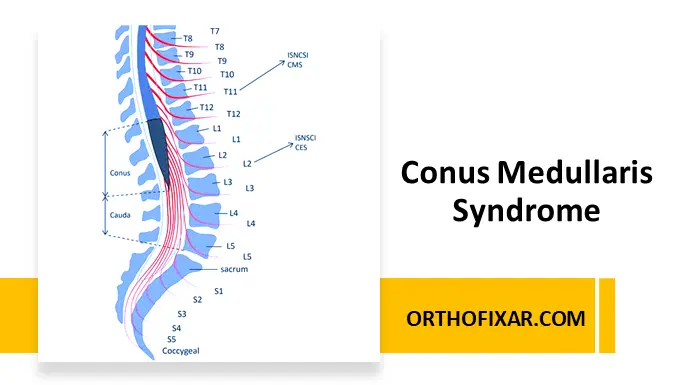
Conus medullaris syndrome (CMS) is a neurological condition resulting from injury to the terminal portion of the spinal cord known as the conus medullaris, typically located at the L1–L2 vertebral level in adults. It is a neurosurgical emergency that requires prompt recognition and management to prevent permanent neurological deficits.
Anatomy and Pathophysiology
The conus medullaris represents the tapered distal end of the spinal cord. It contains sacral (S2–S5) and coccygeal segments, which are responsible for:
- Bladder and bowel control
- Sexual function
- Sensory innervation of the perineal region (“saddle area”)
In CMS, damage to this region leads to a combination of upper motor neuron (UMN) and lower motor neuron (LMN) signs due to the involvement of both spinal cord tissue and adjacent nerve roots.
See Also: Lumbar Spine Anatomy: Structure, Function, and Clinical Importance
Etiology
Common causes of conus syndrome include:
- Trauma (e.g., burst fractures at L1)
- Intervertebral disc herniation
- Spinal tumors (e.g., ependymoma, metastases)
- Infections (e.g., epidural abscess)
- Vascular compromise (e.g., ischemia)
- Iatrogenic causes (e.g., post-surgical complications)
Clinical Features
Cauda Equina Syndrome presents with a distinct constellation of symptoms, often with a more symmetrical pattern compared to cauda equina syndrome:
1. Motor Function
- Mild, symmetric weakness in the lower limbs
- Less pronounced than in cauda equina syndrome
2. Sensory Loss
- Saddle anesthesia (perianal, perineal region)
- Symmetric sensory deficits
3. Reflexes
- May show mixed UMN and LMN signs
- Knee reflexes may be preserved
- Ankle reflexes may be diminished
4. Autonomic Dysfunction
- Early and prominent bladder and bowel dysfunction
- Urinary retention or incontinence
- Fecal incontinence
- Erectile dysfunction
Key Clinical Distinction
| Feature | Conus Medullaris Syndrome | Cauda Equina Syndrome |
|---|---|---|
| Onset | Sudden and bilateral | Gradual, often unilateral |
| Pain | Less severe | Severe radicular pain |
| Motor weakness | Mild, symmetric | Marked, asymmetric |
| Sensory loss | Saddle anesthesia (symmetric) | Patchy, dermatomal |
| Reflexes | Mixed UMN/LMN | LMN only |
| Bladder/bowel | Early involvement | Late involvement |
Diagnosis
Clinical Assessment
- Thorough neurological examination
- Assessment of perianal sensation and anal sphincter tone.
- The bulbocavernosus reflex may be permanently lost.
Imaging
- MRI of the lumbosacral spine is the gold standard
- Helps identify compressive lesions, tumors, or ischemia
Additional Studies
- CT scan (if MRI unavailable)
- Urodynamic studies (in selected cases)
Treatment
Conus medullaris syndrome is a medical emergency.
1. Immediate Treatment
- Urgent neurosurgical consultation
- Bladder catheterization if urinary retention present
2. Definitive Treatment
- Surgical decompression (e.g., laminectomy)
- Removal of causative lesion (tumor, disc, abscess)
3. Medical Therapy
- Antibiotics (if infection)
- Corticosteroids (controversial; may be used in certain tumor-related compression)
Prognosis
- Prognosis depends on timing of intervention
- Early decompression significantly improves outcomes
- Autonomic dysfunction (bladder/bowel) may persist even after treatment
Key Takeaways
- Conus medullaris syndrome affects the terminal spinal cord, leading to early autonomic dysfunction
- Symptoms are typically bilateral and symmetric
- MRI is essential for diagnosis
- Urgent surgical intervention is often required
References & More
- Nene Y, Jilani TN. Neuroanatomy, Conus Medullaris. [Updated 2023 Aug 7]. In: StatPearls [Internet]. Treasure Island (FL): StatPearls Publishing; 2026 Jan-. Available from: Pubmed
- Rider LS, Marra EM. Cauda Equina and Conus Medullaris Syndromes. 2023 Aug 7. In: StatPearls [Internet]. Treasure Island (FL): StatPearls Publishing; 2026 Jan–. PMID: 30725885. Pubmed
- Rider LS, Marra EM. Cauda Equina and Conus Medullaris Syndromes. [Updated 2023 Aug 7]. In: StatPearls [Internet]. Treasure Island (FL): StatPearls Publishing; 2026 Jan-. Available from: Pubmed
- Vaishya S, Pojskic M, Bedi MS, Oertel J, Sippl C, Robertson S, Zygourakis C. Cauda equina, conus medullaris and syndromes mimicking sciatic pain: WFNS spine committee recommendations. World Neurosurg X. 2024 Feb 10;22:100274. doi: 10.1016/j.wnsx.2024.100274. PMID: 38496349; PMCID: PMC10943478. Pubmed
- Egol KA. Handbook of fractures. 6th ed. Philadelphia: Lippincott Williams & Wilkins; 2019.