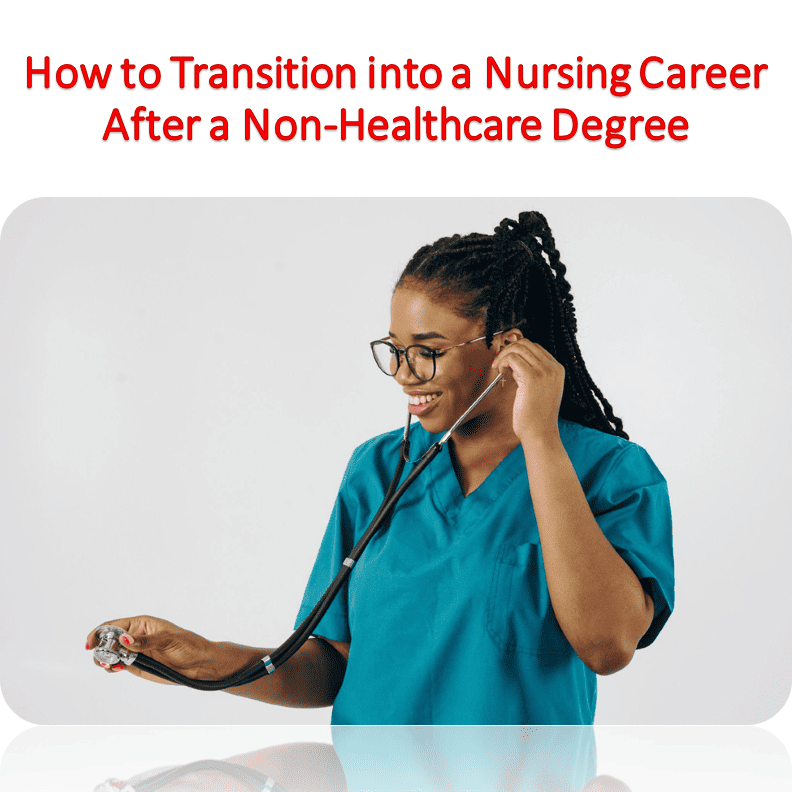
You can move into nursing after earning a degree in history, business, biology, or almost any other non-healthcare field. The most common route is an accelerated pre-licensure nursing program designed for people who already hold a bachelor’s degree, though some students take the traditional path instead. This guide explains the realistic options, the prerequisites you will need to complete, how to choose a program, and how to plan the transition without wasting time or money.
Why a Non-Healthcare Degree Is Not a Barrier
Nursing programs care about whether you have completed the required science and social science prerequisites and whether your academic record shows you can handle a rigorous clinical curriculum. Your original major is rarely the deciding factor. In fact, admissions committees often value the broader perspective that career changers bring.
What matters most is that you can demonstrate competence in the specific prerequisite courses and that you understand what nursing work actually involves. Many accelerated programs are built specifically for people with a prior bachelor’s degree, which means your first degree is an advantage rather than a detour.
The Main Pathways into Nursing
There are several recognized routes, and the right one depends on your existing education, your timeline, and the credentials you want to hold.
Accelerated Bachelor of Science in Nursing (ABSN)
An ABSN is an intensive program for people who already hold a non-nursing bachelor’s degree. It typically condenses the core nursing curriculum into a shorter timeframe than a standard four-year BSN, and graduates earn a Bachelor of Science in Nursing. Admission usually requires a set of prerequisite courses, a minimum GPA, and sometimes healthcare experience.
Direct-Entry Master’s in Nursing
Some universities offer graduate-entry nursing programs for people with a bachelor’s degree in another field. These lead to a master’s-level nursing credential and can prepare graduates for licensure. They are generally longer and more expensive than an ABSN, so weigh the cost against the career outcomes you actually want.
Traditional BSN or ADN Programs
You can also apply to a standard BSN program or an Associate Degree in Nursing (ADN). These routes take longer for someone who already has a degree, but they may be more accessible depending on your location and finances. An ADN can lead to RN licensure, and many nurses later complete an RN-to-BSN bridge.
Comparison at a Glance
| Pathway | Typical Entry Requirement | Credential Earned | Relative Time and Cost |
|---|---|---|---|
| Accelerated BSN | Prior bachelor’s degree plus prerequisites | BSN | Shorter than a standard BSN; cost varies by school |
| Direct-entry master’s | Prior bachelor’s degree plus prerequisites | Master’s-level nursing credential | Longer and often higher cost |
| Traditional BSN | High school diploma or college credits | BSN | Usually four years |
| ADN | College admission requirements | Associate degree | Often two to three years; bridge options available |
Prerequisites You Will Almost Certainly Need
Most nursing programs require a common core of science and social science courses, usually completed with a minimum grade. Exact requirements differ by institution, so always confirm against the program’s own page.
Typical prerequisites include:
- Anatomy and physiology, often with a lab
- Microbiology
- Chemistry, sometimes with a lab
- Human growth and development or lifespan psychology
- Statistics or a research methods course
- English composition
- Nutrition in some programs
- Sociology or ethics in some programs
A common pitfall is taking prerequisites at a community college without checking whether the target program accepts those credits. Some programs require that science courses be completed within a certain number of years, so verify the transfer and recency rules before enrolling.
How to Choose a Nursing Program
Program quality and fit matter more than prestige. Use these criteria to compare options objectively.
- Accreditation: Confirm the program holds accreditation from a recognized nursing accrediting body, since this affects licensure eligibility and future education.
- NCLEX pass rates: Most programs publish first-time pass rates; compare them over multiple years.
- Clinical placement: Ask how clinical sites are assigned and whether you must arrange your own transportation or placement.
- Prerequisite policy: Check which courses count, minimum grades, and any expiration rules.
- Cost and aid: Compare total tuition, fees, and available financial aid, not just the headline price.
- Schedule format: Determine whether the program is full-time, hybrid, or requires daytime availability for clinicals.
In the United States, you can verify accreditation through the Commission on Collegiate Nursing Education and the Accreditation Commission for Education in Nursing. For broader institutional accreditation, check the U.S. Department of Education accreditation information.
Licensure and the NCLEX
In the United States, every state requires nurses to be licensed, and licensure is handled by state boards of nursing. After graduating from an approved program, you apply to your state board, register for the NCLEX-RN examination, and meet the board’s other requirements. The official NCLEX information from NCSBN explains the exam and registration process.
Each state board sets its own application steps, fees, and background check requirements. Find your board through the NCSBN directory of state boards of nursing and follow its instructions exactly. Requirements for international applicants and for nurses moving between states also vary, so confirm details with the specific board.
Getting Healthcare Experience Before You Apply
Many accelerated programs prefer or require some exposure to clinical settings. You do not need to be a nurse to gain relevant experience, and even a modest amount can strengthen your application and confirm your interest.
- Work as a certified nursing assistant or patient care technician where certification is available.
- Volunteer in a hospital, clinic, or community health organization.
- Take a phlebotomy or medical assistant course if it fits your schedule.
- Shadow nurses in different settings to understand the range of the role.
Keep a simple record of your hours and responsibilities. Some programs ask for verification, and a clear log makes the application easier.
Planning the Transition Financially and Personally
Nursing school is demanding, and career changers often juggle family and work commitments. A realistic plan reduces the risk of dropping out mid-program.
- Budget for tuition, fees, textbooks, uniforms, and exam costs.
- Check whether your employer offers tuition assistance or flexible scheduling.
- Explore federal student aid through the Federal Student Aid portal and any state or institutional aid programs.
- Plan childcare and transportation for clinical shifts, which can start early and run long.
- Speak with your support network about the time commitment before you enroll.
Scholarships and loan repayment programs exist in many regions, but eligibility and availability change. Verify current details directly with the sponsoring organization or government agency rather than relying on secondhand summaries.
Common Mistakes Career Changers Make
Most setbacks are avoidable with a little research up front.
- Applying before completing prerequisites, which wastes an application cycle.
- Assuming all science credits transfer without checking.
- Choosing a program based only on cost or location without checking accreditation.
- Underestimating the time required for clinicals and study.
- Skipping healthcare experience and then discovering nursing is not the right fit.
- Ignoring state licensure rules until after graduation.
A Practical Step-by-Step Plan
Here is a sequence that keeps the process organized.
- Confirm your interest by shadowing or volunteering in a clinical setting.
- List three to five programs and download their prerequisite checklists.
- Compare your transcripts against those checklists and identify gaps.
- Enroll in missing prerequisites at an institution whose credits are accepted.
- Prepare for standardized admissions tests if the programs require them.
- Gather transcripts, references, and any experience documentation.
- Submit applications and track deadlines carefully.
- After acceptance, complete background checks, immunizations, and licensure paperwork.
What the Work Is Really Like
Nursing combines clinical judgment, patient communication, and physical stamina. Shifts can be long, and you will work with people in distress. Understanding this before you commit helps you choose a program and specialty that fit you.
It also helps to know that nursing offers many directions, from bedside care to community health, education, and administration. Your prior degree can be an asset in those later roles, especially if it built skills in communication, analysis, or management.
Conclusion
Moving into nursing after a non-healthcare degree is a well-established path. Focus on the specific prerequisites, choose an accredited program that fits your life, and verify licensure requirements with your state board. With careful planning, your first degree becomes a foundation rather than an obstacle.
Frequently Asked Questions
Can I become a nurse with a non-healthcare degree?
Yes. Accelerated BSN and direct-entry master’s programs are designed for people who already hold a bachelor’s degree in another field. You will still need to complete the required prerequisite courses and meet each program’s admission standards.
How long does it take to transition into nursing?
Timelines vary widely. Accelerated programs are shorter than traditional routes, but the total time depends on how many prerequisites you still need and how quickly you can complete them. Ask each program for its expected duration.
Do I need a science background to get into nursing school?
You need to complete the required science courses, but you do not need a science degree. Many career changers take anatomy, physiology, microbiology, and chemistry as post-baccalaureate prerequisites before applying.
What GPA do nursing programs require?
Minimum GPAs differ by program and are often set for both overall and prerequisite coursework. Check the official admissions page of each school, since requirements change and some programs are more competitive than the stated minimum suggests.
Is healthcare experience required for admission?
Some programs require or prefer it, while others do not. Even when it is optional, relevant experience strengthens your application and helps you confirm that nursing is the right choice.
Can I work while attending nursing school?
Some students work part-time, but clinical schedules and study demands can make this difficult. Review the program’s schedule before committing and discuss flexibility with your employer.
How do I become licensed as a nurse?
Graduate from an approved program, apply to your state board of nursing, and pass the NCLEX-RN examination. Each board sets its own application steps and fees, so follow its official instructions.
Are online nursing programs legitimate?
Some accredited programs offer hybrid or online coursework with in-person clinical requirements. Verify accreditation and clinical arrangements directly with the program before enrolling.
What if my previous credits are old or from another country?
Policies vary. Some programs limit how old science credits can be, and foreign transcripts may need evaluation. Contact each program’s admissions office to confirm how your credits will be assessed.
Can I specialize later with a non-nursing background?
Yes. After licensure and experience, nurses can pursue specialties and advanced degrees. Your earlier education may be useful in areas such as management, education, or research.