When you need to find reliable medical evidence for a paper, a presentation, or clinical decision-making, knowing how to conduct a proper medical literature search is essential. This guide walks you through choosing the right keywords, picking databases, and building a search strategy that saves time and returns accurate results. Whether you are a medical student or a resident, these steps will help you retrieve high-quality studies every time.
Why a Strong Search Strategy Matters
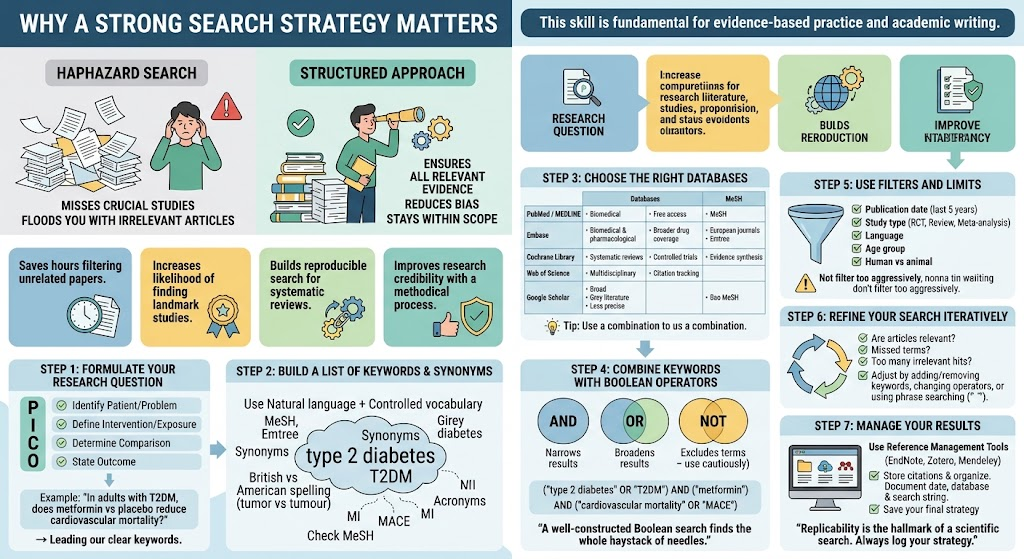
A haphazard search can miss crucial studies or flood you with irrelevant articles. A structured approach to medical literature search ensures you cover all relevant evidence, reduce bias, and stay within the scope of your question. This skill is fundamental for evidence-based practice and academic writing.
- Saves hours of filtering through unrelated papers.
- Increases the likelihood of finding landmark studies.
- Helps you build a reproducible search for systematic reviews or meta-analyses.
- Improves the credibility of your research by showing a methodical process.
Step 1: Formulate Your Research Question
Before typing any terms, clarify what you are looking for. Use frameworks like PICO (Population, Intervention, Comparison, Outcome) to break down your question.
- Identify the patient population or problem.
- Define the intervention or exposure.
- Determine the comparison group (if any).
- State the outcome of interest.
For example: “In adults with type 2 diabetes, does metformin compared to placebo reduce cardiovascular mortality?” This gives you clear keywords: adults, type 2 diabetes, metformin, placebo, cardiovascular mortality.
Step 2: Build a List of Keywords and Synonyms
Effective medical literature search depends on using both natural language and controlled vocabulary (MeSH terms in PubMed, Emtree in Embase). Start with brainstorming synonyms and alternate spellings.
- Use a thesaurus or look at relevant articles to find synonyms.
- Include British and American English variations (e.g., “tumour” vs. “tumor”).
- Consider acronyms and abbreviations (e.g., “MI” for myocardial infarction).
- Check MeSH database for official terms.
For the diabetes example, possible keywords: “type 2 diabetes mellitus”, “T2DM”, “metformin”, “cardiovascular mortality”, “heart disease death”, “major adverse cardiovascular events”.
Step 3: Choose the Right Databases
Not all databases cover the same literature. For clinical questions, use a combination of the following:
| Database | Scope | Strengths |
|---|---|---|
| PubMed / MEDLINE | Biomedical literature since 1946 | Free access, strong MeSH indexing, wide clinical coverage |
| Embase | Biomedical and pharmacological | Broader drug coverage, more European journals, Emtree terms |
| Cochrane Library | Systematic reviews and controlled trials | High-quality evidence synthesis, meta-analyses |
| Web of Science | Multidisciplinary, includes citation tracking | Useful for citation chaining and interdisciplinary topics |
| Google Scholar | Broad, includes grey literature | Quick but less precise; use as supplementary tool |
For most clinical questions, start with PubMed and add Embase if you have access. For systematic reviews, always include Cochrane and a second database.
Step 4: Combine Keywords with Boolean Operators
Boolean operators—AND, OR, NOT—let you refine your medical literature search.
- AND: Narrows results (both terms must appear).
- OR: Broadens results (either term appears).
- NOT: Excludes unwanted terms (use cautiously to avoid missing relevant articles).
Example search string for the diabetes question: (“type 2 diabetes” OR “T2DM” OR “diabetes mellitus, type 2”) AND (“metformin” OR “biguanide”) AND (“cardiovascular mortality” OR “major adverse cardiac event” OR “MACE”)
“A well-constructed Boolean search is the difference between finding a needle in a haystack and finding the whole haystack of needles.”
Step 5: Use Filters and Limits
Once you run a search, apply filters to narrow results to what you really need. Most databases let you limit by:
- Publication date (e.g., last 5 years)
- Study type (randomized controlled trial, review, meta-analysis)
- Language
- Age group
- Human vs. animal studies
Be careful not to filter too aggressively—you might accidentally exclude important older studies or non-English trials.
Step 6: Refine Your Search Iteratively
No search is perfect on the first attempt. Review the first 20 results and note:
- Are the articles relevant?
- Are there terms you missed?
- Are there too many irrelevant hits?
Adjust by adding or removing keywords, changing operators, or using phrase searching with quotation marks (e.g., “cardiovascular mortality”). Iterate until your results become precise and comprehensive.
Step 7: Manage Your Results
Keep track of your search history and saved articles. Use reference management tools like EndNote, Zotero, or Mendeley to store citations and organize them by topic.
- Document the date you ran each search.
- Record which database and search string you used.
- Save your final search strategy so you can reproduce it later.
“Replicability is the hallmark of a scientific search. Always log your strategy.”
Common Pitfalls in Medical Literature Search
Even experienced researchers make mistakes. Watch out for:
- Relying only on one database.
- Using too few synonyms, which leads to missing relevant papers.
- Not using MeSH terms when available.
- Forgetting to exclude animal studies on a human-focused question.
- Overusing NOT, which can accidentally filter out relevant articles containing the excluded term in a different context.
Putting It All Together: A Sample Search Workflow
- Formulate PICO question.
- List main concepts and synonyms.
- Choose PubMed and Embase (if accessible).
- Build a Boolean string, test it, and refine.
- Apply filters (e.g., last 5 years, RCTs).
- Run the search, screen abstracts, and save relevant records.
- Export to reference manager and deduplicate.
- Perform citation tracking on key papers (forward and backward).
Conclusion
Mastering medical literature search is a skill that grows with practice. By breaking down your question, choosing the right databases, combining keywords with Boolean logic, and iterating your approach, you will consistently retrieve relevant evidence. This process not only strengthens your academic work but also supports safe, informed clinical decisions. Apply these principles every time you search, and your results will speak for themselves.
Frequently Asked Questions
What is the best database for medical literature search?
There is no single “best” database because it depends on your question. PubMed is an excellent free starting point for clinical topics. For drug-focused questions, Embase offers broader pharmacological coverage. For systematic reviews, always include the Cochrane Library and at least one major database like MEDLINE or Embase.
How do I find MeSH terms for my search?
You can browse the MeSH database directly from PubMed’s homepage. Alternatively, look at the MeSH terms listed on relevant articles in PubMed; they appear under the abstract. Use the “MeSH” tab in PubMed to search for a term and see its hierarchy and related synonyms.
What is the difference between PubMed and MEDLINE?
MEDLINE is a subset of PubMed that includes only indexed journals selected by the National Library of Medicine. PubMed contains MEDLINE plus in-process citations, articles from PubMed Central (full text), and some other sources. In practice, searching PubMed usually covers all MEDLINE content and more.
How many keywords should I include in a single search?
There is no fixed number, but a good rule is to use 2-4 main concepts with 2-5 synonyms each. Overloading a search with too many terms can make it unmanageable or overly narrow. Start small and expand only if needed.
Should I use the NOT operator often?
Use NOT sparingly and only when you are certain that the excluded term will never appear in a relevant article. For example, limiting to “human” by using “NOT animals” can accidentally remove articles that discuss both. It is safer to apply filters for species when available rather than using NOT.
How can I tell if my search strategy is good enough?
Run a test search and check the first 30-50 results. If more than 80% are relevant, your strategy is strong. If you find a landmark article that you know exists but did not appear, review your keywords and MeSH terms. Also compare your search output to a known systematic review in the same topic.
Why is it important to document my search strategy?
Documentation allows others to replicate your work, which is essential for systematic reviews and for academic transparency. It also helps you track changes if you need to update the search later. Many journals now require a search strategy appendix.
Can I use Google Scholar for a medical literature search?
Google Scholar can be helpful for finding grey literature, patents, and citations, but it lacks the precision of controlled vocabulary and advanced Boolean searching. Use it as a supplement, not as your primary database, especially for clinical questions where accuracy matters.
How do I handle search results that are too broad or too narrow?
If results are too broad, add more AND conditions or use more specific MeSH subheadings. If too narrow, remove some AND terms, add OR synonyms, or broaden your filters (e.g., expand the date range). Always check your spelling and consider that a single typo can produce zero results.
What are some free tools to help me build a search strategy?
PubMed’s MeSH database is free. The Cochrane Handbook provides detailed guidance on search strategy design. The Yale MeSH Analyzer and the Polyglot Search Translator (from the University of Alberta) can help translate strategies between databases. Many universities also offer open-access search strategy worksheets.