Spinal tumors can develop silently, often mimicking common back pain or nerve issues. Recognizing the warning signs early and understanding which diagnostic tests confirm a spinal tumor can make a significant difference in treatment outcomes and preserving neurological function. This guide covers the most common symptoms, when to seek medical attention, and the key tests used to diagnose spinal tumors accurately.
What Are Spinal Tumors?
A spinal tumor is an abnormal growth of cells within or near the spinal cord, the vertebrae, or the surrounding tissues. These tumors can be benign (non-cancerous) or malignant (cancerous). They may originate in the spine (primary spinal tumor) or spread from another part of the body, such as the lungs, breast, or prostate (metastatic spinal tumor).
Because the spinal canal is a confined space, even a small tumor can compress the spinal cord or nerve roots. This compression leads to the symptoms that patients notice first.
Early Warning Signs of a Spinal Tumor
The earliest warning signs are often subtle and easy to dismiss. However, certain patterns are more suggestive of a spinal tumor than typical mechanical back pain.
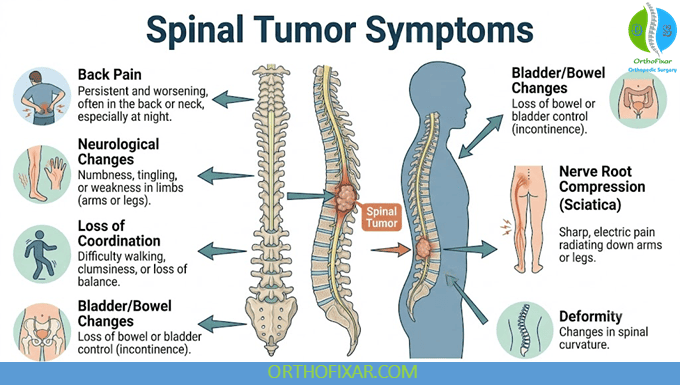
- Persistent back pain that does not improve with rest or changes in position.
- Pain that worsens at night and may wake you from sleep.
- Pain that increases with straining such as coughing, sneezing, or bearing down.
- Pain that radiates down your arms or legs, following a nerve pathway.
- Numbness or tingling in the hands, fingers, feet, or toes.
- Muscle weakness in the arms or legs, making it hard to grip objects or walk steadily.
Unlike typical back pain that improves with lying down, spinal tumor pain often becomes more intense at night. This is a key distinguishing feature that doctors use during evaluation.
Specific Symptoms Based on Tumor Location
Where the tumor sits along the spine determines which symptoms appear first. The spine is divided into three main regions: cervical (neck), thoracic (mid-back), and lumbar (lower back).
Cervical Spine Tumors
- Neck pain that may spread to the shoulders or arms.
- Numbness or weakness in the arms, hands, or fingers.
- Difficulty with fine motor tasks like buttoning a shirt or writing.
- In rare cases, weakness in the legs if the spinal cord is compressed.
Thoracic Spine Tumors
- Mid-back pain, often felt between the shoulder blades.
- Bilateral leg weakness or numbness.
- Loss of coordination or balance when walking.
- Bowel or bladder dysfunction (incontinence or retention) can occur if compression is significant.
Lumbar Spine Tumors
- Lower back pain that may radiate into the buttocks and legs.
- Sciatica-like pain that does not respond to typical treatments.
- Weakness in the legs or feet, causing a foot drop.
- Loss of sensation in the saddle area (inner thighs, groin, and perineum).
For example, a patient with a lumbar tumor might notice they drag their left foot when walking, while someone with a thoracic tumor may feel a tight band-like sensation around their chest or abdomen.
“The most common early symptom of a spinal tumor is localized back pain, but the distinctive feature is that the pain persists at rest and often worsens at night. If you have back pain that wakes you up regularly, it warrants further investigation.” — Clinical Neurology Note
Neurological Changes You Should Not Ignore
Spinal tumors do not just cause pain—they also affect how your nervous system works. Neurological changes are often the most alarming signs and require urgent medical evaluation.
- Loss of bladder or bowel control: This can indicate cauda equina syndrome, a surgical emergency.
- Sudden or progressive weakness: Difficulty standing up from a chair or climbing stairs.
- Numbness or sensory loss: An inability to feel light touch, temperature, or vibration in the legs.
- Gait disturbances: Walking becomes unsteady, or you may trip frequently.
If you experience any of these neurological symptoms along with back pain, seek medical attention immediately. Delaying treatment can lead to permanent nerve damage.
Diagnostic Tests for Spinal Tumors
Confirming the presence of a spinal tumor requires imaging and sometimes tissue sampling. The diagnostic process typically starts with a clinical exam and progresses to advanced imaging.
Physical and Neurological Exam
Your doctor will check your reflexes, muscle strength, sensation, and coordination. They may also test for specific signs like the Babinski reflex or clonus, which can indicate upper motor neuron involvement.
Magnetic Resonance Imaging (MRI)
MRI is the gold standard for diagnosing spinal tumors. It provides detailed images of the spinal cord, nerve roots, and surrounding soft tissues. An MRI with contrast can highlight tumor boundaries and help differentiate between tumor types.
Computed Tomography (CT) Scan
A CT scan is useful for visualizing bone structures. It can show whether a tumor has eroded the vertebrae or spread into the spinal canal. CT myelography, where dye is injected into the spinal fluid, may be used if MRI is not available or contraindicated.
Biopsy
If imaging suggests a tumor, a biopsy is often needed to determine if it is benign or malignant. A needle biopsy guided by CT or MRI is common. The tissue sample is examined under a microscope to identify the tumor type, which guides treatment decisions.
Electromyography (EMG) and Nerve Conduction Studies
These tests measure the electrical activity of muscles and the speed of nerve signals. They help assess how much nerve damage the tumor has caused, especially if there is muscle weakness or numbness.
Lumbar Puncture (Spinal Tap)
In cases where a tumor is suspected to involve the spinal cord lining, a lumbar puncture can analyze the cerebrospinal fluid for abnormal cells or markers.
Comparison of Diagnostic Imaging Tests
| Test | What It Shows Best | When It Is Used |
|---|---|---|
| MRI | Soft tissues, spinal cord, nerve roots | Primary test for tumor detection and characterization |
| CT Scan | Bone structures, calcifications | Evaluating bone destruction or surgical planning |
| CT Myelography | Spinal cord and nerve root compression | When MRI is contraindicated or not available |
| Biopsy | Tumor tissue type and grade | Confirming diagnosis and guiding treatment |
| PET Scan | Metabolic activity, possible metastases | Staging cancers that may have spread to the spine |
“An MRI is non-negotiable when a spinal tumor is suspected. It provides the clearest picture of the spinal cord and can detect tumors that plain X-rays or CT scans might miss entirely.” — Radiologist Insight
When to See a Doctor
Many people have back pain at some point in their lives, but certain red flags signal a need for prompt medical attention. You should see a doctor if:
- Your back pain is persistent and does not improve with rest or over-the-counter pain relievers.
- Pain is worse at night or wakes you from sleep.
- You notice any numbness, tingling, or weakness in your arms or legs.
- You experience unexplained weight loss, fever, or chills alongside back pain.
- You have a history of cancer (even if treated years ago) and develop new back pain.
Early diagnosis dramatically improves treatment options. For instance, a small benign tumor can sometimes be surgically removed with full recovery, while a larger malignant tumor may require radiation, chemotherapy, or complex surgery.
Treatment Overview
Treatment for spinal tumors depends on the tumor type, location, size, and whether it is benign or malignant. Common approaches include:
- Observation: Small, benign, asymptomatic tumors may be monitored with regular imaging.
- Surgery: Often the first line for tumors causing compression or neurological symptoms.
- Radiation therapy: Used to shrink tumors or treat inoperable ones.
- Chemotherapy: For malignant tumors such as lymphoma or metastatic disease.
- Targeted therapy and immunotherapy: Newer options for specific tumor types.
For example, a patient with a small intradural-extramedullary meningioma may undergo a successful surgical resection with minimal recovery time, while a patient with metastatic lung cancer to the spine might receive a combination of radiation and systemic therapy.
Conclusion
Spinal tumor symptoms can be easy to overlook because they often start as ordinary back pain. However, paying attention to key warning signs—such as pain that worsens at night, neurological changes in the arms or legs, and bladder or bowel dysfunction—can lead to earlier diagnosis. MRI remains the most reliable test for detecting these tumors, and prompt evaluation by a specialist is critical. If you recognize any of these symptoms in yourself or a loved one, do not wait. Early detection preserves quality of life and opens the door to more effective treatment options.
Frequently Asked Questions (FAQ)
What is the most common symptom of a spinal tumor?
The most common symptom is persistent back pain that does not improve with rest. Unlike mechanical back pain, spinal tumor pain often worsens at night and may wake you from sleep.
Can spinal tumors be benign?
Yes, many spinal tumors are benign. Common benign spinal tumors include meningiomas, schwannomas, and neurofibromas. Benign tumors grow slowly and may not require immediate treatment if they are not causing symptoms.
Are spinal tumors always cancerous?
No, spinal tumors can be either benign (non-cancerous) or malignant (cancerous). Malignant spinal tumors can be primary (originate in the spine) or metastatic (spread from another part of the body).
What is the difference between a primary and metastatic spinal tumor?
A primary spinal tumor starts in the spine itself, such as an astrocytoma or chordoma. A metastatic spinal tumor originates elsewhere in the body (e.g., lung, breast, prostate) and spreads to the spine. Metastatic tumors are more common than primary spinal tumors.
How is a spinal tumor diagnosed?
Diagnosis typically starts with a neurological exam and is confirmed with magnetic resonance imaging (MRI). A biopsy may be needed to determine if the tumor is benign or malignant. CT scans and PET scans are used for additional evaluation.
Is back pain at night always a sign of a spinal tumor?
No, nighttime back pain can have many causes, including inflammatory arthritis, infection, or disc problems. However, persistent nocturnal back pain that does not improve with rest should be evaluated by a doctor to rule out a tumor.
Can a spinal tumor cause leg weakness?
Yes, spinal tumors can compress the spinal cord or nerve roots, leading to weakness, numbness, or tingling in the legs. This is especially common with tumors in the thoracic or lumbar spine.
What is cauda equina syndrome?
Cauda equina syndrome is a medical emergency caused by compression of the nerve roots at the bottom of the spinal cord. Symptoms include severe lower back pain, loss of bladder or bowel control, numbness in the saddle area, and leg weakness. Immediate surgery is required.
Do spinal tumors always require surgery?
Not always. Small, benign, and asymptomatic tumors may be monitored with regular imaging. Surgery is typically recommended when the tumor causes pain, neurological symptoms, or is growing. Some tumors are treated with radiation or chemotherapy instead.
What is the prognosis for a spinal tumor?
Prognosis depends on the tumor type, location, size, and whether it is benign or malignant. Benign tumors often have an excellent prognosis with complete surgical removal. Malignant tumors have a more variable outlook and require a multidisciplinary treatment approach. Early diagnosis is strongly associated with better outcomes.