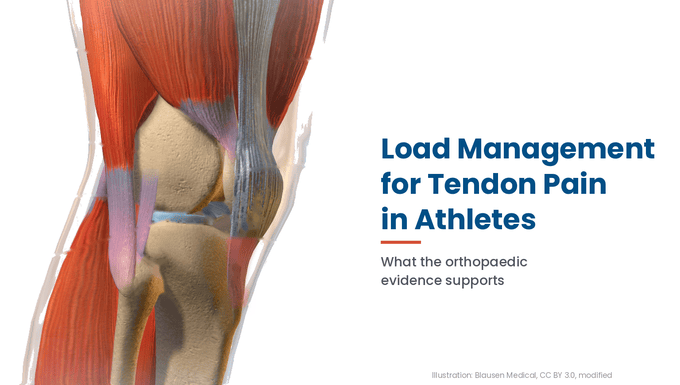
Tendon pain in Athletes is one of the most stubborn overuse problems in sport. Runners feel it in the Achilles, jumpers below the kneecap, throwers and racket players at the elbow and shoulder, and lifters almost anywhere. The usual first response is to stop the painful activity and wait for it to settle. For most overuse tendinopathy, that is the weakest option available. The tendon needs the right dose of load, applied consistently, and the clinician’s job is to find that dose and to recognise the cases where load is not the answer. This article is educational and does not replace individual assessment.
Epidemiology
Tendinopathy is common wherever a tendon is loaded fast and often. In a cross-sectional study of 613 elite athletes from nine sports, 14.2% had current jumper’s knee, with the highest rates in volleyball and basketball and no cases in cycling or orienteering; symptoms had lasted an average of 32 months [1]. Recreational athletes are affected too, with a prevalence of 8.5% among 891 non-elite players [2], and tendinitis ranks among the most common injury types in the weight-training sports [3].
Pathology: A Load Problem More Than Inflammation
The word “tendinitis” suggests an inflamed tendon that will settle with rest and anti-inflammatories. Khan and colleagues argued in 2002 that this picture is largely a myth [4]. Painful tendons typically show rounded cells, new blood vessels and disorganised collagen [5], which describes a tissue that has failed to adapt to the load placed on it. Cook and Purdam’s continuum model frames tendinopathy as a spectrum rather than a single state, which helps explain why two athletes with the same diagnosis can respond so differently; it remains a model rather than a proven sequence [6].
Clinically, the presentation is familiar: pain with loading, localised tenderness, sometimes swelling, and a drop in performance [5].
Why Complete Rest Rarely Works
Rest reduces pain because it removes the provocation, but it does little for the tissue. Carbon-14 dating shows that the core of the adult Achilles tendon is laid down during the first 17 years of life and is essentially not renewed afterwards [7], so an unloaded tendon does not quietly rebuild itself. Loading, on the other hand, is the stimulus for collagen synthesis, which stays elevated for about three days after exercise [5].
In Achilles tendinopathy, patients who kept running and jumping under a pain-monitoring model did as well at 12 months as those who stopped for six weeks, with no sign of harm [8]. In Alfredson’s early series, a 12-week heavy eccentric programme returned all 15 recreational athletes to running, while all 15 in a comparison group treated conventionally, including rest and anti-inflammatory drugs, went on to surgery [9].
Treatment: Loading Options
Several loading strategies have reasonable support. The choice depends on how irritable the tendon is and what the athlete needs to return to.
- Isometrics. Sustained holds can reduce pain quickly. In a small crossover study of volleyball players with patellar tendinopathy, pain during a single-leg decline squat fell from 7.0 to 0.17 out of 10 and was still reduced 45 minutes later [10]. A later meta-analysis found isometrics no better than isotonic exercise for chronic tendinopathy [11], so they work best as a pain-management tool before training, alongside a full programme.
- Heavy slow resistance (HSR). In patellar tendinopathy, HSR performed as well as eccentric training and, unlike a corticosteroid injection, kept its benefit at six months, with reduced tendon swelling and vascularity [12].
- Eccentric training. Still effective, but harder to stick with. In Achilles tendinopathy, eccentric training and HSR produced the same outcomes at one year, but compliance was higher with HSR (92% vs 78%) and satisfaction tended to be higher too [13].
- Intensity. In healthy tendons, stiffness adapts to how heavy the load is rather than to the type of contraction [14]. That supports progressing load over time rather than chasing one particular exercise.
Comparing the Options
| Option | Best For | Key Considerations |
| Isometric holds | Short-term pain relief before training | Relief still present at 45 minutes in a small trial; not better than isotonic exercise for chronic tendinopathy |
| Heavy slow resistance | Rebuilding tendon capacity over about 12 weeks | Gains held at six months and one year; highest satisfaction and compliance in trials |
| Eccentric training | Achilles and patellar tendinopathy | Outcomes similar to HSR at 52 weeks; lower compliance (78% vs 92%) |
| Corticosteroid injection | Short-term pain control under medical supervision | Worse one-year recovery (83% vs 96%) and more recurrence (54% vs 12%) than placebo |
| Rest from the painful activity | Red flags or suspected rupture, until medically assessed | Does not rebuild tendon capacity; pain-monitored loading caused no measurable harm |
Corticosteroid Injections
Corticosteroid injections reliably reduce pain in the short term, and for a competing athlete that is exactly the risk. A Lancet review of 41 trials found a large early effect on lateral elbow pain that reversed at intermediate and long-term follow-up [15]. In a later randomised trial, patients who received an injection were less likely to have recovered or much improved at one year (83% vs 96% with placebo) and far more likely to relapse (54% vs 12%) [16]. Relief that arrives before the tendon has regained capacity makes an early return to full training more likely.
Practical Load Management
In practice, load management means adjusting training rather than stopping it.
- Modify the provoking activity: running volume, jump count, throwing load, range of motion or weekly lifting volume.
- Use isometric holds before training if they reduce pain, as preparation rather than the main stimulus.
- Build a progressive heavy slow resistance block; the trials above ran for 12 weeks.
- Monitor symptoms during loading, after the session and the next morning. If pain builds from day to day, reduce load or volume rather than abandoning the programme.
For a detailed walkthrough of the continuum model, loading progressions and recovery timelines, see this guide to tendonitis vs tendinosis.
When to Refer
Refer the athlete to a physician or orthopaedic surgeon if any of the following are present:
- A sudden pop or snap with immediate weakness, which may indicate rupture.
- Inability to bear weight, lift the arm or complete a basic movement.
- Marked swelling, heat, redness or fever.
- Pain at night or at rest that is not linked to loading.
- Numbness, tingling or pain that radiates along a limb.
- Pain after trauma, or a visible deformity.
- No meaningful improvement after a properly dosed 12-week programme.
Author’s note. Deferring assessment has a real cost. While preparing for a competition, I sustained an elbow injury and continued training through to the event, by which point elbow extension was reduced by roughly 15%. A persistent loss of extension after the competition led to arthroscopic surgery. Competitive athletes often postpone medical assessment until after an event; when the signs above are present, that delay can turn a manageable injury into a lasting limitation.
Key Clinical Pearls
- Tendinopathy responds to graded load; complete rest alone rarely restores capacity.
- Isometrics ease pain in the short term; heavy slow resistance and eccentric training rebuild capacity over months.
- Corticosteroid injections relieve pain early but are linked with worse one-year outcomes and more recurrence.
- Red flags and a lack of progress after a well-dosed programme call for medical assessment, not more load.
References
- Lian OB, Engebretsen L, Bahr R. Prevalence of jumper’s knee among elite athletes from different sports: a cross-sectional study. Am J Sports Med. 2005;33(4):561-567. PMID: 15722279. Link
- Zwerver J, Bredeweg SW, van den Akker-Scheek I. Prevalence of jumper’s knee among nonelite athletes from different sports: a cross-sectional survey. Am J Sports Med. 2011;39(9):1984-1988. PMID: 21737835
- Keogh JW, Winwood PW. The epidemiology of injuries across the weight-training sports. Sports Med. 2017;47(3):479-501. PMID: 27328853
- Khan KM, Cook JL, Kannus P, Maffulli N, Bonar SF. Time to abandon the “tendinitis” myth. BMJ. 2002;324(7338):626-627. PMID: 11895810
- Magnusson SP, Langberg H, Kjaer M. The pathogenesis of tendinopathy: balancing the response to loading. Nat Rev Rheumatol. 2010;6(5):262-268. PMID: 20308995
- Cook JL, Purdam CR. Is tendon pathology a continuum? A pathology model to explain the clinical presentation of load-induced tendinopathy. Br J Sports Med. 2009;43(6):409-416. PMID: 18812414
- Heinemeier KM, Schjerling P, Heinemeier J, Magnusson SP, Kjaer M. Lack of tissue renewal in human adult Achilles tendon is revealed by nuclear bomb 14C. FASEB J. 2013;27(5):2074-2079. PMID: 23401563
- Silbernagel KG, Thomeé R, Eriksson BI, Karlsson J. Continued sports activity, using a pain-monitoring model, during rehabilitation in patients with Achilles tendinopathy: a randomized controlled study. Am J Sports Med. 2007;35(6):897-906. PMID: 17307888
- Alfredson H, Pietilä T, Jonsson P, Lorentzon R. Heavy-load eccentric calf muscle training for the treatment of chronic Achilles tendinosis. Am J Sports Med. 1998;26(3):360-366. PMID: 9617396
- Rio E, Kidgell D, Purdam C, et al. Isometric exercise induces analgesia and reduces inhibition in patellar tendinopathy. Br J Sports Med. 2015;49(19):1277-1283. PMID: 25979840
- Clifford C, Challoumas D, Paul L, Syme G, Millar NL. Effectiveness of isometric exercise in the management of tendinopathy: a systematic review and meta-analysis of randomised trials. BMJ Open Sport Exerc Med. 2020;6(1):e000760. PMID: 32818059
- Kongsgaard M, Kovanen V, Aagaard P, et al. Corticosteroid injections, eccentric decline squat training and heavy slow resistance training in patellar tendinopathy. Scand J Med Sci Sports. 2009;19(6):790-802. PMID: 19793213
- Beyer R, Kongsgaard M, Hougs Kjær B, et al. Heavy slow resistance versus eccentric training as treatment for Achilles tendinopathy: a randomized controlled trial. Am J Sports Med. 2015;43(7):1704-1711. PMID: 26018970
- Bohm S, Mersmann F, Arampatzis A. Human tendon adaptation in response to mechanical loading: a systematic review and meta-analysis of exercise intervention studies on healthy adults. Sports Med Open. 2015;1(1):7. PMID: 27747846
- Coombes BK, Bisset L, Vicenzino B. Efficacy and safety of corticosteroid injections and other injections for management of tendinopathy: a systematic review of randomised controlled trials. Lancet. 2010;376(9754):1751-1767. PMID: 20970844
- Coombes BK, Bisset L, Brooks P, Khan A, Vicenzino B. Effect of corticosteroid injection, physiotherapy, or both on clinical outcomes in patients with unilateral lateral epicondylalgia: a randomized controlled trial. JAMA. 2013;309(5):461-469. PMID: 23385272