Shoulder osteoarthritis is one of the most common causes of shoulder pain and stiffness, particularly as cartilage gradually wears down with age. It affects the smooth, slippery tissue that cushions the ends of bones inside the joint, and when that cushion thins, the bones can rub together in ways that produce pain, grinding, and loss of motion. The condition tends to develop slowly, and while it cannot be reversed, it can usually be managed effectively with exercise, lifestyle adjustments, and medical care. This guide explains what shoulder osteoarthritis is, how it differs from other shoulder problems, which exercises and daily habits help most, and when it is time to seek professional care.
What Is Shoulder Osteoarthritis?
Osteoarthritis is a degenerative joint disease in which the cartilage inside a joint breaks down over time. Cartilage is the smooth, slippery tissue that covers the ends of bones and allows them to glide against each other without friction. As it wears away, the bones lose their protective cushion, and movement becomes painful and restricted.
The shoulder contains two main joints that osteoarthritis can affect, either separately or together:
- The glenohumeral joint. This is the primary ball-and-socket joint, where the rounded head of the upper arm bone (humerus) meets the shallow socket of the shoulder blade (scapula). It provides most of the shoulder’s range of motion.
- The acromioclavicular joint. This is where the collarbone (clavicle) meets the top of the shoulder blade. It handles smaller movements and is a frequent site of arthritis-related pain at the top of the shoulder.
Osteoarthritis is not simply the result of mechanical wear. The entire joint can change, including the cartilage, the bone underneath it, the joint lining (synovium), and the ligaments that stabilize the joint. These changes typically develop gradually over months or years, which is why early symptoms are often subtle.
While osteoarthritis becomes more common with age, it is not an inevitable part of aging. It can also appear earlier in life following an injury or after years of repetitive heavy use.
What Causes Shoulder Osteoarthritis?
Osteoarthritis is often described as wear-and-tear arthritis, but that label oversimplifies the process. The condition involves a combination of mechanical stress, joint biology, and individual risk factors. In many cases, no single cause can be identified, and the joint simply changes with time and use.
Factors that can raise the risk of developing shoulder osteoarthritis include:
- Age. Cartilage becomes weaker and less resilient over time, and cumulative stress on the joint adds up.
- Previous shoulder injury. Fractures, dislocations, and other trauma can damage cartilage and alter how the joint moves, increasing stress on remaining cartilage.
- Repetitive heavy use. Occupations and activities that involve repeated heavy lifting or overhead work place sustained stress on the shoulder joint.
- Prior shoulder surgery. Surgery can change joint mechanics and contribute to cartilage breakdown over time.
- Family history. A genetic predisposition to osteoarthritis can increase risk.
- Excess body weight. Higher body weight increases mechanical stress on weight-bearing joints and is also associated with systemic inflammation that can affect joints generally.
- Other joint conditions. Inflammatory conditions such as rheumatoid arthritis can damage joint cartilage and lead to secondary osteoarthritis.
Understanding these risk factors can help you take practical steps to protect your shoulder, especially if you have a history of injury or a physically demanding job.
Symptoms of Shoulder Osteoarthritis
The hallmark symptoms of shoulder osteoarthritis are pain and stiffness. Pain usually begins gradually and worsens over time. Many people notice it most in the morning or after a period of rest, and it often eases with gentle movement.
Typical symptoms include:
- A deep ache in the shoulder that may radiate into the upper arm
- Stiffness that makes it difficult to reach behind your back, such as when fastening clothing
- Pain when lifting the arm overhead or reaching out to the side
- A grinding, clicking, or cracking sensation (crepitus) during movement
- Pain that worsens with activity and improves with rest
- Weakness in the arm, particularly when lifting or carrying objects
- Sleep disruption, especially when lying on the affected side
Some people also notice visible changes. The joint may appear larger due to bone spurs or swelling, and the muscles around the shoulder may look thinner if the arm has been used less. These changes reflect how the condition affects both the joint and the surrounding soft tissues.
How Symptoms Change Over Time
In the early stages, pain may come and go, appearing only after certain activities. As the condition progresses, stiffness often becomes the dominant problem. Range of motion gradually decreases, and movements that were once automatic, such as reaching a high shelf, fastening a bra, or putting on a coat, can become difficult and frustrating.
The pace of change varies widely. Some people experience mild symptoms for years, while others notice a steady decline in function. Tracking your symptoms can help you and your doctor adjust treatment over time.
How Doctors Diagnose Shoulder Osteoarthritis
Diagnosis typically begins with a medical history and physical examination. Your doctor will ask about the nature and location of your pain, when it started, what makes it better or worse, and how it affects daily activities. They will also assess your shoulder’s range of motion, strength, and stability, and may compare it with the unaffected side.
Imaging and laboratory tests may be used to confirm the diagnosis and rule out other conditions:
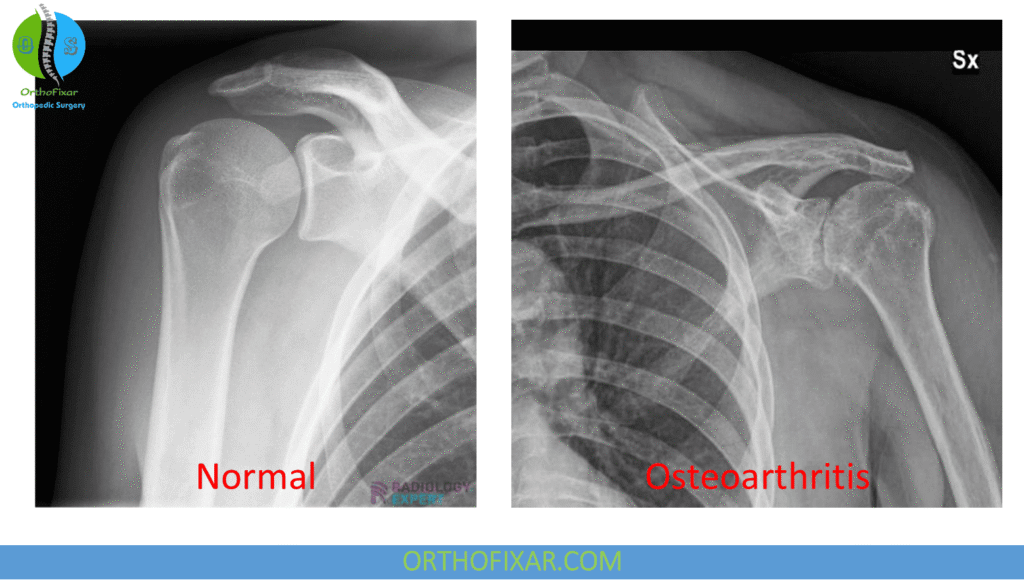
- X-rays. These are the most useful imaging test for osteoarthritis. They can reveal joint space narrowing (indicating cartilage loss), bone spurs (osteophytes), and changes in the shape of the joint.
- MRI or ultrasound. These may be ordered to evaluate soft tissues such as tendons, ligaments, and the rotator cuff, especially if the diagnosis is unclear or if a coexisting injury is suspected.
- Blood tests. These can help rule out inflammatory types of arthritis, such as rheumatoid arthritis, which require different treatment.
Because several shoulder conditions produce similar symptoms, an accurate diagnosis is essential. The right treatment depends on identifying the right problem.
Shoulder Osteoarthritis vs Other Shoulder Problems
Many shoulder conditions cause pain and limited movement, so distinguishing between them helps guide treatment. The table below compares common shoulder problems.
| Condition | Main Symptom | Typical Cause | Key Difference |
|---|---|---|---|
| Osteoarthritis | Deep ache and stiffness | Cartilage wear over time | Grinding sensation; pain worsens with both rest and activity |
| Rotator cuff tear | Weakness and pain with lifting | Injury or degenerative wear | Weakness is often the primary problem |
| Frozen shoulder (adhesive capsulitis) | Severe stiffness in all directions | Inflammation and thickening of the joint capsule | Stiffness typically outweighs pain |
| Shoulder bursitis | Sharp pain with movement | Inflammation of a fluid-filled sac | Pain often has a more sudden onset |
| Tendinitis | Pain near the tendon | Overuse or strain | Pain is usually localized to one spot |
If you are unsure which condition you have, seek a professional evaluation. Self-diagnosis can lead to ineffective or even harmful treatment choices.
Exercises for Shoulder Osteoarthritis
Exercise is one of the most effective ways to manage shoulder osteoarthritis. It keeps the joint moving, strengthens the muscles that support it, and reduces stiffness. Always start gently, progress gradually, and stop if pain becomes sharp or severe. A doctor or physical therapist can help you choose exercises that match your condition and fitness level.
Pendulum Exercise
Lean forward and let your affected arm hang down. Gently swing the arm in small circles, then reverse direction. Perform for about 30 seconds in each direction. This exercise helps loosen the joint with minimal effort and is often used early in rehabilitation.
Wall Walks
Stand facing a wall and walk your fingers up the wall as high as you can without significant pain, then walk them back down. Repeat 5 to 10 times. This improves range of motion in a controlled way.
Shoulder Blade Squeezes
Sit or stand with good posture. Pull your shoulder blades back and down as if squeezing a pencil between them. Hold for 5 seconds, then relax. Do 10 repetitions. This strengthens the muscles that stabilize the shoulder blade and support healthy shoulder mechanics.
Doorway Stretch
Place your forearm on a door frame with your elbow bent to about 90 degrees. Gently step forward until you feel a stretch in the front of your shoulder. Hold for 20 to 30 seconds. This helps relieve tightness in the chest and front of the shoulder.
Resistance Band Rows
Attach a light resistance band to a secure point. Hold the band and pull it toward your chest, squeezing your shoulder blades together. Perform 2 to 3 sets of 10 repetitions. This builds strength in the upper back and supports better posture.
Isometric Shoulder Holds
Press your arm against a wall or door frame without moving the joint. Hold for 5 to 10 seconds. This builds strength without straining the joint through a painful range of motion.
Aim for a short session most days. Even 10 minutes of daily movement can help maintain function. A physical therapist can design a program tailored to your specific limitations and goals.
Everyday Tips for Living With Shoulder Osteoarthritis
Small changes at home and at work can make a meaningful difference. The goal is to protect the joint while staying as active as possible.
- Use a pillow to support your arm while sleeping, and avoid sleeping on the affected shoulder.
- Keep frequently used items within easy reach to avoid repetitive overhead stretching.
- Use a step stool rather than reaching for high shelves.
- Warm up your shoulder with gentle movement before heavy or repetitive tasks.
- Take short breaks during repetitive work to rest and reposition the shoulder.
- Apply heat for stiffness, especially in the morning, and cold for sharp pain or swelling after activity.
- Maintain a healthy weight to reduce overall joint stress.
- Ask for help with heavy lifting, and use tools with larger, easier-to-grip handles.
- Practice good posture to reduce strain on the shoulder and upper back.
These habits will not cure osteoarthritis, but they can reduce pain, preserve function, and help you stay independent.
Treatment Options for Shoulder Osteoarthritis
Treatment usually follows a stepwise approach, starting with conservative measures and progressing to more advanced options only if needed. Most people do not require surgery.
Medications
Over-the-counter pain relievers such as acetaminophen can help with mild pain. Nonsteroidal anti-inflammatory drugs (NSAIDs) such as ibuprofen or naproxen can reduce both pain and inflammation. Always follow the label directions and consult a doctor if you take these medications frequently or have underlying health conditions. Topical creams and gels applied to the skin can also provide localized relief. For stronger pain, a doctor may prescribe other medications.
Physical Therapy
A physical therapist can teach exercises that improve motion and strength, and may use hands-on techniques to loosen tight tissues. Physical therapy is often the most important component of treatment because it addresses the underlying mechanical problems that contribute to pain and stiffness.
Injections
Corticosteroid injections can reduce pain and inflammation for a period of time, though they are not a cure and repeated injections are generally limited. Some doctors also use injections of a lubricant-like substance (viscosupplementation), although results vary and evidence for its effectiveness is mixed.
Other Procedures
If pain is severe and other treatments have not provided adequate relief, a doctor may discuss:
- Radiofrequency ablation. This procedure uses heat to reduce pain signals from nerves around the joint.
- Arthroscopy. A minimally invasive procedure to clean the joint and remove loose fragments or damaged tissue.
- Shoulder replacement surgery. Reserved for advanced cases with severe pain and significant loss of function. It can be very effective for appropriately selected patients.
Surgery is typically a last resort, considered only after conservative treatments have been exhausted.
When to See a Doctor
See a doctor if shoulder pain lasts more than a few weeks, keeps getting worse, or interferes with daily activities. Seek care promptly if you notice:
- Sudden severe pain or swelling
- Redness or warmth in the joint
- Fever along with shoulder pain
- Inability to move the arm at all
- Numbness or tingling in the arm or hand
- Pain following a fall or injury
These signs may indicate a different problem, such as infection, fracture, or nerve involvement, that requires urgent evaluation.
Outlook and Long-Term Management
Shoulder osteoarthritis is a long-term condition, but most people can manage it well with the right approach. Staying active, maintaining a healthy weight, and performing gentle exercises can slow the progression of stiffness and help protect the joint.
The course of the condition varies from person to person. Some people have mild symptoms for years, while others experience a gradual worsening. Regular check-ups and a well-designed treatment plan can help you stay in control and adapt as your needs change.
Movement is essential. Avoiding all activity can make the joint stiffer and weaker, which can worsen symptoms over time. The key is to find a balance between rest and activity that keeps the shoulder functioning without provoking pain.
Conclusion
Shoulder osteoarthritis is a common and often manageable cause of shoulder pain and stiffness. Understanding the symptoms, performing appropriate exercises, and adopting simple daily habits can make a real difference in comfort and function. If pain is severe or does not improve with conservative measures, talk to a doctor about other treatment options. With the right plan, most people can keep their shoulder working and remain active.
Frequently Asked Questions
Can shoulder osteoarthritis be cured?
There is no cure for osteoarthritis, but symptoms can be managed effectively with exercise, lifestyle changes, and medical treatment. Many people find that their pain and stiffness improve significantly with the right plan.
What exercises are best for shoulder osteoarthritis?
Gentle range-of-motion exercises such as pendulum swings and wall walks are a good starting point. Strengthening exercises for the shoulder blades and upper back also help. A physical therapist can tailor a program to your specific needs and limitations.
Should I rest my shoulder or keep moving it?
Complete rest can make the joint stiffer and weaker. Gentle, regular movement is usually better. Avoid activities that cause sharp pain, but try to keep the shoulder active within a comfortable range.
Is heat or cold better for shoulder osteoarthritis?
Heat is often better for stiffness, especially in the morning or before exercise. Cold can help with sharp pain and swelling after activity. Try both and see which works best for you.
Can I still work if I have shoulder osteoarthritis?
Many people continue to work with some adjustments. Modify your tasks, take breaks, and maintain good posture. If your job involves heavy lifting or overhead work, talk to your doctor or an occupational therapist about strategies to protect your shoulder.
Will I need surgery for shoulder osteoarthritis?
Most people do not need surgery. Surgery is usually considered only when pain is severe and other treatments have not helped. Your doctor can discuss the risks and benefits of surgical options.
Does shoulder osteoarthritis get worse over time?
It can progress slowly, but the speed varies from person to person. Staying active and following a treatment plan may help slow the process and reduce symptoms.
What foods should I eat if I have shoulder osteoarthritis?
A balanced diet rich in fruits, vegetables, whole grains, and lean proteins supports overall joint health. Some people find that foods high in omega-3 fatty acids help reduce inflammation. There is no single diet that cures osteoarthritis, but healthy eating contributes to better overall well-being.
Can I prevent shoulder osteoarthritis?
You cannot always prevent it, but you can lower your risk. Avoid shoulder injuries, maintain a healthy weight, and stay active. If you sustain a shoulder injury, seek proper treatment early to reduce the chance of long-term joint damage.
When should I see a doctor about shoulder pain?
See a doctor if pain lasts more than a few weeks, gets worse, or limits your daily activities. Seek care right away if you have sudden severe pain, swelling, or cannot move your arm.