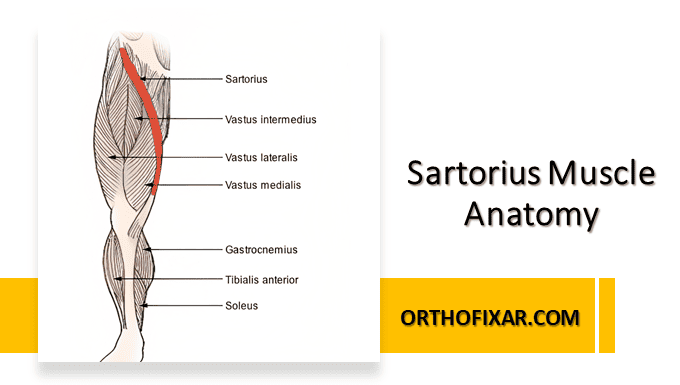
The sartorius muscle, commonly known as the “tailor’s muscle,” is a long, thin, ribbon-like muscle of the thigh. It is the longest muscle in the human body and runs obliquely from the lateral to the medial aspect of the supero-anterior thigh. The sartorius muscle lies superficially in the anterior compartment of the thigh, enclosed within its own distinct fascial sheath, and descends to the medial side of the knee.
The term sartorius is derived from the Latin word sartor, meaning tailor or patcher. This name reflects the characteristic cross-legged position adopted by tailors, which is produced by the combined actions of the sartorius muscle.
Sartorius Muscle Anatomy
Origin & Insertion
The sartorius muscle originates from the anterior superior iliac spine (ASIS) of the pelvis.
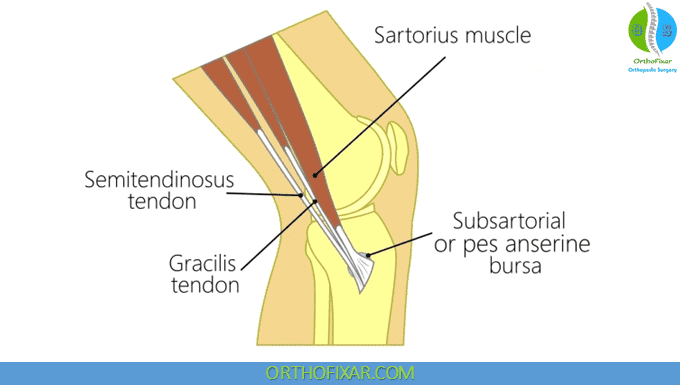
It travels obliquely across the thigh to insert on the superior aspect of the medial surface of the tibial shaft, near the tibial tuberosity. At this site, it joins the gracilis and semitendinosus muscles to form the pes anserinus.
See Also: Hip Muscles Anatomy
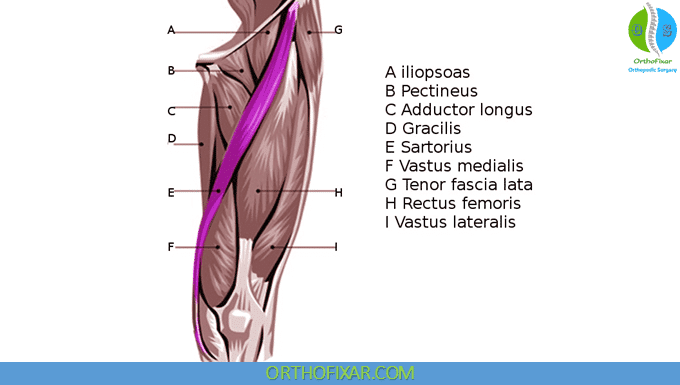
Innervation & Blood Supply
Blood Supply: Muscular branches of the femoral artery
Innervation: Femoral nerve (L2, L3, L4 nerve roots)
Sartorius Muscle Function
The sartorius muscle acts across two joints—the hip and the knee. Its primary actions include:
- Hip flexion
- Hip abduction (weak)
- Lateral (external) rotation of the thigh
- Knee flexion
When both sartorius muscles contract together, they position the lower limbs into a cross-legged sitting posture. Despite its length, the sartorius is a relatively weak muscle and functions mainly as a synergist, assisting other thigh muscles rather than producing powerful movements on its own.
| Origin | Anterior superior iliac spine |
| Insertion | Superior aspect of the medial surface of the tibial shaft near the tibial tuberosity (joins gracilis and semitendinosus at the pes anserinus) |
| Innervation | Femoral nerve (L2, L3, L4) |
| Blood Supply | Muscular branches of the femoral artery |
| Action | Flexes and laterally rotates the hip joint and flexes the knee |
The sartorius is one of the three muscles forming the pes anserinus, along with the gracilis and semitendinosus. This structure provides dynamic stability to the medial knee.
FAQ
What is the sartorius muscle?
The sartorius muscle is a long, superficial muscle of the anterior thigh and is the longest muscle in the human body. It runs obliquely from the pelvis to the medial side of the knee.
Why is the sartorius called the tailor’s muscle?
It is called the tailor’s muscle because its combined actions—hip flexion, abduction, and lateral rotation with knee flexion—produce the classic cross-legged sitting position used by tailors.
What is the origin and insertion of the sartorius?
The sartorius muscle originates from the anterior superior iliac spine (ASIS) and inserts on the superior medial surface of the tibia as part of the pes anserinus.
What nerve innervates the sartorius?
The sartorius is innervated by the femoral nerve, receiving fibers from the L2, L3, and L4 nerve roots.
What are the functions of the sartorius?
The sartorius muscle flexes the hip and knee, weakly abducts and laterally rotates the thigh, and assists in bringing the legs into a cross-legged position
What muscles form the pes anserinus?
The pes anserinus is formed by the sartorius, gracilis, and semitendinosus muscles, inserting together on the medial surface of the tibia.
References & More
- Cael, C. (2010). Functional anatomy: Musculoskeletal anatomy, kinesiology, and palpation for manual therapists. Philadelphia, PA: Wolters Kluwer Health/Lippincott, Williams & Wilkins.
- Moore, K. L., Dalley, A. F., & Agur, A. M. R. (2014). Clinically Oriented Anatomy (7th ed.). Philadelphia, PA: Lippincott Williams & Wilkins.
- Clinically Oriented Anatomy – 8th Edition
- Walters BB, Varacallo M. Anatomy, Bony Pelvis and Lower Limb: Thigh Sartorius Muscle. [Updated 2023 Aug 28]. In: StatPearls [Internet]. Treasure Island (FL): StatPearls Publishing; 2024 Jan-. Available from: Pubmed