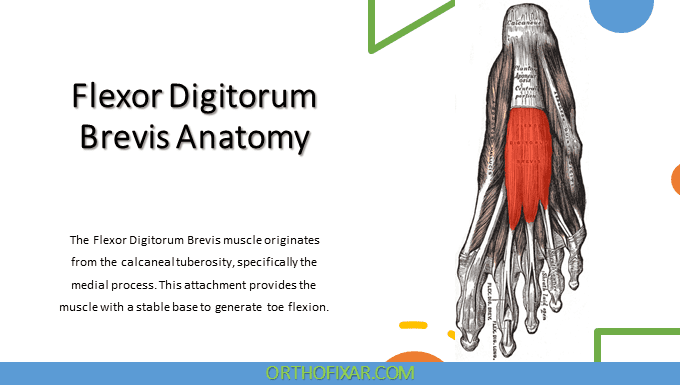
The Flexor Digitorum Brevis lies in the central compartment of the sole of the foot, immediately above the central part of the plantar aponeurosis, with which it is firmly united.
Flexor Digitorum Brevis Anatomy
Origin: The Flexor Digitorum Brevis muscle originates from the calcaneal tuberosity, specifically the medial process. This attachment provides the muscle with a stable base to generate toe flexion.
Insertion: The muscle inserts into the middle phalanges of the second to fifth toes via four tendons. These tendons split and then merge with those from the flexor digitorum longus to assist in toe movement.
Action: The primary function of the Flexor Digitorum Brevis is to flex the proximal interphalangeal (PIP) joints of the second to fifth toes. This action is crucial for maintaining balance and providing the necessary propulsion during gait.
Innervation: Innervated by the medial plantar nerve, the Flexor Digitorum Brevis is part of the plantar compartment muscles controlled by the tibial nerve.
Arterial Supply: Flexor digitorum brevis muscle is vascularized by the branches of the posterior tibial artery; medial plantar and lateral plantar arteries.
See Also: Foot Anatomy

Clinical Relevance:
- Plantar Fasciitis: Given its close association with the plantar fascia, inflammation or degeneration of the plantar fascia (plantar fasciitis) can affect the Flexor Digitorum Brevis, leading to pain and difficulty in toe flexion.
- Gait Abnormalities: Dysfunction in the FDB muscle can result in altered gait patterns. A weakened or injured Flexor Digitorum Brevis muscle may hinder the toe-off phase, leading to compensatory changes in other muscles and joints.
- Toe Deformities: Conditions like hammer toes can involve the FDB, either through muscle imbalance or compensatory changes, resulting in altered toe positions and function.
- Medial Plantar Neuropathy: Since the Flexor Digitorum Brevis muscle is innervated by the medial plantar nerve, compression or injury to this nerve may impair muscle function, leading to toe flexion weakness.
See Also: Gait Cycle
| Origin | Calcaneal tuberosity |
| Insertion | Middle phalanx of second to fifth toes of the foot |
| Innervation | Medial plantar nerve |
| Blood Supply | Medial plantar and lateral plantar arteries |
| Action | Flexes the toes of the foot |
References & More
- Clinically Oriented Anatomy – 8th Edition
- Orbay H, Kerem M, Unlü RE, Esmer AF, Cömert A, Tüccar E, Sensöz O. Vascular anatomy of plantar muscles. Ann Plast Surg. 2007 Apr;58(4):420-6. doi: 10.1097/01.sap.0000239821.73853.95. PMID: 17413886. Pubmed