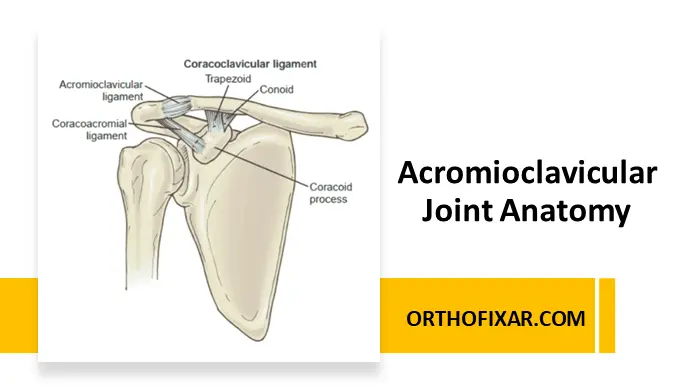
The acromioclavicular (AC) joint is a key anatomical structure of the shoulder girdle, playing a crucial role in upper limb mobility and stability. Understanding its anatomy is essential for medical assistants, clinicians, and rehabilitation professionals, especially when assessing shoulder injuries or dysfunction.
Overview of the AC Joint
The acromioclavicular joint is formed by the articulation between the distal (lateral) end of the clavicle and the acromion process of the scapula. It is classified as a plane synovial joint, allowing gliding movements that contribute to the complex motion of the shoulder.
This joint is essential for maintaining the coordinated relationship between the scapula and the clavicle, particularly during the early and late stages of glenohumeral (GH) joint range of motion.
See Also: Clavicle Anatomy | Bone & Muscles
Biomechanics and Movements
The AC joint allows motion in three degrees of freedom, each occurring around an oblique axis:
- Internal and external rotation around a vertical axis
- Upward and downward rotation around an axis perpendicular to the plane of the scapula
- Anterior and posterior tilting of the scapula around a horizontal axis
These subtle but critical movements enable proper scapulothoracic rhythm and ensure efficient shoulder mechanics during arm elevation and overhead activities.
Structural Components
Synovial Features
The AC joint is enclosed by a synovial membrane, which facilitates smooth articulation. A fibrocartilaginous articular disc is often present between the clavicle and acromion. However, studies (including findings reported in PubMed-indexed literature) indicate that this disc typically degenerates and may disappear by the fourth decade of life.
Ligamentous Support
1. Acromioclavicular (AC) Ligament
The AC ligament reinforces the joint capsule and is divided into:
- Superior band
- Inferior band
Its primary role is to maintain horizontal stability, preventing the clavicle from overriding the acromion. It ensures continuity between the articulating surfaces and stabilizes the joint during translational movements.
2. Coracoclavicular (CC) Ligament
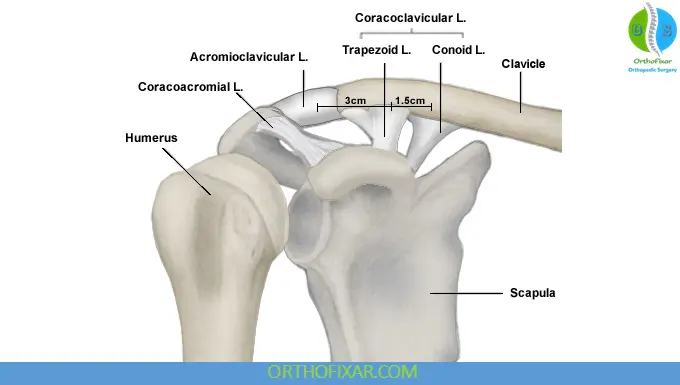
The coracoclavicular ligament is the most important stabilizer of the AC joint, although it lies extrinsic to the joint itself. It connects the clavicle to the coracoid process of the scapula, effectively suspending the scapula from the clavicle.
It consists of two distinct components:
• Trapezoid Ligament
- Lateral and quadrilateral in shape, it inserts 3 cm from end of clavicle.
- Limits lateral displacement of the clavicle over the acromion.
• Conoid Ligament
- Medial and triangular, it inserts 4.5 cm from end of clavicle in the posterior border.
- Restricts superior displacement of the clavicle.
- Plays a critical role in passive posterior rotation of the scapula during arm elevation.
A bursa separates these two ligaments, allowing smooth mechanical interaction.
Functional Significance
The coordinated action of the AC and CC ligaments:
- Maintains joint integrity and alignment
- Limits excessive motion in both horizontal and vertical planes
- Facilitates proper scapulohumeral rhythm
- Supports efficient force transmission from the upper limb to the axial skeleton
Because of its direct connection to the scapula, the coracoclavicular ligament significantly influences scapulohumeral motion, especially during overhead activities.
Clinical Relevance
The Acromioclavicular joint is frequently involved in shoulder injuries, particularly:
- AC joint separations (often due to falls on the shoulder)
- Degenerative changes such as osteoarthritis
- Ligament sprains or tears, especially involving the coracoclavicular ligament
Damage to these stabilizing structures can disrupt shoulder biomechanics, leading to pain, instability, and reduced range of motion.
Key Takeaways
- The AC joint is a plane synovial joint enabling gliding movements
- It allows three degrees of freedom, crucial for shoulder coordination
- Stability is provided by the AC ligament (horizontal stability) and CC ligament (primary vertical stability)
- The trapezoid and conoid ligaments have distinct but complementary roles
- Degeneration of the articular disc is a normal age-related finding
- Dysfunction or injury to this joint significantly impacts overall shoulder function
References & More
- Wong M, Kiel J. Anatomy, Shoulder and Upper Limb, Acromioclavicular Joint. [Updated 2023 Jul 24]. In: StatPearls [Internet]. Treasure Island (FL): StatPearls Publishing; 2026 Jan-. Available from: Pubmed
- Perry NPJ, Omonullaeva NK, Bacevich BM, Nascimento RJ, O’Donnell EA, Price MD, Mazzocca AD. Acromioclavicular Joint Anatomy and Biomechanics: The Significance of Posterior Rotational and Translational Stability. Clin Sports Med. 2023 Oct;42(4):557-571. doi: 10.1016/j.csm.2023.05.002. Epub 2023 Jul 1. PMID: 37716721. Pubmed
- Marchese RM, Black AC, Bordoni B. Anatomy, Shoulder and Upper Limb, Coracoclavicular Joint (Coracoclavicular Ligament) [Updated 2024 Jul 16]. In: StatPearls [Internet]. Treasure Island (FL): StatPearls Publishing; 2026 Jan-. Available from: Pubmed
[…] capsule of the AC joint is thickened superiorly and is primarily responsible for resisting AP displacement of the […]