Hypercalcemia is one of the commonest metabolic abnormalities met in hospital and outpatient practice, and it is frequently picked up incidentally on routine biochemistry [1]. This guide takes the approach of a bedside teaching session: recognise the syndrome, find the cause with a PTH-led algorithm, and treat the emergency before the aetiology is settled.
Definition and Epidemiology
Hypercalcemia is generally defined as a serum calcium above 10.5 mg/dL (about 2.6 mmol/L) and is graded as mild, moderate or severe according to the level [2]. Prevalence in the general population is roughly 1–2%, and about 90% of cases are explained by two conditions: primary hyperparathyroidism and malignancy [1].
Malignancy-associated Hypercalcemia affects around 20% of patients with cancer at some point in their course, is more common in advanced disease, and is linked to higher mortality [2,3]. Multiple myeloma has the highest prevalence among cancers [3].
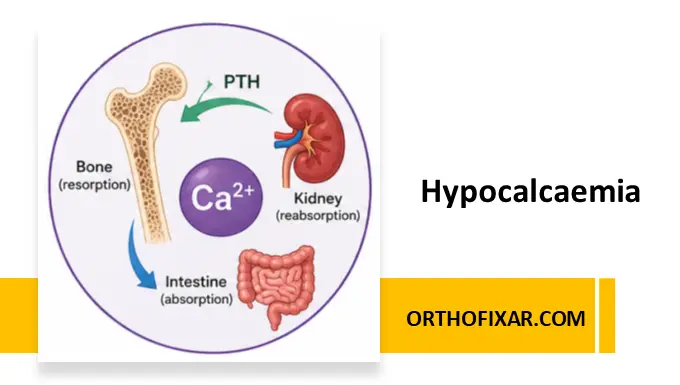
See Also: Hypocalcaemia: Causes, Symptoms, Diagnosis, Treatment & ECG Findings
Clinical Features
Symptoms track the degree of calcium elevation, which is the first teaching point.
By severity
- Mild: may be no more than lassitude, polyuria and polydipsia.
- Around 3–3.5 mmol/L: anorexia, nausea, muscle weakness and fatigue.
- Severe (above 3.5 mmol/L): abdominal pain, nausea, vomiting, marked fatigue and depression.
Chronic effects
Long-standing Hypercalcemia can cause kidney stones or nephrocalcinosis from chronic hypercalciuria, and some patients develop joint symptoms from chondrocalcinosis. The classic adage summarises the picture: “moans, groans, bones and stones.”
Remember that no physical sign is specific to Hypercalcemia [3], so always look for symptoms and signs of the underlying cause.
Causes of Hypercalcemia
A useful framework is to group causes by mechanism.
Increased bone resorption
- Primary and tertiary hyperparathyroidism
- Malignancy (bony metastases, myeloma, or PTHrP-secreting solid tumours)
- Hyperthyroidism
- Prolonged immobilisation
Increased calcium or vitamin D absorption
- Granulomatous disorders: sarcoidosis, tuberculosis, histoplasmosis. Granulomatous disease and some lymphomas increase production of active 1,25-dihydroxyvitamin D [1].
- Vitamin D excess
Drugs
Lithium, thiazides, theophylline toxicity, vitamin A toxicity and vitamin D excess.
Familial and other causes
- MEN types I and II
- Familial hypocalciuric Hypercalcemia (FHH)
- Addison’s disease, phaeochromocytoma
Primary hyperparathyroidism
Usually due to an adenoma or hyperplasia. Tertiary hyperparathyroidism arises when secondary hyperplasia becomes autonomous. Supportive findings of the primary form are Hypercalcemia, hypophosphataemia and a raised serum PTH.
Malignancy
Two mechanisms dominate. Excess PTHrP production (humoral Hypercalcemia of malignancy) is the most common, and local osteolysis from bony metastases or myeloma is the next most common [4]. Active vitamin D production by some lymphomas is a further route [1].
Familial hypocalciuric Hypercalcemia
FHH results from inactivating mutations in the calcium-sensing receptor gene. It ranges from an asymptomatic biochemical finding on routine bloods to life-threatening disease in neonatal FHH.
Investigation: A PTH-Led Algorithm
Measure PTH first, because it separates PTH-mediated from non-PTH-mediated Hypercalcemia [3].
- Confirm and repeat the raised calcium, and check phosphate, renal function and vitamin D.
- Measure PTH.
- If PTH is normal or high: measure 24-hour urinary calcium excretion.
- Normal or high urinary calcium suggests primary or tertiary hyperparathyroidism.
- Low urinary calcium suggests FHH.
- If PTH is suppressed: pursue symptom-guided investigation for malignancy, and test for hyperthyroidism (TSH) and adrenal insufficiency (cortisol).
- Imaging: chest radiography may reveal a primary lung tumour or granulomatous disease such as tuberculosis or sarcoidosis.
Management
Acute severe Hypercalcemia: a medical emergency
Critically ill patients should be treated as soon as the diagnosis is made [2]. The cornerstone is prompt intravenous fluid. Intravenous bisphosphonates and glucocorticoids are second-line options. Review the drug chart and stop contributory drugs such as thiazides, lithium, and vitamin A or D supplements.
Hypercalcemia of malignancy
- Bisphosphonates: pamidronate and zoledronic acid are approved for malignancy-associated Hypercalcemia, and pooled phase III data show zoledronic acid is more potent, with faster normalisation and longer control [5]. In the pooled analysis, complete response occurred in 88% with zoledronic acid 4 mg versus 70% with pamidronate 90 mg, and 24% of patients relapsed within 56 days [6]. Adjust the zoledronic acid dose to creatinine clearance [5].
- Denosumab: a RANKL-inhibiting monoclonal antibody, approved by the US FDA for Hypercalcemia of malignancy, including disease refractory to bisphosphonates [5]. A systematic review supporting the Endocrine Society guideline found no significant difference in resolution of Hypercalcemia compared with bisphosphonates, and about two-thirds of refractory or recurrent cases resolved with denosumab after bisphosphonate therapy [7].
- Prevention in bone metastatic disease: denosumab delayed time to first Hypercalcemia of malignancy by 37% versus zoledronic acid (HR 0.63, 95% CI 0.41–0.98), with events in 1.7% versus 2.7% of patients [6].
Long-term management
Treatment must be directed at the underlying cause. Primary hyperparathyroidism is often treated surgically.
Key Teaching Points
- Mild Hypercalcemia may be asymptomatic or non-specific; severity drives symptoms.
- Primary hyperparathyroidism and malignancy cause about 90% of cases.
- Always measure PTH first, then urinary calcium if PTH is not suppressed.
- Normal or high PTH with low urinary calcium points to FHH, which usually needs no intervention.
- Suppressed PTH should prompt a search for malignancy, thyroid and adrenal disease.
- Severe Hypercalcemia is an emergency: fluids first, then antiresorptive therapy.
Frequently Asked Questions
What are the classic symptoms of Hypercalcemia? “Moans, groans, bones and stones”: depression and fatigue, abdominal symptoms, bone and joint complaints, and renal stones.
What is the most common cause of Hypercalcemia? Primary hyperparathyroidism and malignancy together account for about 90% of cases [1].
How do you tell primary hyperparathyroidism from FHH? Both can have normal or high PTH, but 24-hour urinary calcium is normal or high in hyperparathyroidism and low in FHH.
What is the first-line treatment of severe Hypercalcemia? Intravenous fluids, with intravenous bisphosphonates and glucocorticoids as second-line options, and then treatment of the cause.
When is denosumab used? In Hypercalcemia of malignancy, including cases refractory to bisphosphonates [5,7].
Research Limitations
This article is an educational synthesis of review literature and a supplied clinical text, not a systematic review or a clinical guideline. Dosing, thresholds and drug availability vary by country and institution; verify against current local protocols, the product information and the primary guidance. Calcium thresholds in this article follow the supplied text (mmol/L) and the cited reviews (mg/dL), and laboratory reference ranges differ, so interpret values against your own laboratory and corrected or ionised calcium.
References
- Sadiq NM, Anastasopoulou C, Patel G, Badireddy M. Hypercalcemia. StatPearls [Internet]. Treasure Island (FL): StatPearls Publishing. PMID: 28613465. https://www.ncbi.nlm.nih.gov/books/NBK430714/
- Review of Current Clinical Concepts in the Pathophysiology, Etiology, Diagnosis, and Management of Hypercalcemia. Med Sci Monit. 2022;28:e935821. https://pmc.ncbi.nlm.nih.gov/articles/PMC8889795/
- Malignancy-Related Hypercalcemia. StatPearls [Internet]. Treasure Island (FL): StatPearls Publishing. PMID: 29494030. https://www.ncbi.nlm.nih.gov/books/NBK482423/
- Denosumab in the treatment of hypercalcemia secondary to malignancy. Orphan Drugs: Research and Reviews. 2015;5. https://www.dovepress.com/denosumab-in-the-treatment-of-hypercalcemia-secondary-to-malignancy-peer-reviewed-fulltext-article-ODRR
- Denosumab: a new agent in the management of hypercalcemia of malignancy. PubMed Central. https://pmc.ncbi.nlm.nih.gov/articles/PMC4976858/
- Denosumab for Treatment of Hypercalcemia of Malignancy. PubMed Central. https://pmc.ncbi.nlm.nih.gov/articles/PMC4154084/
- Seisa MO, Nayfeh T, Hasan B, et al. A Systematic Review Supporting the Endocrine Society Clinical Practice Guideline on the Treatment of Hypercalcemia of Malignancy in Adults. J Clin Endocrinol Metab.
- Diel IJ, Body JJ. The role of denosumab in the prevention of hypercalcaemia of malignancy in cancer patients with metastatic bone disease. (Integrated analysis of two randomised trials; basis for the prevention figures in reference 6.)
- The diagnosis and management of hypercalcaemia. BMJ. 2015;350:h2723. PMID: 26037642. https://pubmed.ncbi.nlm.nih.gov/26037642/