Bone biopsy is a specialized diagnostic procedure used to obtain a sample of bone tissue for microscopic, microbiological, or molecular analysis. It remains one of the most important investigations in orthopedic oncology, musculoskeletal infections, and metabolic bone disorders. In many cases, imaging studies such as X-rays, computed tomography (CT), and magnetic resonance imaging (MRI) may suggest a diagnosis, but histopathological examination obtained through a bone biopsy is often required to establish definitive confirmation.
Bone biopsy plays a critical role in distinguishing between conditions that may appear similar on imaging, including bone tumors, osteomyelitis, pathological fractures, and metabolic bone diseases. According to studies published in PubMed and the National Center for Biotechnology Information (NCBI), image-guided bone biopsy provides diagnostic accuracy exceeding 90–95% when performed appropriately.
What is a Bone Biopsy?
A bone biopsy is a medical procedure in which a small sample of bone tissue is removed and examined in a laboratory. The tissue may undergo:
- Histopathological evaluation
- Microbiological culture
- Molecular testing
- Immunohistochemical analysis
- Genetic studies when indicated
The primary objective is to determine the exact nature of a bone lesion, identify infection-causing organisms, or assess metabolic abnormalities affecting bone structure and remodeling.
Why is a Bone Biopsy Performed?
Bone biopsy is often the most reliable method for establishing a definitive diagnosis when imaging findings are inconclusive.
Diagnosis of Bone Tumors
When imaging reveals a destructive bone lesion, it may be difficult to distinguish between:
- Benign bone tumors
- Malignant primary bone tumors
- Metastatic bone disease
- Infectious processes
- Pathological fractures
Even when radiological findings appear highly suggestive of a tumor, definitive treatment should not proceed without histological confirmation. Radical surgical procedures should never be undertaken solely based on imaging appearances.
Evaluation of Bone Infections
Bone biopsy is valuable in diagnosing osteomyelitis and other bone infections because it provides:
- Histological confirmation of inflammation
- Identification of the causative microorganism
- Antibiotic susceptibility testing
- Guidance for targeted antimicrobial therapy
Microbiological culture obtained from biopsy tissue remains the gold standard for diagnosing many bone infections.
Assessment of Metabolic Bone Disease
In selected patients, bone biopsy may help evaluate metabolic disorders affecting bone turnover and mineralization.
Examples include:
- Osteoporosis
- Osteomalacia
- Hyperparathyroidism
- Renal osteodystrophy
A tetracycline-labeled bone biopsy may be used to assess bone formation and remodeling dynamics, allowing clinicians to determine both the type and severity of metabolic bone disease.
Conditions that May Require Bone Biopsy
Bone Tumors
Common tumor-related indications include:
- Osteosarcoma
- Chondrosarcoma
- Ewing sarcoma
- Giant cell tumor
- Metastatic bone lesions
- Multiple myeloma
Bone Infections
Biopsy is frequently performed when osteomyelitis is suspected, especially when:
- Blood cultures are negative
- Imaging findings are inconclusive
- Previous antibiotic therapy has failed
Vertebral Collapse
A collapsed vertebral body may result from:
- Osteoporotic compression fracture
- Metastatic disease
- Primary bone tumor
- Vertebral osteomyelitis
Biopsy helps differentiate among these possibilities.
Unexplained Bone Lesions
Persistent bone abnormalities that cannot be characterized through imaging alone may require tissue diagnosis.
Types of Bone Biopsy
Bone biopsies are generally categorized into two major types:
Open Bone Biopsy
Open biopsy involves surgical exposure of the lesion and removal of a substantial tissue sample.
Advantages
- Larger tissue specimen
- Higher likelihood of obtaining representative tissue
- Better visualization of the lesion
Disadvantages
Open biopsy has several drawbacks:
- Requires surgery and anesthesia
- Increased risk of infection
- Greater postoperative recovery time
- Potential spread of tumor cells or infection through newly created tissue planes
- May complicate future definitive surgery
- Difficult access to deep lesions may require extensive dissection through healthy tissue
Because of these limitations, open biopsy is generally reserved for situations where needle biopsy is unlikely to provide adequate tissue.
Closed Bone Biopsy
Closed biopsy, also called percutaneous bone biopsy, is performed using a biopsy needle or trephine.
Advantages
- Minimally invasive
- Lower complication rates
- Shorter recovery time
- Reduced risk of tumor contamination
- Can be performed under imaging guidance
Tissue Collection
Depending on lesion characteristics:
- Solid tissue is removed using a cutting needle or trephine
- Fluid collections can be aspirated through the biopsy needle
For most bone lesions, carefully performed closed biopsy is considered the preferred diagnostic method.
Image-Guided Bone Biopsy
Modern bone biopsies are frequently performed under imaging guidance to improve accuracy and safety.
Fluoroscopy-Guided Biopsy
Fluoroscopy provides real-time visualization of needle placement and is particularly useful for deep-seated lesions.
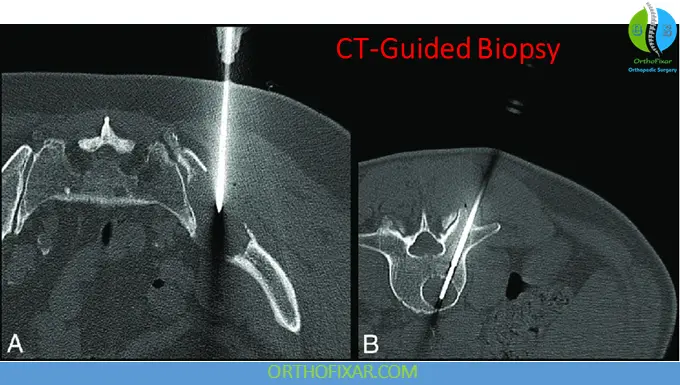
CT-Guided Biopsy
CT guidance is widely used because it offers:
- Precise localization
- Accurate needle trajectory planning
- Improved diagnostic yield
- Reduced risk of injury to surrounding structures
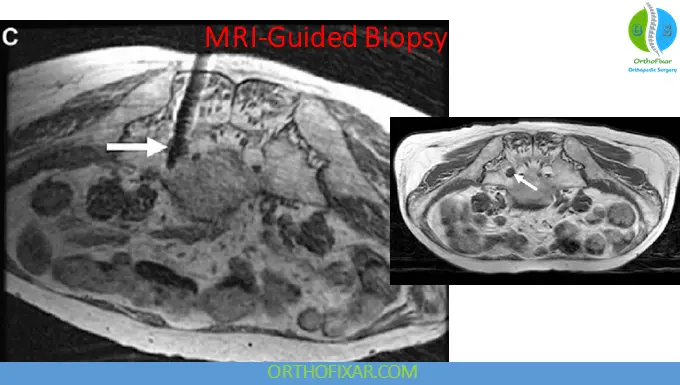
MRI-Guided Biopsy
MRI guidance is less common but may be useful in selected cases involving soft tissue extension.
Precautions Before Performing a Bone Biopsy
Careful planning is essential to maximize diagnostic accuracy and minimize complications.
Pre-Procedural Imaging Review
The biopsy approach should be planned using:
- X-rays
- CT scans
- MRI scans
- Nuclear imaging when necessary
Consider Future Surgical Treatment
If malignancy is suspected, the biopsy tract should be placed in a location that can later be excised during definitive tumor surgery.
Strict Sterile Technique
Bone biopsy should be performed:
- In an operating room or sterile procedure suite
- Under local or general anesthesia
- Using full aseptic precautions
Protection of Vital Structures
The operator must have detailed knowledge of local anatomy to avoid:
- Major blood vessels
- Nerves
- Tendons
- Adjacent organs
Management of Vascular Lesions
Certain tumors are highly vascular and may bleed significantly during biopsy. Adequate preparations for hemorrhage control should always be available.
A lesion presumed to be an abscess may occasionally represent a vascular abnormality such as an aneurysm, emphasizing the importance of careful imaging review before needle insertion.
Handling and Processing of Biopsy Specimens
Proper specimen handling is essential for obtaining accurate results.
Suspected Infection
When infection is suspected:
- Tissue should be sent immediately for culture
- Appropriate transport media should be used
- Smears may also be prepared for microscopic examination
Histological Examination
Tissue intended for pathology should be:
- Carefully preserved
- Placed in formalin
- Protected from mechanical damage
Crystal-Associated Disorders
Specimens suspected of containing crystals should not be placed in formalin because crystal structures may be destroyed.
Instead, samples should be:
- Examined immediately
- Preserved in saline when necessary
Risks and Complications of Bone Biopsy
Although generally safe, bone biopsy carries potential risks.
Bleeding
Minor bleeding is common, while significant hemorrhage is uncommon but may occur in vascular lesions.
Infection
Infection is rare when proper sterile technique is followed.
Nerve Injury
Improper needle placement can damage nearby nerves.
Pathological Fracture
Weak bones affected by tumors or severe disease may fracture after biopsy.
Sampling Error
One of the most important limitations is obtaining insufficient or non-representative tissue, which can lead to inconclusive results.
Close collaboration between:
- Orthopedic surgeons
- Radiologists
- Pathologists
helps reduce this risk.
Diagnostic Accuracy of Bone Biopsy
Numerous studies have demonstrated high diagnostic performance for image-guided bone biopsy.
When performed by experienced specialists:
- Diagnostic accuracy often exceeds 95%
- Sensitivity and specificity are high for both tumors and infections
- CT-guided techniques provide excellent tissue targeting
However, accuracy depends on:
- Proper lesion selection
- Adequate tissue sampling
- Correct specimen handling
- Expert pathological interpretation
Bone Biopsy Results
Results typically include:
Histopathology Report
Determines:
- Benign versus malignant lesions
- Tumor subtype
- Degree of inflammation
- Metabolic abnormalities
Microbiology Report
Identifies:
- Bacterial species
- Fungal organisms
- Mycobacterial infections
- Antibiotic susceptibility patterns
Specialized Studies
Additional testing may include:
- Immunohistochemistry
- Cytogenetics
- Molecular diagnostics
Conclusion
Bone biopsy remains the gold standard for diagnosing many bone disorders, including tumors, infections, and metabolic bone diseases. While imaging studies provide valuable information, definitive diagnosis often requires tissue confirmation. Closed image-guided biopsy is now the preferred approach in most cases because it is minimally invasive, highly accurate, and associated with fewer complications than open biopsy.
Careful planning, appropriate specimen handling, and close cooperation between orthopedic surgeons, radiologists, microbiologists, and pathologists are essential to achieving optimal diagnostic outcomes. In experienced hands, bone biopsy provides diagnostic accuracy exceeding 95%, making it one of the most valuable tools in modern musculoskeletal medicine.
Key Takeaways
- Bone biopsy provides definitive diagnosis of many bone lesions.
- It is essential before treating suspected bone tumors.
- Bone biopsy helps identify infectious organisms and antibiotic sensitivity.
- Closed image-guided biopsy is preferred in most situations.
- Proper planning minimizes complications and improves diagnostic yield.
- Diagnostic accuracy exceeds 95% when performed by experienced specialists.
- Metabolic bone diseases may require specialized tetracycline-labeled bone biopsy for assessment.
References
- Williams AE, Ho JW, Sundaram N. Bone Biopsies: Practical Considerations and Technical Tips. Semin Intervent Radiol. 2024 Dec 10;41(5):444-454. doi: 10.1055/s-0044-1791720. PMID: 39664228; PMCID: PMC11631373. Link
- Rindy LJ, Chambers AR. Bone Marrow Aspiration and Biopsy. [Updated 2023 May 29]. In: StatPearls [Internet]. Treasure Island (FL): StatPearls Publishing; 2026 Jan-. Available from: https://www.ncbi.nlm.nih.gov/books/NBK559232/
- Guedes A, Nakagawa SA. Biopsy of bone tumors: a literature review. Rev Assoc Med Bras (1992). 2024 Jun 7;70(suppl 1):e2024S131. doi: 10.1590/1806-9282.2024S131. PMID: 38865550; PMCID: PMC11164262. Link
- Blom, A., Warwick, D., & Whitehouse, M. R. (2018). Apley & Solomon’s system of orthopaedics and trauma (10th ed.). CRC Press