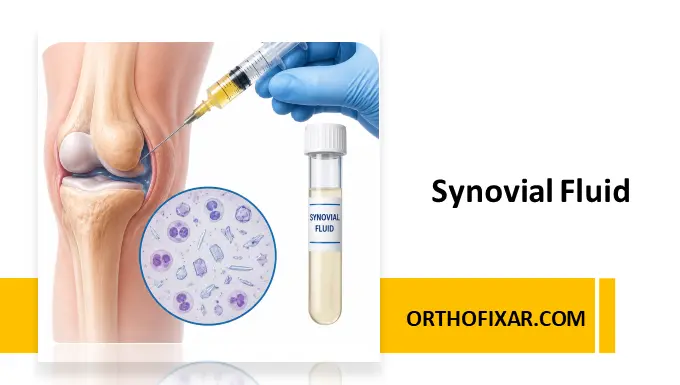
What Is Synovial Fluid?
Synovial fluid — also referred to as joint fluid — is the viscous, straw-colored liquid that fills the cavities of synovial joints. It is classified as physiologic, meaning its presence in a healthy joint is entirely normal and essential.
According to Seidman & Limaiem (NCBI StatPearls, 2023), synovial fluid is defined as the collection of fluid confined within a joint space. It acts simultaneously as a lubricant for articular cartilage and as a nutrient source — via diffusion — for surrounding avascular structures such as cartilage, menisci, and labra.
Key anatomical context: Synovial fluid is enclosed and regulated by the synovial membrane (synovium), a specialized connective tissue lining that lines the inner surface of joint capsules, tendon sheaths, and bursae, but does not cover articular cartilage directly.
Synovial joints containing synovial fluid include the knee, hip, shoulder, elbow, wrist, and ankle — any diarthrodial joint where two bones move relative to one another under physiologic load.
Composition & Production of Synovial Fluid
Synovial fluid is produced as an ultrafiltrate of blood plasma, a process driven by hydrostatic and osmotic pressure gradients across the synovial capillary wall. Its composition is further shaped by active secretion from synovial cells.
Primary Components
| Component | Origin | Primary Role |
|---|---|---|
| Hyaluronan (hyaluronic acid) | Type B synoviocytes | Viscosity, lubrication, shock absorption |
| Lubricin (proteoglycan 4) | Synoviocytes & chondrocytes | Boundary lubrication of articular surfaces |
| Proteinases & Collagenases | Synovial membrane | Extracellular matrix remodeling |
| Prostaglandins | Synovial cells | Inflammatory signaling & homeostasis |
| Plasma proteins | Blood plasma ultrafiltration | Nutrient supply to avascular cartilage |
| Leukocytes (small number) | Blood | Immune surveillance (<200 WBC/mm³ in health) |
The Role of Synoviocytes in Production
The synovial membrane contains two functionally distinct cell populations that together regulate joint homeostasis:
- Type A synoviocytes (macrophage-like): responsible for debris clearance, phagocytosis of wear particles, and immune surveillance within the joint.
- Type B synoviocytes (fibroblast-like): the primary secretory cells, producing hyaluronan, lubricin, collagens, and matrix proteins. These cells are the main source of synovial fluid production.
Viscoelastic Properties
Normal synovial fluid behaves as a non-Newtonian fluid — its viscosity decreases as shear rate increases. This property is principally attributable to hyaluronan’s high molecular weight polymeric structure. Under high compressive loads, hyaluronan molecules undergo conformational changes that absorb and store mechanical energy, releasing it on decompression. At low loads, the same molecules act as efficient lubricants.
⚕ Clinical Pearl In diseased joints (e.g., rheumatoid arthritis, septic arthritis), inflammation degrades hyaluronan through enzymatic cleavage, resulting in markedly reduced viscosity. The fluid loses its non-Newtonian behavior, impairing both lubrication and shock absorption — which underlies much of the pain and cartilage damage in inflammatory joint disease.
Physiologic Functions of Synovial Fluid
Synovial fluid serves multiple, interdependent roles that collectively maintain joint integrity and enable pain-free movement across a lifetime of mechanical loading.
1. Lubrication of Articular Cartilage
The most recognized function is the reduction of friction between opposing articular surfaces. Hyaluronan and lubricin work in concert: hyaluronan provides fluid-film lubrication (a thin fluid layer that separates surfaces), while lubricin provides boundary lubrication (direct molecular coating of cartilage under high loads when the fluid film is squeezed out).
2. Nutrient Supply to Avascular Cartilage
Articular cartilage is avascular; it depends entirely on synovial fluid for oxygen, glucose, and other nutrients, as well as for the removal of metabolic waste products from chondrocytes. Joint movement facilitates convective mixing within the fluid, enhancing this nutritive diffusion.
3. Shock Absorption & Load Distribution
Synovial fluid distributes compressive forces evenly across the joint surface, protecting subchondral bone and cartilage from focal stress concentrations. Its rheological (flow) properties allow it to resist sudden high-load events more effectively than a simple Newtonian fluid would.
4. Joint Hydration & Tissue Support
By filling the joint space, synovial fluid maintains the hydration of intra-articular tissues — including menisci and the labrum — preventing desiccation and preserving tissue biomechanical properties.
5. Immune Surveillance
A small population of leukocytes (predominantly mononuclear cells) is normally present in synovial fluid. These cells provide a first line of defense against pathogens entering the joint space and contribute to the clearance of cellular debris from routine mechanical wear.
Synovial Fluid Analysis: Overview
Synovial fluid analysis is a cornerstone diagnostic and therapeutic procedure in joint medicine. When a patient presents with an acutely painful, swollen joint — particularly with warmth or erythema — synovial fluid analysis is often the single most informative test available to the clinician.
Why it matters: Synovial fluid analysis is a low-cost, highly effective means of pain reduction and diagnosis that can be performed quickly at the bedside without general anesthesia and without requiring a specialized surgeon — substantially increasing its utility in both inpatient and outpatient settings. (Seidman AJ, Limaiem F. NCBI StatPearls, 2023)
Components of a Complete Synovial Fluid Analysis
A comprehensive synovial fluid analysis typically encompasses the following assessments:
| Test | What It Evaluates | Clinical Utility |
|---|---|---|
| Gross appearance | Color, clarity, viscosity | Initial triage (normal vs. abnormal) |
| Total WBC count | Leukocyte concentration | Categorize as non-inflammatory / inflammatory / infectious |
| Differential (PMN%) | Neutrophil percentage | >75% PMNs strongly suggests bacterial infection |
| Crystal analysis | Polarized light microscopy | Diagnose gout (MSU) or pseudogout (CPPD) |
| Gram stain | Bacterial morphology | Rapid presumptive infection identification |
| Culture & sensitivity | Aerobic & anaerobic organisms | Definitive microbial diagnosis & antibiotic guidance |
| Glucose | Joint fluid glucose level | Low values in RA, septic, and crystal arthritis |
| Protein | Protein concentration | Elevated in inflammatory/hemorrhagic states |
Arthrocentesis: Indications & Technique
Arthrocentesis is the procedural process by which synovial fluid is collected via aspiration of the joint space. It is the prerequisite step for any synovial fluid analysis.
Indications for Arthrocentesis
- Acute painful joint with surrounding warmth or erythema of unknown cause
- Clinical suspicion for septic arthritis (joint infection)
- Suspected subacute or chronic periprosthetic joint infection
- Acute exacerbation of chronic knee pain from osteoarthritis
- Acute joint trauma with painful hemarthrosis
- Definitive diagnosis of gout or pseudogout
- Joint effusion of unknown etiology
⚕ Clinical Pearl Infection and gout can coexist within the same joint space. The presence of urate crystals does not exclude concurrent septic arthritis. Both conditions must be actively ruled out in the appropriate clinical context. (Seidman AJ, Limaiem F. NCBI StatPearls, 2023)
See Also: Joint Arthrocentesis: Indications, Clinical Applications & Complications
Classification of Synovial Fluid: WBC Count Thresholds
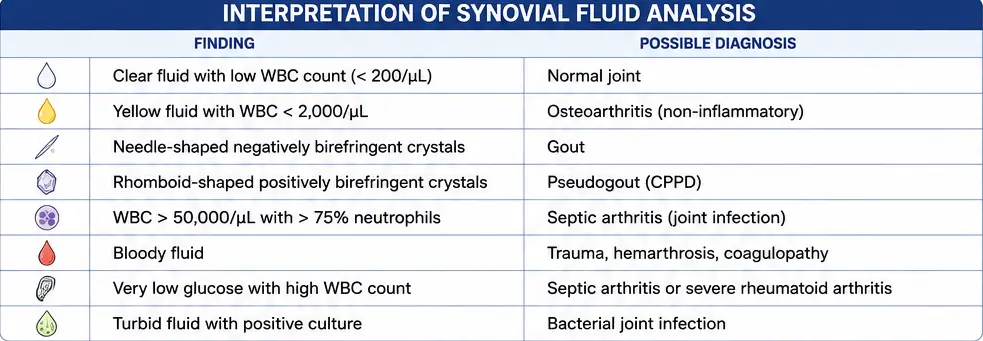
The total white blood cell (WBC) count is the single most clinically informative initial parameter in synovial fluid analysis. It forms the basis of the widely used three-tier classification system endorsed by the American Rheumatologic Association.
| Category | WBC Count (cells/mm³) | PMN % | Common Causes | Appearance |
|---|---|---|---|---|
| Normal | <200 | <25% | Healthy joint | Clear, straw-colored, high viscosity |
| Non-Inflammatory | 200 – 2,000 | <25% | Osteoarthritis, trauma, meniscal tears | Clear to slightly cloudy, viscosity preserved |
| Inflammatory | 2,000 – 50,000 | 25–75% | Gout, pseudogout, RA, reactive arthritis | Cloudy, yellow, reduced viscosity |
| Infectious / Septic | >50,000 | >75% | Bacterial septic arthritis | Opaque, turbid, purulent; very low viscosity |
| Hemorrhagic | Variable | Variable | Trauma, ligament/tendon injury, coagulopathy | Bloody or xanthochromic |
⚕ Important Caveat WBC count thresholds apply to native adult joints. In joints with prior hardware (post-traumatic fixation, joint replacement), the diagnostic cut-offs differ significantly. A WBC count that would suggest infection in a native joint may be within expected ranges for a periprosthetic environment. (Seidman AJ, Limaiem F. NCBI StatPearls, 2023)
PMN Differential: The Role of Neutrophil Percentage
Beyond the total WBC count, the polymorphonuclear (PMN) differential provides additional discriminatory power. A PMN percentage exceeding 75% is strongly indicative of bacterial joint infection, even when the total WBC count falls short of the 50,000/mm³ threshold. This parameter is therefore essential in the diagnostic workup of any suspected septic arthritis.
Crystal Analysis: Gout & Pseudogout
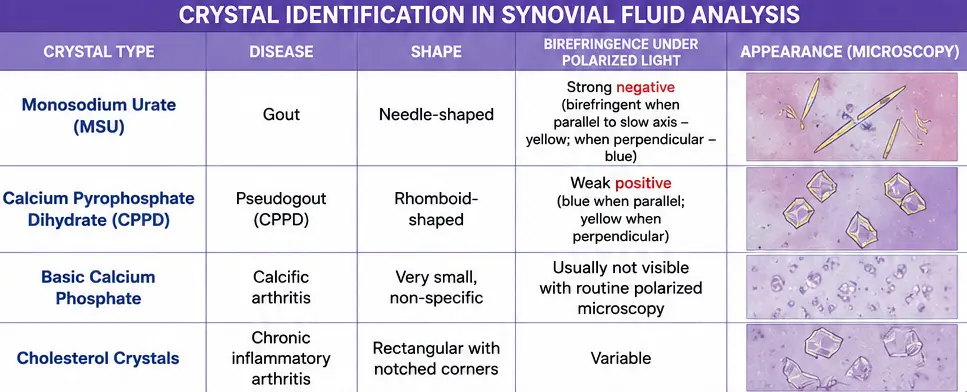
Polarized light microscopy of synovial fluid is the definitive diagnostic method for crystal-induced arthropathies. Two distinct crystal types are clinically relevant:
| Crystal Type | Disease | Appearance | Birefringence |
|---|---|---|---|
| Monosodium Urate (MSU) | Gout | Needle-shaped, negatively birefringent | Strong negative (yellow when parallel to polarizer) |
| Calcium Pyrophosphate Dihydrate (CPPD) | Pseudogout | Rhomboid / rod-shaped | Weak positive (blue when parallel to polarizer) |
The identification of MSU crystals constitutes a definitive diagnosis of gout; similarly, CPPD crystals confirm pseudogout. It is critical to recognize that crystal arthritis and septic arthritis are not mutually exclusive — culture and Gram stain remain mandatory even when crystals are identified.
Synovial Fluid in Common Disease States
Osteoarthritis (OA)
Non-inflammatory effusions with WBC counts below 2,000/mm³ and preserved viscosity are most commonly associated with osteoarthritis and mechanical joint disease. Large cohort studies indicate OA remains the predominant cause of synovial effusion in older adults, characterized by low cellularity and a predominantly mononuclear differential.
Rheumatoid Arthritis (RA)
RA typically produces inflammatory effusions with WBC counts between 2,000 and 50,000/mm³. Synovial fluid glucose is often reduced in RA due to increased metabolic activity of infiltrating leukocytes. While synovial fluid analysis is not central to routine RA diagnosis per EULAR guidelines, it remains indispensable when infection or crystalline disease must be excluded — particularly when RA presents as monoarthritis.
Septic Arthritis
Septic arthritis is a medical emergency. Synovial fluid WBC counts typically exceed 50,000/mm³ with greater than 75% PMNs. Gram stain and culture are mandatory. Early identification and joint drainage are critical to preventing permanent cartilage destruction.
Traumatic Hemarthrosis
Traumatic joint injury — particularly tears of the anterior cruciate ligament, meniscus, or adjacent tendons — commonly produces hemarthrosis. The synovial fluid appears grossly bloody or xanthochromic. Therapeutic arthrocentesis provides significant pain relief and may restore range of motion in the acutely traumatic knee.
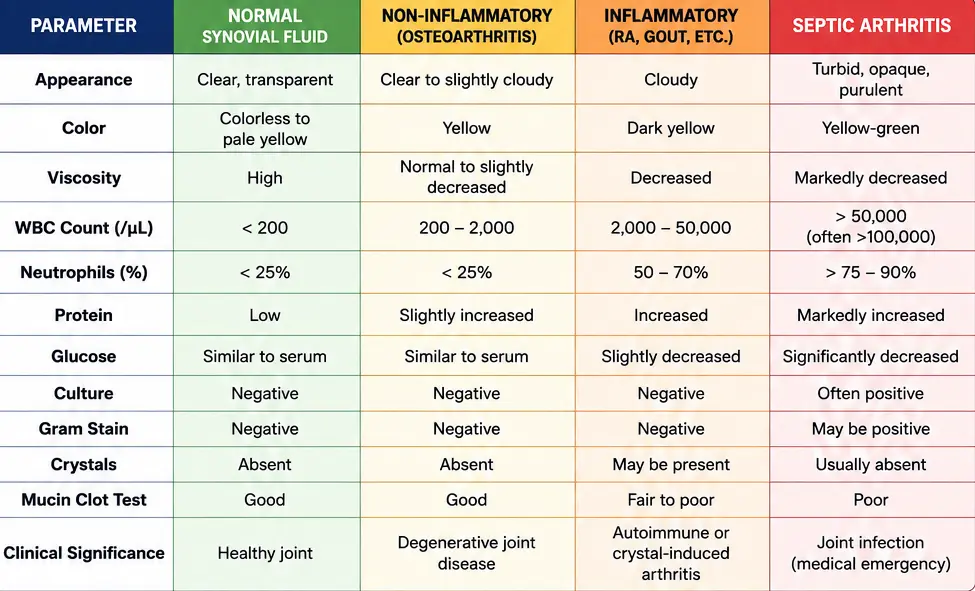
| Parameter | Normal Synovial Fluid | Non-Inflammatory (Osteoarthritis) | Inflammatory (Rheumatoid Arthritis, Gout) | Septic Arthritis |
|---|---|---|---|---|
| Appearance | Clear, transparent | Clear to slightly cloudy | Cloudy | Turbid, opaque, purulent |
| Color | Colorless to pale yellow | Yellow | Dark yellow | Yellow-green |
| Viscosity | High | Normal to slightly decreased | Decreased | Markedly decreased |
| WBC Count (/µL) | < 200 | 200–2,000 | 2,000–50,000 | > 50,000 (often >100,000) |
| Neutrophils (%) | < 25% | < 25% | 50–70% | > 75–90% |
| Protein | Low | Slightly increased | Increased | Markedly increased |
| Glucose | Similar to serum | Similar to serum | Slightly decreased | Significantly decreased |
| Culture | Negative | Negative | Negative | Often positive |
| Gram Stain | Negative | Negative | Negative | May be positive |
| Crystals | Absent | Absent | May be present | Usually absent |
| Mucin Clot Test | Good | Good | Fair to poor | Poor |
| Clinical Significance | Healthy joint | Degenerative joint disease | Autoimmune or crystal-induced arthritis | Joint infection (medical emergency) |
Complications & Interfering Factors
Complications of Arthrocentesis
Complications from arthrocentesis are uncommon and typically not severe. Reported complications include:
- Reaccumulation of joint effusion (most common reported complication)
- Iatrogenic joint infection from non-sterile technique
- Local pain, bruising, or ecchymosis at the aspiration site
- Iatrogenic hemarthrosis from bleeding
- Rare cartilage damage from needle insertion
- Skin reactions to antiseptics or adhesive dressings
Interfering Factors in Synovial Fluid Analysis
- Needle obstruction by synovium: the synovial membrane can clog the needle during aspiration, reducing sample yield or preventing collection entirely.
- Non-sterile technique: sample contamination can falsely elevate cell counts and confound culture results.
- Delayed processing: prolonged transit time degrades leukocytes and accelerates crystal dissolution, affecting both cell count accuracy and crystal identification.
- Coexisting pathology: as emphasized above, multiple etiologies can coexist — gout does not exclude concurrent infection.
Clinical Significance of Synovial Fluid Analysis
Synovial fluid analysis occupies a central and often irreplaceable role in the workup of joint pathology. It simultaneously provides:
- Definitive diagnostic information for septic arthritis, gout, and pseudogout
- Supportive data for inflammatory arthritides (RA, reactive arthritis, spondylarthropathies)
- Immediate therapeutic benefit through decompression of tense effusions
- Guidance for targeted antibiotic therapy via culture and sensitivity results
Its accessibility — at the bedside, without general anesthesia, by non-surgical physicians — makes it one of the most cost-effective diagnostic interventions available in acute joint medicine. Physiologic changes in synovial fluid volume and composition occur in response to trauma, inflammation, and microbial penetration; understanding these changes enables clinicians to translate a simple aspiration into a powerful clinical tool.
Bottom line for clinical practice: In any patient presenting with an acutely painful, swollen joint — particularly with erythema or fever — synovial fluid analysis via arthrocentesis should be performed promptly. Do not allow the possibility of crystal arthritis to delay evaluation for septic arthritis. Both diagnoses may be present simultaneously.
References
- Seidman AJ, Limaiem F. Synovial Fluid Analysis. In: StatPearls [Internet]. Treasure Island (FL): StatPearls Publishing; 2026 Jan. Updated 2023 May 1. NCBI Bookshelf NBK537114
- Freemont AJ. Microscopic analysis of synovial fluid — the perfect diagnostic test? Ann Rheum Dis. 1996 Oct;55(10):695–7. PubMed: 8984932 | PMC1010283
- Shmerling RH, Delbanco TL, Tosteson AN, Trentham DE. Synovial fluid tests. What should be ordered? JAMA. 1990 Aug;264(8):1009–14. PubMed: 2198352
- Juneja P, Munjal A, Hubbard JB. Anatomy, Joints. In: StatPearls [Internet]. Treasure Island (FL): StatPearls Publishing; 2026 Jan. Updated 2024 Apr 21. NCBI Bookshelf NBK507893
- Clayburne G, Baker DG, Schumacher HR Jr. Estimated synovial fluid leukocyte numbers on wet drop preparations as a potential substitute for actual leukocyte counts. J Rheumatol. 1992 Jan;19(1):60–2. PubMed: 1556701
- Wyatt MC, Beswick AD, Kunutsor SK, Wilson MJ, Whitehouse MR, Blom AW. Factors to consider when assessing the diagnostic accuracy of synovial leukocyte count in periprosthetic joint infection. JBJS Rev. 2019 Aug;7(8):e7. PMC6757010