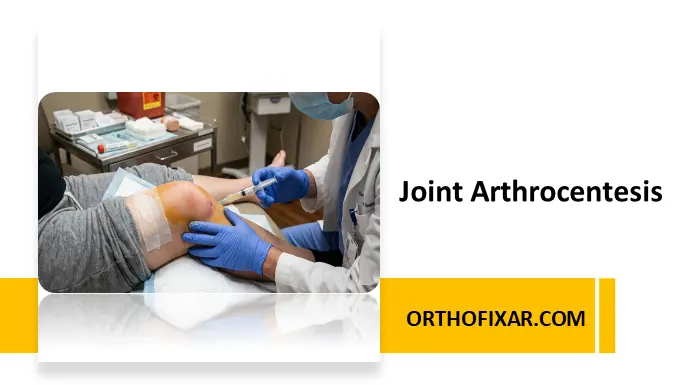
Joint arthrocentesis, also known as joint aspiration, is a common diagnostic and therapeutic procedure used in rheumatology, orthopedics, emergency medicine, and primary care. The procedure involves inserting a sterile needle into a synovial joint to remove synovial fluid for analysis or therapeutic purposes.
Arthrocentesis plays a critical role in diagnosing septic arthritis, crystal-induced arthropathies, inflammatory arthritis, and unexplained joint effusions. It can also provide immediate symptom relief by reducing intra-articular pressure and facilitating medication administration.
Understanding the indications, contraindications, technique, complications, and interpretation of synovial fluid findings is essential for medical professionals.
What is Joint Arthrocentesis?
Joint arthrocentesis is the aspiration of synovial fluid from a joint space using a sterile needle and syringe. The fluid obtained can be examined macroscopically, microscopically, microbiologically, and chemically to determine the underlying cause of joint pathology.
The procedure may be performed for:
- Diagnostic evaluation
- Therapeutic decompression
- Intra-articular medication injection
Commonly aspirated joints include:
- Knee
- Shoulder
- Elbow
- Wrist
- Ankle
- Hip
- Metatarsophalangeal joints
Anatomy Relevant to Arthrocentesis
Synovial Joint Structure
A synovial joint consists of:
- Articular cartilage
- Synovial membrane
- Joint capsule
- Synovial fluid
- Supporting ligaments
Synovial fluid functions as a lubricant and nutrient source for cartilage. In disease states, the volume and composition of synovial fluid may change significantly.
Knee Joint Anatomy
The knee is the most commonly aspirated joint because:
- Large joint space
- Easily accessible landmarks
- Frequent involvement in inflammatory and infectious diseases
The suprapatellar pouch is often targeted during aspiration of the knee.
See Also: Knee Effusion Tests
Indications for Joint Arthrocentesis
Diagnostic Indications
Arthrocentesis is indicated whenever an unexplained joint effusion is present.
Common diagnostic indications include:
Suspected Septic Arthritis
Joint aspiration is considered mandatory when septic arthritis is suspected because delayed diagnosis can rapidly result in cartilage destruction and permanent disability.
Clinical features include:
- Acute painful swollen joint
- Fever
- Restricted range of motion
- Elevated inflammatory markers
Crystal-Induced Arthritis
Synovial fluid examination can identify crystals associated with:
- Gout
- Pseudogout
Crystal identification under polarized microscopy remains the gold standard for diagnosis.
Evaluation of Inflammatory Arthritis
Arthrocentesis helps assess:
- Rheumatoid arthritis
- Psoriatic arthritis
- Reactive arthritis
- Juvenile idiopathic arthritis
Unexplained Joint Effusion
Aspiration is indicated when the cause of swelling remains uncertain after clinical evaluation.
Therapeutic Indications
Symptom Relief
Removal of excess synovial fluid can:
- Reduce pain
- Improve mobility
- Decrease intra-articular pressure
Intra-Articular Medication Administration
Arthrocentesis may be followed by injection of:
- Corticosteroids
- Hyaluronic acid
- Platelet-rich plasma (selected cases)
Contraindications to Arthrocentesis
Absolute Contraindications
There are very few absolute contraindications.
These include:
- Overlying skin infection at the puncture site
- Severe cellulitis over the joint
Relative Contraindications
- Anticoagulant therapy
- Bleeding disorders
- Prosthetic joints
- Uncooperative patients
- Severe thrombocytopenia
The benefits and risks should be carefully evaluated before proceeding.
Synovial Fluid Analysis
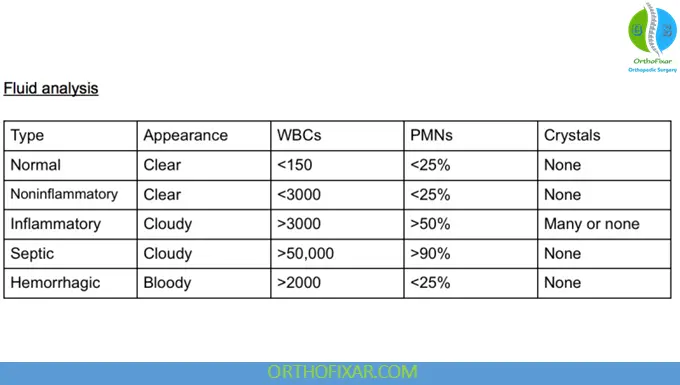
Synovial fluid analysis is one of the most valuable aspects of arthrocentesis.
Gross Appearance
Normal fluid is:
- Clear
- Pale yellow
- Viscous
Abnormal findings include:
| Appearance | Possible Cause |
|---|---|
| Cloudy | Inflammatory arthritis |
| Purulent | Septic arthritis |
| Bloody | Trauma, hemarthrosis |
| Milky | Crystal disease |
White Blood Cell Count
| Classification | WBC Count (cells/µL) |
|---|---|
| Normal | <200 |
| Non-inflammatory | 200–2,000 |
| Inflammatory | 2,000–75,000 |
| Septic | Usually >50,000 |
Crystal Analysis
Gout
Findings:
- Monosodium urate crystals
- Needle-shaped crystals
- Negative birefringence
Pseudogout
Findings:
- Calcium pyrophosphate crystals
- Rhomboid crystals
- Positive birefringence
Gram Stain and Culture
Essential when infection is suspected.
Positive cultures help identify:
- Causative organisms
- Antibiotic sensitivities
Arthrocentesis of Specific Joints
Knee Joint Arthrocentesis
The knee is the easiest and most frequently aspirated joint.
Common approaches:
- Superolateral
- Medial
- Lateral
Shoulder Arthrocentesis
Typically performed through:
- Posterior approach
- Anterior approach
Ultrasound guidance improves success rates.
Hip Arthrocentesis
Usually performed under:
- Ultrasound guidance
- Fluoroscopy guidance
Because of nearby neurovascular structures, blind aspiration is generally avoided.
Complications of Arthrocentesis
Although generally safe, complications may occur.
Infection
Iatrogenic septic arthritis is rare but serious.
Bleeding
Risk increases in patients with:
- Coagulopathies
- Anticoagulant therapy
Pain
Temporary discomfort at the puncture site is common.
Neurovascular Injury
Rare when proper technique is used.
Post-Injection Flare
May occur after corticosteroid injection.
Clinical Applications of Arthrocentesis
Septic Arthritis
Immediate aspiration is essential for diagnosis and management.
Gout
Joint fluid analysis remains the definitive diagnostic test.
Pseudogout
Identification of calcium pyrophosphate crystals confirms the diagnosis.
Rheumatoid Arthritis
Fluid analysis assists in excluding infection and crystal arthropathies.
Hemarthrosis
Aspiration may reveal:
- Trauma-related bleeding
- Coagulation disorders
- Intra-articular injuries
Ultrasound-Guided Arthrocentesis
Ultrasound guidance has become increasingly popular because it:
- Improves needle placement
- Increases procedural success
- Reduces complications
- Enhances patient comfort
Particularly useful for:
- Small joints
- Deep joints
- Difficult aspirations
Advantages of Arthrocentesis
Benefits include:
- Rapid diagnosis
- Immediate symptom relief
- Detection of infection
- Crystal identification
- Guidance of treatment decisions
- Opportunity for therapeutic injections
Prognosis After Arthrocentesis
Most patients tolerate the procedure well.
Recovery is usually immediate, with minimal downtime.
The overall prognosis depends primarily on the underlying joint disorder rather than the procedure itself.
Key Points
- Joint arthrocentesis is an essential diagnostic and therapeutic procedure.
- It is the gold standard for evaluating unexplained joint effusions.
- Synovial fluid analysis helps distinguish infectious, inflammatory, crystal-induced, and non-inflammatory joint diseases.
- Septic arthritis should always prompt urgent arthrocentesis.
- Ultrasound-guided arthrocentesis improves accuracy and success rates.
- Complications are uncommon when proper sterile technique is followed.
Frequently Asked Questions (FAQs)
Is arthrocentesis painful?
Most patients experience only mild discomfort. Local anesthesia significantly reduces procedural pain.
What is the most common joint for arthrocentesis?
The knee joint is the most frequently aspirated joint because of its accessibility and large synovial space.
Why is synovial fluid analyzed after arthrocentesis?
Analysis helps diagnose infection, gout, pseudogout, inflammatory arthritis, and other causes of joint effusion.
Can arthrocentesis treat joint pain?
Yes. Removing excess fluid can relieve pain and improve joint mobility.
What are the major risks of arthrocentesis?
The primary risks include infection, bleeding, pain, and rare neurovascular injury.
References & More
- Tantillo TJ, BOUDREAUX SYDNEY, Katsigiorgis G. Arthrocentesis. [Updated 2023 Jul 25]. In: StatPearls [Internet]. Treasure Island (FL): StatPearls Publishing; 2026 Jan-. Available from: https://www.ncbi.nlm.nih.gov/books/NBK557805/
- Akbarnia H, Saber AY, Smith T, et al. Knee Arthrocentesis. [Updated 2024 Feb 27]. In: StatPearls [Internet]. Treasure Island (FL): StatPearls Publishing; 2026 Jan-. Available from: https://www.ncbi.nlm.nih.gov/books/NBK470229/
- Mackie JW. Joint aspiration: arthrocentesis. Can Fam Physician. 1987 Sep;33:2057-62. PMID: 21263975; PMCID: PMC2218651. Link