A Hamate fracture — especially of the hook of the hamate — is a common injury in athletes and people involved in activities that load the ulnar side of the wrist (e.g., golf, baseball, racquet sports). These fractures can be elusive on initial imaging, leading to missed diagnoses and prolonged pain. That’s where the Hook of Hamate Pull Test or Hamate Fracture Test becomes a valuable clinical tool.
What Is the Hook of the Hamate?
The hamate is one of the small carpal bones on the ulnar (pinky) side of the wrist. Its hook (hamulus) protrudes anteriorly and serves as an attachment point for several ligaments and flexor tendons. Due to its anatomy and function, it is particularly vulnerable during forced wrist loading or direct impact.
A fracture of this hook can cause:
- Persistent ulnar-sided wrist pain
- Weak grip strength
- Pain with wrist flexion and ulnar deviation
See Also: Wrist Anatomy
Introducing the Hook of Hamate Pull Test
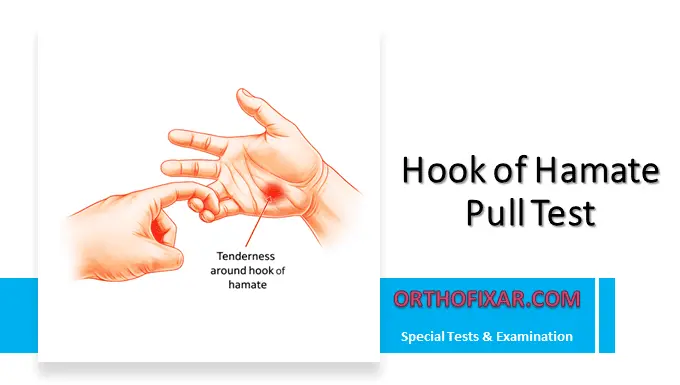
The Hook of Hamate Pull Test is a specialized provocative maneuver used to assess for hook of the hamate fractures.
Why It Works
The Hamate Fracture Test stresses the flexor tendons that anchor along the hook of the hamate. When these tendons are pulled against an injured or fractured hamulus, it reproduces the patient’s characteristic sharp pain — a key diagnostic clue.
See Also: Hamate Fracture
How to Perform the Hook of Hamate Pull Test?
- Position the Patient:
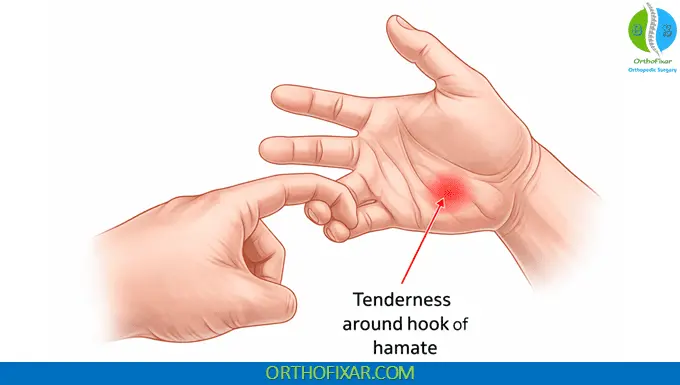
- The patient’s wrist is placed in ulnar deviation (bent towards the little finger side).
- Apply Resistance:
- Ask the patient to flex the fingers (make a fist) against resistance.
- Observe for Pain:
- A positive test elicits sharp, localized pain at the ulnar side of the wrist — typically near the base of the hypothenar eminence.
What a Positive Hook of Hamate Pull Test Suggests?
A positive Hamate Pull Test is highly associated with hook of hamate fractures and should prompt further evaluation with imaging such as:
- X-rays (though initial views may miss non-displaced fractures)
- CT scan or MRI for definitive diagnosis
Clinical Significance
The Hook of Hamate Pull Test is particularly useful in:
- Athletes with persistent ulnar wrist pain after trauma
- Patients with suspected carpal bone injuries not clearly visible on plain radiographs
- Differentiating hamate fractures from soft-tissue injuries
In clinical settings, this test helps practitioners identify occult fractures early and reduce the risk of delayed diagnosis, chronic pain, or complications such as nonunion.
Summary
The Hook of Hamate Pull Test is a simple, yet powerful physical exam maneuver with high clinical relevance for suspected hook of the hamate fractures. By combining ulnar deviation and resisted finger flexion, it replicates the patient’s pain and guides further imaging and management.
💡 Remember: Persistent ulnar-sided wrist pain after injury warrants careful evaluation — and the Hamate Pull Test should be part of your examination toolkit.
References & More
- Sahu MA, Tahir A, Sahu MA, Varachia A, Khawar H, Ahmed U. Fractures of the Hamate Bone: A Review of Clinical Presentation, Diagnosis and Management in the United Kingdom. Cureus. 2024 Nov 17;16(11):e73839. doi: 10.7759/cureus.73839. PMID: 39552736; PMCID: PMC11569506. Pubmed
- Hook of hamate pull test. Wright TW, Moser MW, Sahajpal DT. J Hand Surg Am. 2010;35:1887–1889. doi: 10.1016/j.jhsa.2010.08.024. PubMed