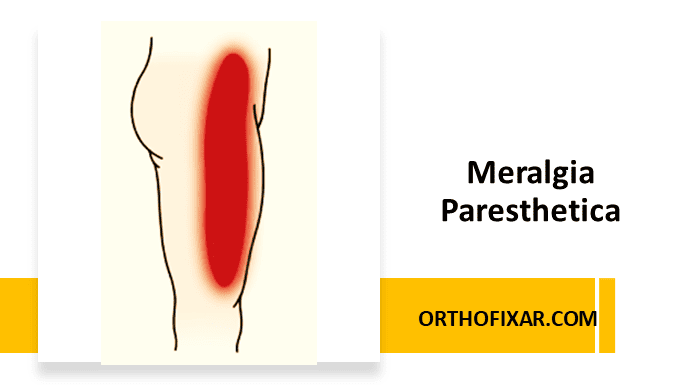
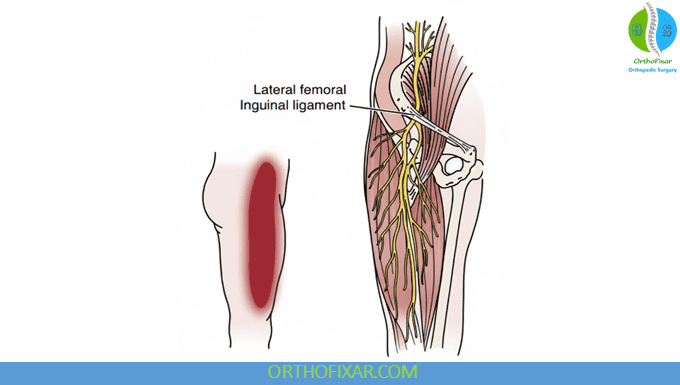
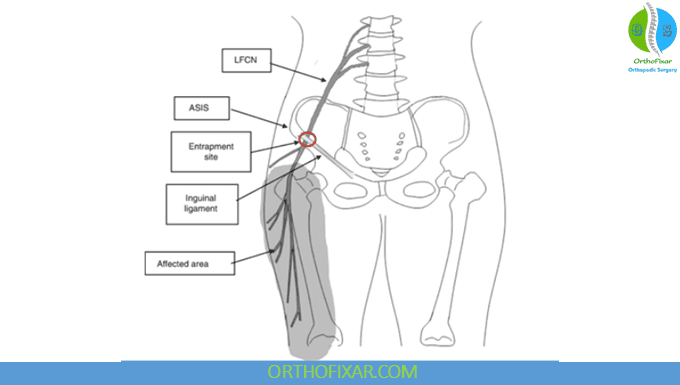
Meralgia Paresthetica (MP) is a condition characterized by sensory disturbances, including burning pain, tingling, and numbness, over the lateral aspect of the thigh. This condition results from the compression or entrapment of the lateral femoral cutaneous nerve (LFCN) as it passes under the inguinal ligament near the anterior superior iliac spine (ASIS).
Pathophysiology
The lateral femoral cutaneous nerve is purely sensory, meaning it doesn’t control muscle movement but provides sensation to the skin over the anterior and lateral thigh. When this nerve becomes compressed, it leads to abnormal sensations in its distribution area, typically the outer thigh.
The compression usually occurs where the nerve passes beneath the inguinal ligament or near the ASIS, which is a vulnerable area for entrapment.
See Also: Lateral Femoral Cutaneous Nerve Anatomy
Meralgia Paresthetica Causes
Meralgia Paresthetica can arise due to various factors, including:
- Trauma: One of the most common causes is direct trauma, such as from a seat belt injury during a car accident, which can lead to compression of the nerve.
- Prolonged positions: Conditions that place prolonged pressure on the inguinal ligament, like during delivery in stirrups or prolonged sitting, may increase the risk.
- Tight clothing: Wearing belts, waistbands, or tight clothing can cause pressure on the nerve, leading to symptoms.
- Surgical complications: Surgical procedures, particularly those involving the inguinal region (e.g., hernia repairs), can result in nerve entrapment as a complication.
- Obesity: Increased abdominal fat or pressure around the inguinal area can increase the likelihood of nerve compression.
Clinical Presentation
The hallmark of Meralgia Paresthetica is burning pain, but symptoms may also include:
- Numbness or reduced sensation over the lateral thigh.
- Tingling or paresthesias (pins-and-needles sensation).
- Hypersensitivity to touch in the affected area.
- Pain with certain postures (e.g., prolonged sitting, standing, or bending at the waist).
Patients often report the discomfort as bothersome but non-disabling. The pain is usually localized to the anterolateral thigh and does not radiate to other areas of the body.
Diagnosis
The diagnosis of Meralgia Paresthetica is largely clinical, based on patient history and physical examination. The following may assist in confirming the diagnosis:
- Physical Exam: Palpation of the ASIS and evaluation of the inguinal ligament area for tenderness or sensory changes.
- Tinel’s Sign: Percussion over the inguinal ligament may reproduce the patient’s symptoms (burning pain or tingling), suggesting nerve involvement.
- Electrodiagnostic Studies: If the diagnosis is unclear or other conditions need to be ruled out, nerve conduction studies or electromyography (EMG) may help assess nerve function.
Meralgia Paresthetica Treatment
The treatment of Meralgia Paresthetica is typically conservative and aimed at relieving symptoms:
- Avoidance of Triggers: Avoid tight clothing or prolonged sitting that may increase pressure on the affected nerve.
- Weight Management: In patients with obesity, weight loss can reduce pressure on the inguinal region and improve symptoms.
- Medications: Nonsteroidal anti-inflammatory drugs (NSAIDs) or analgesics may be used to alleviate pain. For persistent symptoms, neuropathic pain medications such as gabapentin or pregabalin may be considered. Also, steroid helps to reduce swelling around the nerve and provides temporary relief from the symptoms of meralgia paresthetica.
- Physical Therapy: Stretching and strengthening exercises to improve posture and reduce pressure on the nerve.
- Surgical Intervention: In rare cases, if conservative treatment fails, surgical decompression of the lateral femoral cutaneous nerve may be required.
See Also: Meralgia Paresthetica Injection
Prognosis
The prognosis for Meralgia Paresthetica is generally good with appropriate treatment. Most patients experience significant relief with conservative measures, though some may require longer-term management. In rare cases, persistent symptoms may require surgical intervention.
Summary Points
Meralgia paresthetica is a compression neuropathy of the purely sensory lateral femoral cutaneous nerve, resulting in sensory symptoms and burning pain isolated to the lateral thigh without any motor involvement. Recognition of common causes—including trauma, tight clothing, obstetric positioning, and surgical complications—aids in both diagnosis and prevention strategies.
References & More
- Pecina MM, Krmpotic-Nemanic J, Markiewitz AD. Tunnel Syndromes. Boca Raton, FL: CRC Press; 1991.
- Ivins GK. Meralgia paresthetica, the elusive diagnosis: clinical experience with 14 adult patients. Ann Surg. 2000;232(2):281–286. PubMed
- Orthopedic Physical Assessment by David J. Magee, 7th Edition.