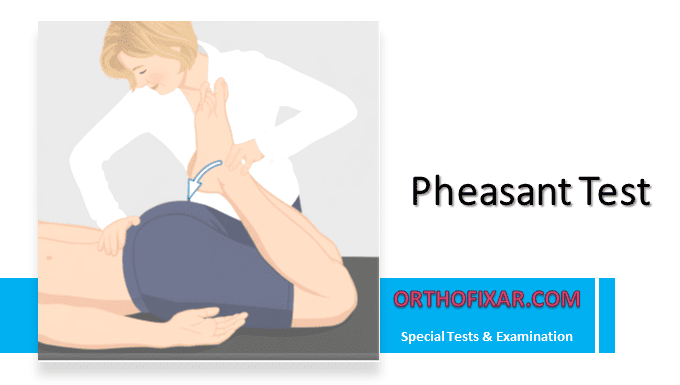
The Pheasant test, also known as the Prone Instability Test, is a clinical examination technique used to assess lumbar spinal segmental instability or nerve root irritation resulting from hyperextension of the lower spine.
The Pheasant Test helps clinicians differentiate between localized lumbar pain caused by muscle or joint involvement and radiating pain due to neural tension or instability. It should always be interpreted in conjunction with other neurological and orthopedic assessments, as excessive lumbar extension may provoke symptoms from various underlying causes.
How to perform the Pheasant Test?
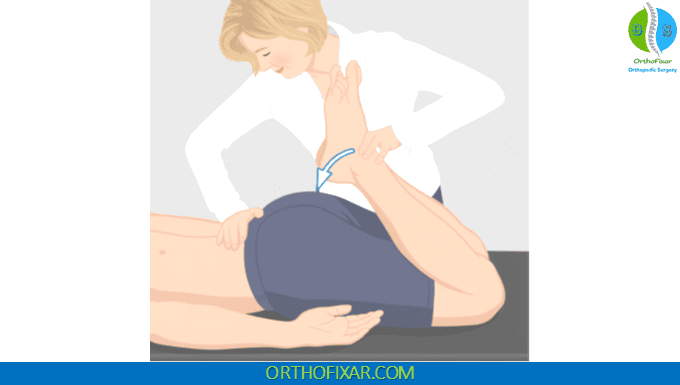
- The patient lies prone (face down) on the examination table in a relaxed position.
- With one hand, the examiner applies gentle but firm pressure to the posterior aspect of the lumbar spine, providing anterior stabilization to the vertebral segments.
- With the other hand, the examiner passively flexes both of the patient’s knees, bringing the heels progressively toward the buttocks until they make contact.
This combined motion creates lumbar hyperextension through the hip extension that occurs as the knees are maximally flexed. The hyperextension movement stresses the posterior elements of the spine and may cause shearing forces at unstable segments.
See Also: Spine Movements
What does a Positive Pheasant Test Mean?
If this maneuver reproduces pain or radiating symptoms in one or both legs, the test is considered positive.
A positive Pheasant Test result suggests:
- Lumbar segmental instability,
- Irritation/compression of the nerve roots, often due to conditions such as spondylolisthesis, facet joint irritation, or disc pathology.
Limitations and Considerations
Specificity and Sensitivity
- Like many orthopedic provocative tests, the Pheasant test should not be used in isolation
- It should be combined with other clinical findings, imaging, and patient history
- False positives can occur in patients with tight hip flexors or rectus femoris
Contraindications
Exercise caution or avoid the test in patients with:
- Acute lumbar trauma
- Known severe osteoporosis
- Active infection or tumor
- Severe radiculopathy with neurological deficits.
Safety Considerations
- The maneuver should be performed gently and progressively
- Stop immediately if severe pain occurs
- Communicate with the patient throughout the examination
- Ensure adequate table support and patient comfort.
References & More
- Kirkaldy-Willis WH. Managing Low Back Pain. Edinburgh: Churchill Livingstone; 1983.
- Orthopedic Physical Assessment by David J. Magee, 7th Edition.
- Seyedhoseinpoor T, Dadgoo M, Taghipour M, Ebrahimi Takamjani I, Sanjari MA, Kazemnejad A, Ebrahimi H, Hasson S. Combining clinical exams can better predict lumbar spine radiographic instability. Musculoskelet Sci Pract. 2022 Apr;58:102504. doi: 10.1016/j.msksp.2022.102504. Epub 2022 Jan 13. PMID: 35063746. PubMed