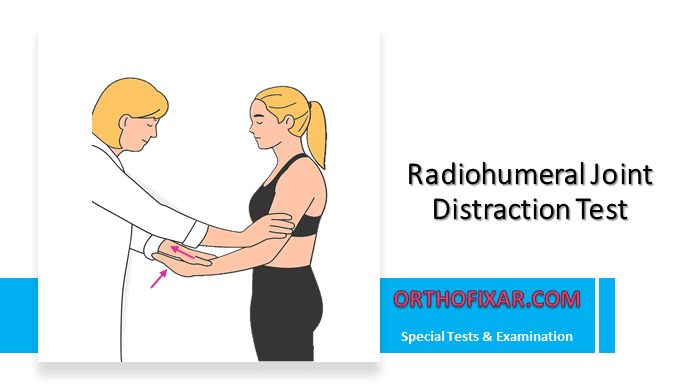
The Radiohumeral Joint Distraction Test is used to assess for the presence of loose bodies within the radiohumeral joint. This test employs the principle of joint distraction to temporarily separate joint surfaces, which can provide diagnostic information about intra-articular pathology.
Loose bodies within the radiohumeral joint can cause mechanical symptoms including pain, catching, and limited range of motion. These fragments may originate from various sources including osteochondritis dissecans, fracture fragments, or degenerative joint disease. The distraction test helps differentiate between pain caused by joint compression versus mechanical impingement from loose bodies.
See Also: Elbow Anatomy
How to Perform the Radiohumeral Joint Distraction Test?
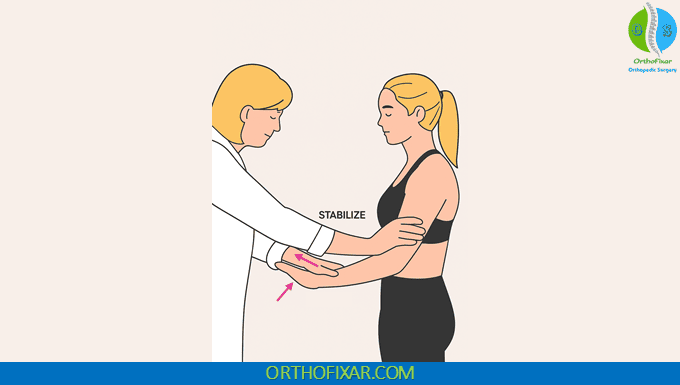
Both patient and examiner assume a standing position. This positioning allows for optimal biomechanical advantage and control during the test:
- Examiner’s grip: The examiner grasps the patient’s distal radius using a lumbrical grip technique
- Hand positioning: The dorsum of the patient’s hand rests comfortably under the examiner’s forearm
- Stabilization: The examiner’s opposite hand stabilizes the distal humerus to prevent compensatory movements.
Phase 1: Baseline Assessment
- Patient performs wrist extension against the examiner’s forearm
- Patient applies maximum possible resistance
- Examiner notes:
- Amount of force generated
- Presence or absence of pain
- Pain intensity rating (1-10 scale)
Phase 2: Distraction Assessment
- Patient relaxes completely
- Examiner applies sustained traction force along the longitudinal axis of the radius
- While maintaining constant distraction, patient repeats wrist extension against examiner’s forearm
- Examiner reassesses:
- Pain presence/absence
- Pain intensity rating (1-10 scale)
What is the Positive Test?
A positive Radiohumeral Joint Distraction Test is indicated when pain intensity decreases during the distraction phase compared to the initial assessment. This finding suggests the possible presence of loose bodies within the radiohumeral joint.
When joint distraction is applied, the radiohumeral joint surfaces are temporarily separated. If loose bodies are present, this separation reduces mechanical impingement and compression of these fragments, resulting in decreased pain during the movement.
A positive Radiohumeral Joint Distraction Test warrants further investigation, which may include:
- Advanced imaging studies (MRI, CT arthrography)
- Arthroscopic evaluation
- Correlation with other clinical findings and patient history
Limitations and Considerations
Test Limitations
- The Radiohumeral Joint Distraction Test provides indirect evidence of loose bodies
- False positives may occur with other joint pathologies
- Patient cooperation and effort significantly affect test reliability
Clinical Context
Results should always be interpreted within the broader clinical context, including:
- Patient history and mechanism of injury
- Other physical examination findings
- Imaging studies when available
- Functional limitations reported by the patient
References & More
- Orthopedic Physical Assessment by David J. Magee, 7th Edition.
- Antuna SA, O’Driscoll SW. Snapping plica associated with radiocapitellar chondromalacia. Arthroscopy. 2001;17:491–495. PubMed