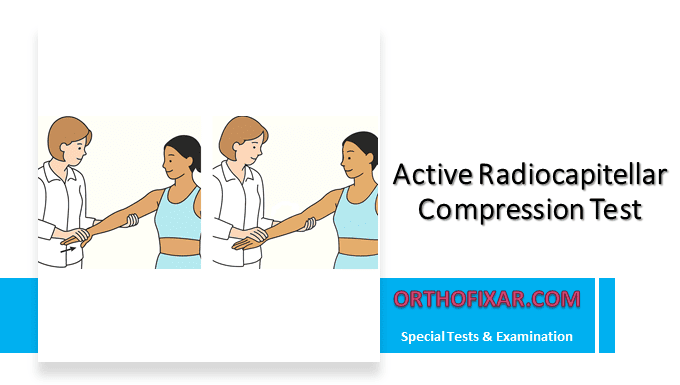
The Active Radiocapitellar Compression Test is a clinical examination technique used to evaluate potential osteochondritis dissecans of the capitellum. This test combines axial compression with active forearm rotation to stress the joint surfaces and elicit symptoms.
The radiocapitellar joint is formed by the articulation between the radial head and the capitellum of the humerus. This joint is crucial for elbow flexion-extension and forearm rotation movements. The joint reaches its closed-pack position at 90° of elbow flexion, where maximum compression occurs between the articular surfaces. Understanding this biomechanical principle is essential for proper test execution.
How to Perform the Active Radiocapitellar Compression Test?
The patient should be seated or standing comfortably with the affected arm accessible to the examiner. The shoulder should be in a neutral position to allow for unrestricted elbow and forearm movement.
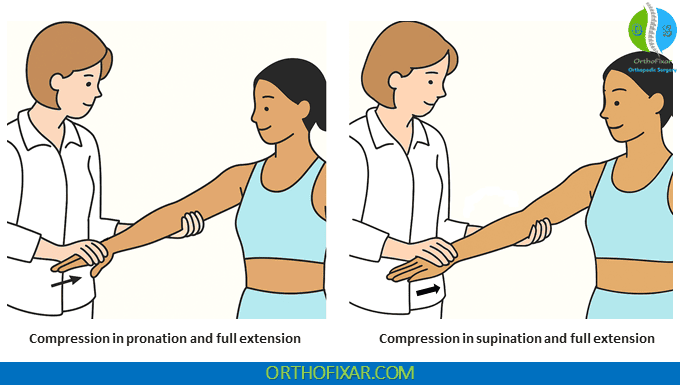
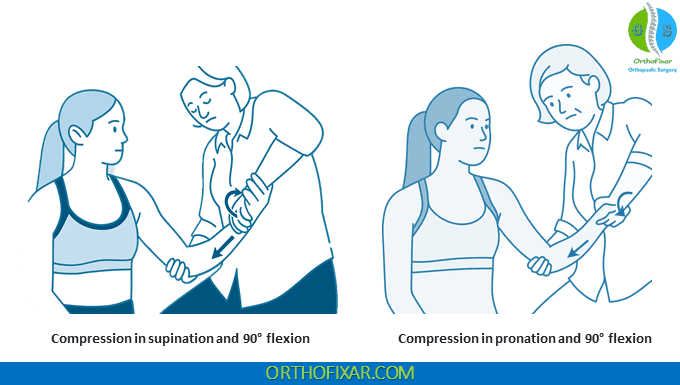
- Initial Positioning: The examiner grasps the patient’s elbow and applies an axial compression load. While some practitioners perform this test with the elbow in full extension, current evidence suggests that compression should be applied with the elbow flexed to 90°, as this position maximizes compression at the radiocapitellar joint due to the closed-pack position.
- Compression Application: Maintain steady, firm compression along the long axis of the radius, directing force through the radial head into the capitellum.
- Active Movement Component: While maintaining the compression, instruct the patient to actively supinate and pronate their forearm through the full available range of motion. The movement should be performed slowly and deliberately to allow for symptom recognition.
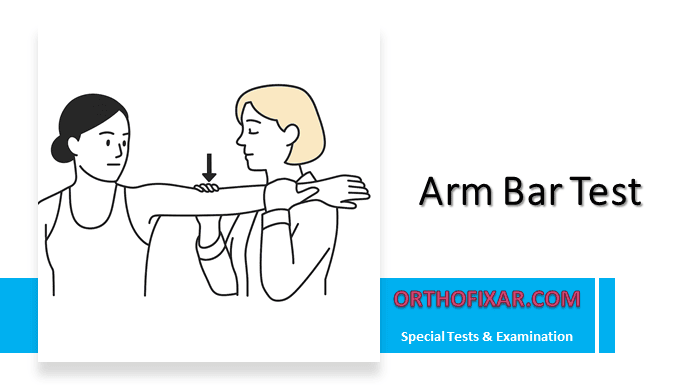
See Also: Arm Bar Test
What is the Positive Test?
A positive Active Radiocapitellar Compression Test is indicated by:
- Pain localized to the lateral compartment of the elbow
- Reproduction of the patient’s familiar symptoms
- Increased discomfort during the rotational movements under compression
Clinical Significance
The primary indication suggested by a positive Active Radiocapitellar Compression Test is osteochondritis dissecans of the capitellum. This condition involves:
- Subchondral bone necrosis with potential overlying cartilage involvement
- Common occurrence in young athletes, particularly those involved in overhead or repetitive elbow activities
- Progressive nature that may lead to loose body formation if untreated
Diagnostic Considerations
While the Active Radiocapitellar Compression Test can be valuable in the clinical assessment, it should be interpreted within the broader context of:
- Patient history and mechanism of injury
- Other physical examination findings
- Imaging studies when indicated
- Differential diagnosis considerations including lateral epicondylitis, radial nerve entrapment, or other causes of lateral elbow pain
See Also: Mill’s Test | Lateral Epicondylitis Assessment
Limitations and Precautions
Clinicians should be aware that:
- The test may produce false positives in patients with other lateral elbow pathologies
- Technique consistency is crucial for reliable results
- Patient apprehension or guarding may affect test outcomes
- The test should be performed gently to avoid exacerbating symptoms
References & More
- Orthopedic Physical Assessment by David J. Magee, 7th Edition.
- Redler LH, Watling JP, Ahmad CS. Five points on physical examination of the throwing athlete’s elbow. Am J Orthop. 2015;44(1):13–18.
- Hsu SH, Moen TC, Levine WN, et al. Physical examination of the athlete’s elbow. Am J Sports Med. 2012;40:699–708. PubMed