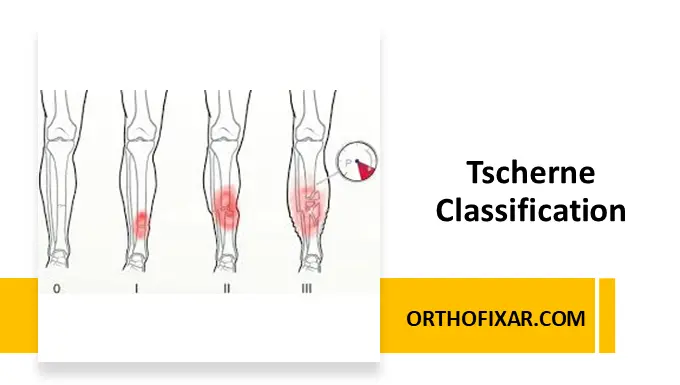
The Tscherne classification is a widely used orthopedic system for grading soft tissue injury associated with fractures, particularly in trauma settings. It was first introduced by Harald Tscherne and Hans-Jörg Oestern in 1982.
Unlike systems that focus solely on bone injury, the Tscherne classification emphasizes the extent of soft tissue damage, which plays a critical role in determining treatment strategy, timing of fixation, and prognosis.
Clinical Importance
Soft tissue injury is a major determinant of outcomes in fracture management. The Tscherne classification system helps clinicians:
- Assess injury severity based on trauma energy
- Guide timing of surgical intervention
- Predict risk of complications (e.g., infection, compartment syndrome)
- Standardize communication in trauma care and research
Higher Tscherne grades correlate with worse functional outcomes and increased complication rates.
Classification Overview
The system divides fractures into two main categories:
- Closed fractures (C classification)
- Open fractures (O classification)
Each is graded from 0 (least severe) to 3 or 4 (most severe) depending on soft tissue damage.
See Also: Gustilo-Anderson Classification
Tscherne Classification for Closed Fractures
C0 – Minimal Injury
- Indirect trauma (e.g., simple spiral fractures)
- Little or no soft tissue damage
C1 – Mild Injury
- Superficial abrasions or contusions
- Mild soft tissue involvement
C2 – Moderate Injury
- Deep contaminated abrasions
- Muscle contusion
- Risk of compartment syndrome
C3 – Severe Injury
- Extensive soft tissue destruction
- Skin contusion, muscle necrosis
- Possible vascular injury or compartment syndrome
👉 Severity increases with energy transfer from trauma, which correlates with both fracture complexity and soft tissue damage.
Tscherne Classification for Open Fractures
O1 – Low Energy
- Small clean wound
- Minimal contamination and soft tissue damage
O2 – Moderate Injury
- Larger laceration
- Moderate contamination and soft tissue injury
O3 – Severe Injury
- Extensive soft tissue damage
- High-energy trauma (e.g., gunshot, crush injuries)
- Possible neurovascular injury
O4 – Very Severe Injury
- Partial or complete amputation
- Massive soft tissue loss
This complements systems like the Gustilo-Anderson classification but provides broader insight into soft tissue physiology.
See Also: Open Fractures
Clinical Application
1. Surgical Decision-Making
- Low grades (C0–C1, O1–O2): Early definitive fixation is often safe
- High grades (C2–C3, O3–O4): Prefer staged management (e.g., external fixation first)
Early fixation in severe injuries increases complications such as infection and wound breakdown.
2. Prognostic Value
- Higher grades → worse outcomes
- Increased risk of:
- Infection
- Delayed healing
- Poor functional recovery
3. Reliability
Studies demonstrate:
- High intraobserver agreement (~0.81)
- Moderate interobserver agreement (~0.65)
This supports its use as a standardized clinical and research tool.
Advantages
- Incorporates both open and closed fractures
- Reflects mechanism and energy of injury
- Useful for initial trauma assessment
- Helps predict complications and outcomes
Limitations
- Difficult to assess deep soft tissue damage early, especially in closed fractures
- Does not account for:
- Patient factors (e.g., diabetes, smoking)
- Exact anatomical location
- No strict treatment algorithm tied to each grade
These limitations mean it should be used alongside clinical judgment and other classification systems.
Tscherne vs Gustilo-Anderson Classification
| Feature | Tscherne Classification | Gustilo-Anderson Classification |
|---|---|---|
| Primary Focus | Soft tissue injury in both closed and open fractures | Severity of open fractures only |
| Origin | Described by Harald Tscherne & Oestern (1982) | Developed by Ramon Gustilo & Anderson (1976) |
| Applies To | Closed (C0–C3) and Open (O1–O4) fractures | Open fractures (Type I–III, with IIIA, IIIB, IIIC) |
| Closed Fractures | Yes (graded C0–C3) | Not included |
| Open Fractures | Yes (O1–O4) | Yes (Type I–III) |
| Assessment Criteria | Degree of soft tissue damage, trauma energy, contamination | Wound size, contamination, soft tissue damage, vascular injury |
| Grading System | C0–C3 (closed) and O1–O4 (open) | Type I, II, IIIA, IIIB, IIIC |
| Severity Progression | Increasing energy and soft tissue destruction | Increasing wound size, contamination, and vascular involvement |
| Vascular Injury Consideration | Included in severe grades (C3, O3–O4) | Explicit in Type IIIC |
| Clinical Use | Guides timing of surgery, especially in closed fractures | Guides antibiotics, debridement, and fixation strategy |
| Prognostic Value | Predicts complications in all fracture types | Strong predictor of infection in open fractures |
| Reliability | Moderate–good interobserver agreement | Variable interobserver reliability (especially Type III subtypes) |
| Limitations | Hard to assess deep tissue damage early | Limited to open fractures; subjective grading |
Summary
The Tscherne classification is a practical and clinically relevant system for evaluating soft tissue injury in fractures. By stratifying injuries based on severity and mechanism, it supports:
- Better treatment planning
- Improved communication among clinicians
- More accurate prognostic assessment
Despite Tscherne classification limitations, it remains a cornerstone in orthopedic trauma assessment, especially when combined with other classification systems and thorough clinical evaluation.
References & More
- Ibrahim DA, Swenson A, Sassoon A, Fernando ND. Classifications In Brief: The Tscherne Classification of Soft Tissue Injury. Clin Orthop Relat Res. 2017 Feb;475(2):560-564. doi: 10.1007/s11999-016-4980-3. Epub 2016 Jul 14. PMID: 27417853; PMCID: PMC5213932. Pubmed
- Tscherne H, Oestern HJ. Die Klassifizierung des Weichteilschadens bei offenen und geschlossenen Frakturen [A new classification of soft-tissue damage in open and closed fractures (author’s transl)]. Unfallheilkunde. 1982 Mar;85(3):111-5. German. PMID: 7090085. Pubmed
- Valderrama-Molina CO, Estrada-Castrillón M, Hincapie JA, Lugo-Agudelo LH. Intra- and interobserver agreement on the Oestern and Tscherne classification of soft tissue injury in periarticular lower-limb closed fractures. Colomb Med (Cali). 2014 Dec 30;45(4):173-8. PMID: 25767306; PMCID: PMC4350383. Pubmed
- Egol KA. Handbook of fractures. 6th ed. Philadelphia: Lippincott Williams & Wilkins; 2019.