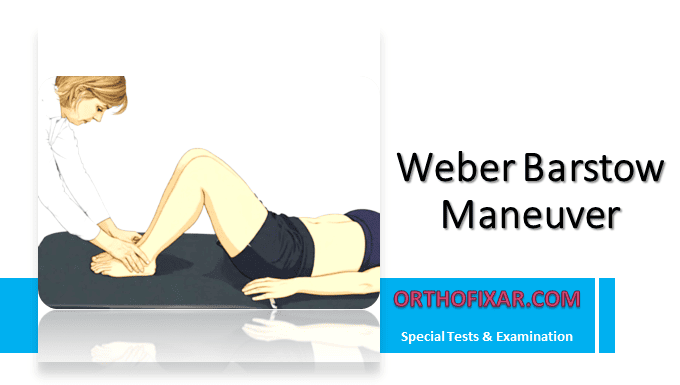
The Weber Barstow maneuver is a visual method for assessing leg length inequality in the supine position. It is particularly useful because it minimizes pelvic obliquity and ensures consistent alignment before the examiner compares the lengths of the lower limbs.
Leg length discrepancy (LLD) is a common musculoskeletal concern that may contribute to altered biomechanics, gait abnormalities, chronic pain, or functional limitations. Accurate assessment is essential for appropriate diagnosis and management. Among the clinical techniques available, the Weber Barstow maneuver offers a simple, reliable visual method for detecting gross leg length asymmetry.
See Also: Leg Length Measurement
How to Perform the Weber Barstow Maneuver?
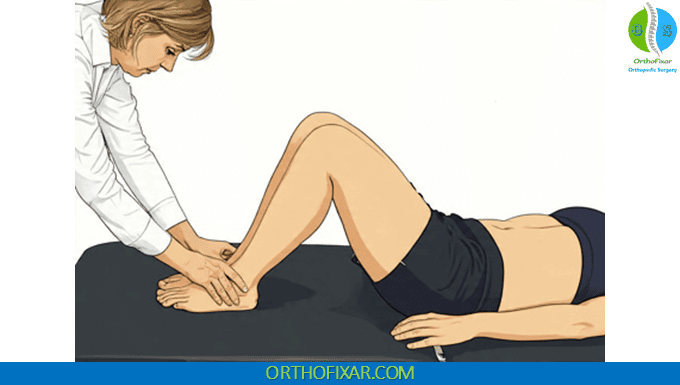
- The patient lies supine on the examination table. The hips and knees are flexed, allowing the examiner to neutralize the pelvis and ensure symmetry.
- The examiner stands at the foot of the table. Thumbs are placed on the distal aspect of the medial malleoli to establish a consistent reference point.
- Ask the patient to raise the pelvis off the table (this maneuver helps “reset” the pelvis and reduces any pre-existing rotation or tilt). The patient then returns to the starting supine position.
- The examiner gently extends both legs simultaneously, ensuring minimal rotational movement. The medial malleoli are again compared using the examiner’s thumbs as reference markers.
- Differences in the vertical or horizontal position of the malleoli indicate leg length asymmetry. A discrepancy prompts further measurement to determine the anatomical source.
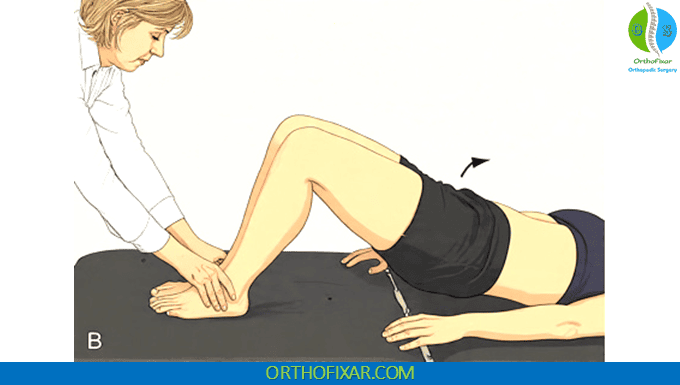

Determining the Source of Leg Length Difference
If the Weber Barstow Maneuver suggests true asymmetry, further segmental measurements help pinpoint the level of shortening:
1. Iliac Crest → Greater Trochanter
Used to assess coxa vara or coxa valga by estimating the femoral neck–shaft angle:
- Normal adult angle: 120°–135°
- < 120° → Coxa vara
- > 135° → Coxa valga
Changes in proximal femoral morphology can contribute to functional leg length inequality.
2. Greater Trochanter → Knee Joint Line (Lateral)
- Assesses femoral shaft length.
- Shortening in this segment suggests previous trauma, surgery, or congenital femoral shortening.
3. Knee Joint Line (Medial) → Medial Malleolus
- Assesses tibial shaft length.
- Useful when tibial deformities, growth disturbances, or fractures are suspected.
Tibial and Femoral Length Comparison
Tibial Length (Prone Method)
- The patient lies prone.
- The examiner places thumbs transversely across the soles just anterior to the heels.
- With the knees flexed to 90°, the relative height of the thumbs indicates tibial length differences.
- Ensuring that the legs remain perpendicular to the table is essential for accuracy.
Femoral Length (Supine Method)
- The patient is supine with hips and knees flexed to 90°.
- If one femur is longer, the corresponding knee will appear higher than the other.
Clinical Significance
The Weber Barstow maneuver is:
- Quick and noninvasive
- Effective for screening leg length discrepancies
- Helpful in distinguishing true vs. apparent LLD
- A gateway to more specific segmental assessment and imaging when necessary
References & More
- Woerman AL. Evaluation and treatment of dysfunction in the lumbar-pelvic-hip complex. In: Donatelli R, Wooden MJ, eds. Orthopedic Physical Therapy. Edinburgh: Churchill Livingstone; 1989.
- Reider B. The Orthopedic Physical Examination. Philadelphia: WB Saunders; 1999
- Gomez-Aguilar E, Reina-Bueno M, Lafuente-Sotillos G, Montes-Salas R, Munuera-Martinez PV, Castillo-Lopez JM. Validity of clinical methods in the detection of leg-length discrepancies. Hip Int. 2021 Mar;31(2):186-190. doi: 10.1177/1120700020910108. Epub 2020 Mar 3. PMID: 32126845. PubMed