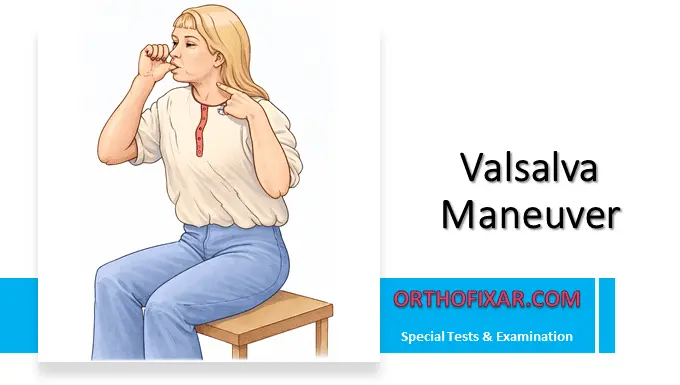
The Valsalva Maneuver for lumbar spine is used to increase intrathecal pressure and thereby exacerbate pain due to spinal cord or nerve root compression. It is also used for assessment of autonomic function status, as a marker for heart failure, for termination of arrhythmias, murmur differentiation, and various other indications.
Valsalva maneuver was first described in 1704 by Antonio Maria Valsalva, who was an Italian physician.
What is Valsalva Maneuver Meaning?
The Valsalva maneuver is a forced expiration against a closed glottis, typically performed by attempting to exhale while keeping the mouth and nose closed. This action raises intrathoracic pressure and triggers predictable cardiovascular responses mediated by autonomic reflexes.
Clinically, it is both a diagnostic and therapeutic maneuver widely used in cardiology, neurology, and general medicine.
How do you perform the Valsalva Maneuver?
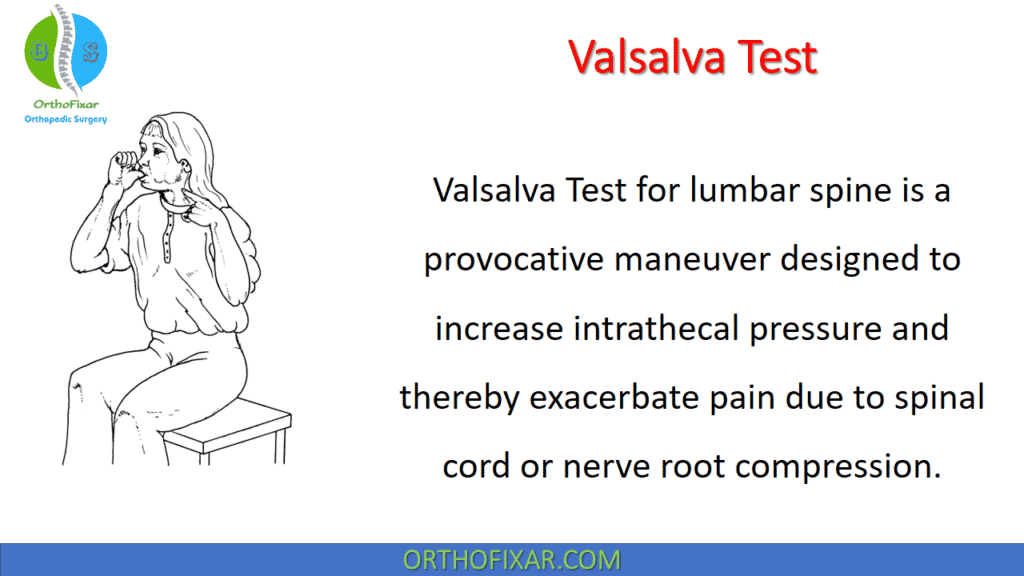
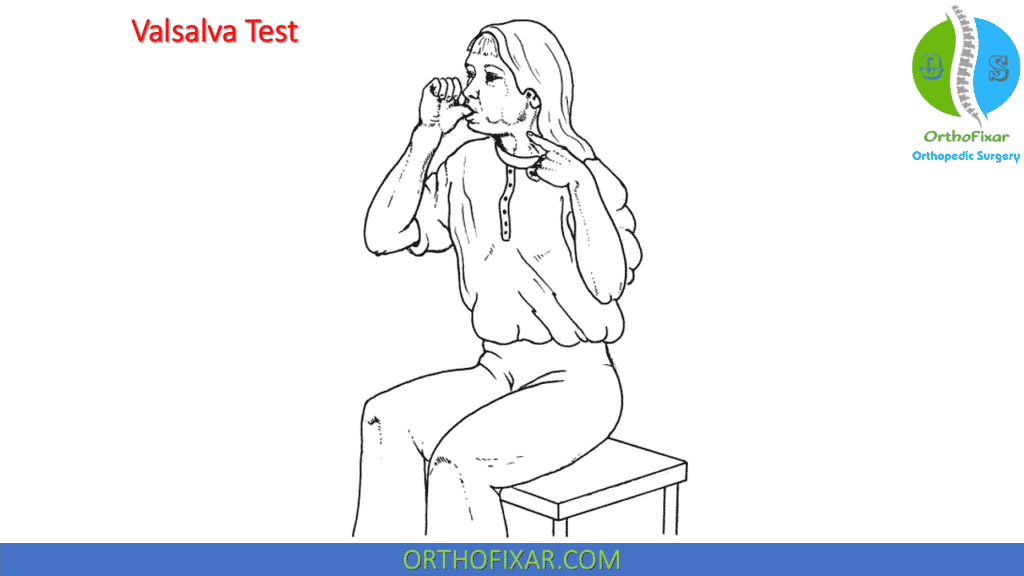
- With the patient sitting, and the examiner is standing within arms’ reach in front of the patient.
- The patient is asked to put the thumb in his mouth and attempts to push the thumb out by blowing out hard.
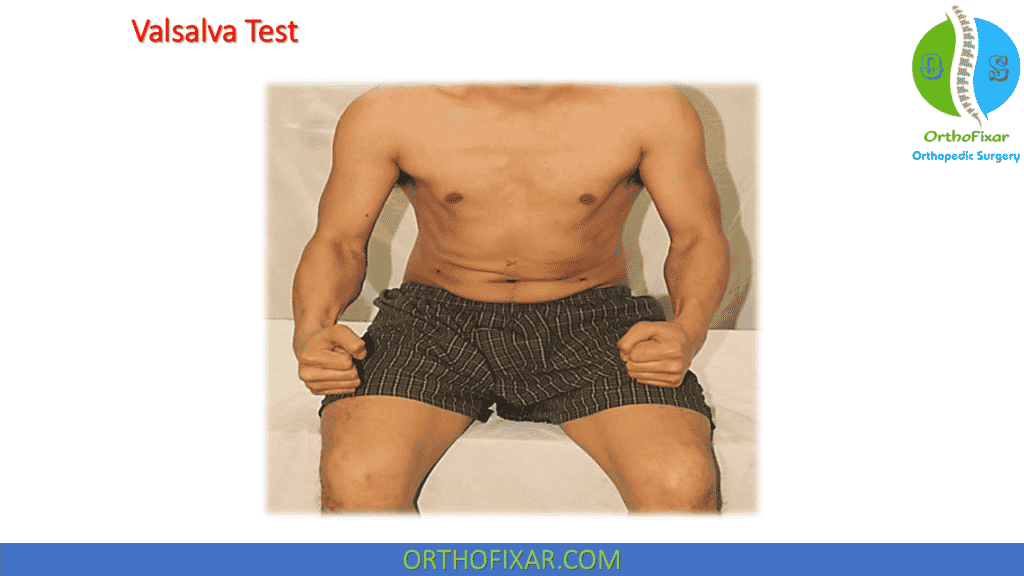
- or, the patient takes and holds a deep breath while bearing down similar to performing a bowel movement.
This maneuver should be performed with care and caution because the patient may become dizzy and pass out during the test or shortly afterward if the procedure blocks the blood supply to the brain.
See Also: Slump Test
What does a positive Valsalva maneuver mean?
Bearing down in this manner increases the intraspinal pressure, revealing the presence of space occupying masses such as extruded intervertebral disks, tumors, narrowing due to osteophytes, and soft tissue swelling. This leads to radicular symptoms entirely confined to the respective dermatome or dermatomes.
The test should be performed with great caution, because the patient may lose consciousness during or after the test due to the increased pressure that may alter venous function and cause dizziness or unconsciousness.
See Also: Lasegue Test
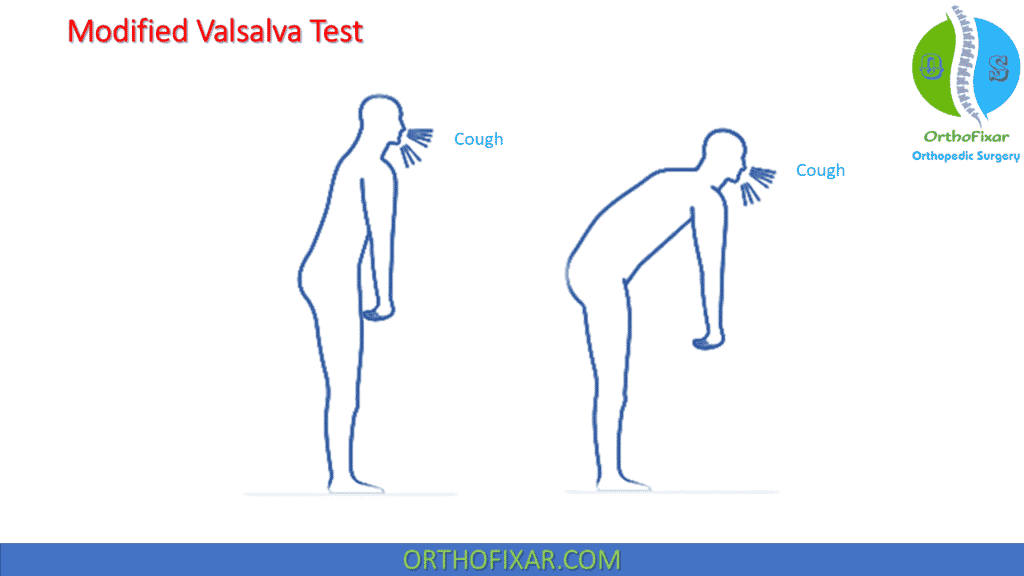
A modification of Valsalva Maneuver was described:
The Modified Valsalva Maneuver is performed with the patient standing and the lumbar spine flexed to 35° to 75° (Cecin’s sign). The patient stands and leans forward until pain or paraesthesia is experienced. This position is held, and the patient is asked to cough. The test is positive if symptoms worsen. If pain is not experienced at this point, the spine is flexed to approximately 35° and the test repeated.
Reliability
The Sensitivity and specificity of Valsalva maneuver for lumbar spine lesions was:
- Sensitivity: 73%
- Specificity: 95%
The Inter-rater Reliability was 0.63.
Another diagnostic accuracy study found the sensitivity and specificity of Valsalva Maneuver were: 22% and 94%, respectively.
Other Valsalva Maneuver indications include:
Here’s a summarized list of the Valsalva maneuver’s uses and applications:
Autonomic Function Assessment
- Part of Ewing battery tests for cardiac autonomic neuropathy
- Measures Valsalva ratio for parasympathetic function
- Used to determine baroreflex sensitivity (BRS)
Heart Failure Assessment
- Helps evaluate heart failure through blood pressure response
- Abnormal blood pressure overshoot indicates impaired ventricular function
Arrhythmia Management
- Helps terminate paroxysmal supraventricular tachycardia (PSVT)
- Works by increasing vagal activity
Murmur Diagnosis
- Helps differentiate between different heart murmurs
- Reduces aortic stenosis murmur intensity
- Increases hypertrophic obstructive cardiomyopathy murmur intensity
Surgical Applications
- Detecting bleeding points during thyroid surgery
- Confirming hemostasis after neurosurgical procedures
- Checking for cerebrospinal fluid leaks
Diagnostic Tool
- Diagnosing varicocele
- Assisting in radiological diagnosis of:
- Liver hemangiomas
- Venous disease
- Foramen ovale
Pain Management
- Reducing venipuncture pain in pregnant women
Physiological Mechanism of the Valsalva Maneuver
This maneuver produces four classic cardiovascular phases:
- Phase I – Onset of strain: Increased intrathoracic pressure compresses the aorta, briefly raising arterial pressure.
- Phase II – Reduced venous return: Venous return to the heart falls, reducing stroke volume and blood pressure. Reflex tachycardia develops through sympathetic activation.
- Phase III – Release of strain: When the strain stops, intrathoracic pressure suddenly drops, causing a transient fall in blood pressure.
- Phase IV – Blood pressure overshoot: Venous return rapidly increases, producing a temporary blood-pressure rise and reflex bradycardia via baroreceptor activation.
These predictable hemodynamic changes make the maneuver useful for autonomic testing and cardiac assessment.
Notes
- The patient often self-reports these findings rather than being identified clinically.
- If the patient is embarrassed or apprehensive about simulating a bowel movement, he or she may be instructed to blow into a closed fist as if inflating a balloon.
- The test increases intrathecal pressure throughout the spinal column, resulting in a slowing of the pulse, decreased venous return, and increased venous pressure, all of which may cause fainting.
- The Valsalva maneuver has references in multiple clinical domains ranging from the evaluation of autonomic dysfunction to the treatment of arrhythmias and a marker for heart failure.
Contraindications and Precautions
Although generally safe, the maneuver increases intra-abdominal and intraocular pressure and may be hazardous in certain conditions.
Avoid or use caution in patients with:
- Retinopathy or glaucoma
- Recent eye surgery or lens implants
- Coronary artery disease
- Valvular or congenital heart disease
- Severe hypotension or aneurysm risk
References
- Nachemson AL, Andersson BJ, Schultz AB. Valsalva maneuver biomechanics. Effects on lumbar trunk loads of elevated intraabdominal pressures. Spine (Phila Pa 1976). 1986 Jun;11(5):476-9. PMID: 3750086. Pubmed
- Cecin, HA: Cecin’s Sign (“X” Sign): Improving the diagnosis of radicular compression by herniated lumbar discs. Rev Bras Reumatol, 50:44, 2010.
- Wainner RS, Fritz JM, Irrgang JJ, Boninger ML, Delitto A, Allison S. Reliability and diagnostic accuracy of the clinical examination and patient self-report measures for cervical radiculopathy. Spine (Phila Pa 1976). 2003 Jan 1;28(1):52-62. doi: 10.1097/00007632-200301010-00014. PMID: 12544957.
- Srivastav S, Jamil RT, Zeltser R. Valsalva Maneuver. [Updated 2022 May 2]. In: StatPearls [Internet]. Treasure Island (FL): StatPearls Publishing; 2022 Jan-. Available from: Pubmed
- Clinical Tests for the Musculoskeletal System 3rd Edition.
- Dutton’s Orthopaedic Examination, Evaluation, And Intervention 3rd Edition.
- Sarvdeep S. Dhatt, Sharad Prabhakar – Handbook of Clinical Examination in Orthopedics.